Quick answer: In D&D 5e, a creature takes 1d6 bludgeoning damage for every 10 feet it falls, up to a maximum of 20d6 (a 200-foot fall, 70 damage on average). It lands prone unless it avoids all the damage. The 2024 Player’s Handbook keeps the same rule. Under the optional rule in Xanathar’s Guide to Everything, you drop up to 500 feet straight away, then up to 500 feet more at the end of each of your turns.
Hark, adventurer, and listen close! In the grand tapestry of our shared worlds, there is a force more constant and often more deadly than any dragon's fire or lich's curse. It is the unyielding pull of the earth itself—gravity. Every hero, from the clumsiest acolyte to the most nimble blademaster, has felt that heart-stopping lurch when their character strays a little too close to the edge. This grimoire is a guide to that very moment—the fall, the impact, and the will to survive it.
We have all been there, gathered around the flickering candlelight. A simple misstep on a castle battlement, a rival's treacherous shove, or a leap of faith that falls tragically short. In that instant, you are plummeting, and the only question that matters is how hard the ground will greet you.
The core edict for falling in the Fifth Edition is beautifully, brutally simple, inscribed so that the game does not grind to a halt while the Dungeon Master consults dusty tomes.
Here is the sacred rule from the Player's Handbook:
A fall from a great height is one of the most common hazards facing an adventurer. At the end of a fall, a creature takes 1d6 bludgeoning damage for every 10 feet it fell, to a maximum of 20d6. The creature lands prone, unless it avoids taking damage from the fall.
Let us unravel this decree. For every ten feet you drop, you add another d6 to the damage roll. Simple as a goblin's wit. A 20-foot fall is 2d6 bludgeoning damage, a 50-foot fall is 5d6, and so it continues.
The damage is capped at 20d6, meaning any fall from 200 feet or higher deals the same maximum devastation. Whether you fall from a 200-foot tower or a flying city a mile above, the fates treat the impact the same. It is a strange quirk, but one that keeps the dice pools from overflowing the table.
And do not forget the final indignity—landing prone. Even if you survive, you are left sprawling on the ground, an easy target for whatever foul beasts might be waiting.
To make it easier, here is a quick-reference scroll. It is a handy little cheat sheet for both players and Dungeon Masters to quickly divine the consequences of a long drop.
| Fall Distance (Feet) | Damage Dice | Average Damage |
|---|---|---|
| 10 | 1d6 | 3-4 |
| 20 | 2d6 | 7 |
| 30 | 3d6 | 10-11 |
| 40 | 4d6 | 14 |
| 50 | 5d6 | 17-18 |
| 60 | 6d6 | 21 |
| 70 | 7d6 | 24-25 |
| 80 | 8d6 | 28 |
| 90 | 9d6 | 31-32 |
| 100 | 10d6 | 35 |
| 150 | 15d6 | 52-53 |
| 200+ | 20d6 | 70 |
As you can see, the numbers climb with frightening speed. A fall of just 50 feet can easily send a low-level character into the arms of the Raven Queen, and a drop from 100 feet is a dire threat even to seasoned heroes. That 20d6 cap might seem generous, but an average of 70 damage is enough to put most characters on death's door, if not through it entirely.
Alright, so your champion is falling. Let us delve into the grim mathematics of what that means for their life force. While the basic rule — 1d6 bludgeoning damage for every 10 feet you fall — seems simple, there is a crucial limit that every Dungeon Master must hold in their mind.
A creature takes 1d6 bludgeoning damage for every 10 feet it fell, to a maximum of 20d6.
That is right, there is a ceiling to this devastation. This means a character plummeting from 200 feet takes the same damage as one falling from a sky-citadel a mile high. It is a matter of game balance, you see. It prevents high-level heroes from being instantly obliterated by a simple shove and keeps you from having to roll a bucketful of dice. Trust me, a sudden stop after a 200-foot drop is already a showstopper for most adventurers.
This handy decision tree breaks down the process beautifully. It is a quick mental checklist for when things go terribly wrong.

As you see, the path is clear: Did they fall? Yes. How far? Very well, let us summon the dice.
To truly understand what this looks like at the table, let us imagine a few unfortunate fates.
The elegance of this system is its speed. It keeps the saga flowing without getting mired in debates of real-world physics. As a Dungeon Master, describing these moments is as vital as the dice roll. You can find inspiration for such dynamic threats in our guide to the https://terraclash.co.uk/2025/09/03/encounter-builder-5-e/.
Think about the sound of it all, too. It is not just about saying "you take 28 damage." It is about describing the sickening crunch and the spray of dirt, truly conveying the crushing impact of a fall. That is what makes players wince and remember the tale.
Gravity may be a stubborn law in our world, but in the realms of D&D, it is more of a guideline. The core rules give us a solid foundation, but the true magic—and the most memorable stories—often comes from the strange edge cases and the sheer, chaotic luck of landing on something (or someone) softer than solid stone.

The classic scenario every player has imagined is breaking their fall by landing on an enemy. Can your barbarian truly dive-bomb the goblin chieftain to avoid the full brunt of a cliff fall? Thankfully, Xanathar's Guide to Everything offers us a fantastic optional rule for this very kind of heroic (or desperate) manoeuvre.
If a creature falls into the space of a second creature, the DM can rule that the fall is broken. The falling creature's damage is halved, and the creature it landed on must make a DC 15 Dexterity saving throw. On a failed save, the second creature takes the same halved damage and is knocked prone.
🎲 Want to try a solo card and dice RPG tonight? Get TerraClash Lite free: a print-and-play game you can play with ordinary dice.
This is a brilliant way to handle it. The rule elegantly splits the damage and turns one character's plummet into a dynamic, two-creature problem. It’s a great tool for adding a layer of chaotic, tactical thinking to any fight with a bit of verticality.
But what happens when you land in something that is neither solid ground nor an unfortunate goblin? A wise Dungeon Master knows the world is full of things that might cushion a fall, and they can use these to reward players for clever thinking or a last-ditch leap of faith.
The question of creature size also often arises at the table. Does a falling gnome truly hit with the same force as a plunging stone giant? For simplicity's sake, the 5e rules do not distinguish, but many DMs enjoy adding more nuance. It feels right that a Tiny creature might take less damage, while a Huge or Gargantuan creature could inflict extra impact damage on whatever they happen to crash into.
Thinking about these variables is what adds real texture and depth to your game's physics. It is this kind of creative expansion on core rules that has fuelled tabletop gaming for decades, inspiring everything from sprawling RPG campaigns to intricate card and board games. That same spirit is behind TerraClash, a fantasy card and dice game for 1 to 6 players that you can print and play free.
For every nasty trap or sudden cliff edge a hero might face, there are a dozen ways to avoid becoming a messy splat on the ground. Gravity may be a relentless foe, but a clever adventurer always has a few tricks up their sleeve to turn a fatal plunge into a tactical, if panicked, repositioning.
The most famous of these, of course, is the Feather Fall spell.
This humble 1st-level spell has likely saved more lives than any other piece of magic in the game. Cast as a simple reaction, it turns a terrified scream into a gentle, controlled drift. It is the classic get-out-of-jail-free card for any caster shoved off a ledge, a perfect example of how simple magic can completely defy nature's laws. Of course, even a soft landing can leave you shaken, so knowing the ins and outs of a D&D healing potion is always a wise backup plan.
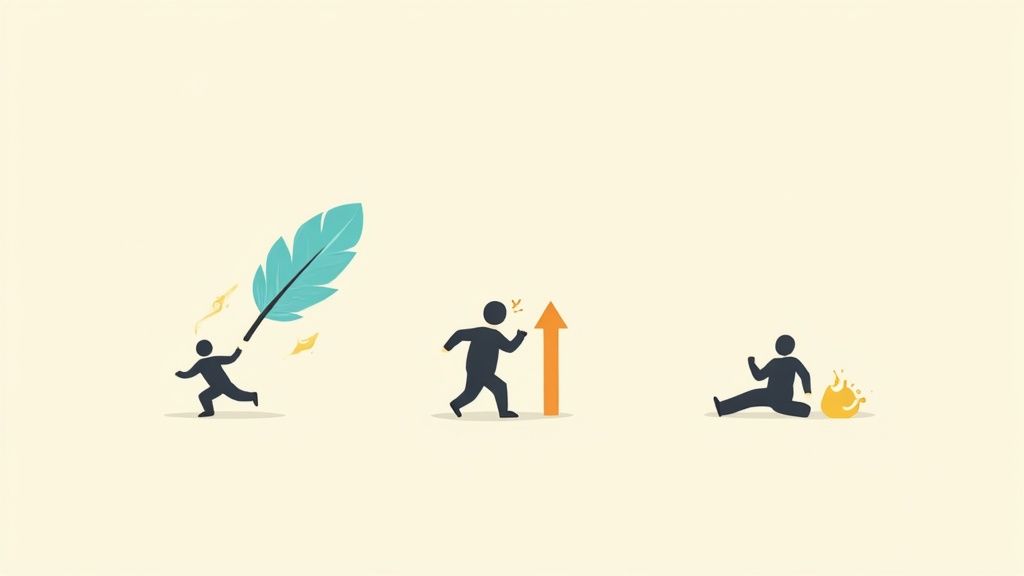
But you do not need to be a spell-slinger to walk away from a great fall. Plenty of heroes rely on pure grit, skill, and training to cheat death.
Some classes are simply built differently. Their abilities are not just for combat; they represent a mastery over their own bodies that can make a long fall much less of a problem.
These are not just lines on a character sheet; they bring the character's core concept to life. The Monk’s control, the Rogue’s agility, the Barbarian’s sheer toughness—they all shine through when staring down a long drop.
Beyond your class, do not forget racial traits and feats. An Aarakocra or Winged Tiefling can just fly, making the entire concept of falling a bit of a joke. The Athlete feat is another great one, letting you stand up from prone using only 5 feet of movement—perfect for getting back into the fight after you have survived the landing. Every choice you make builds your character's unique toolkit. It is this deep strategic thinking that makes tabletop games so engaging, from classic D&D sessions to modern deck-builders like TerraClash, which challenges players to build their own unique paths to victory, with our game being suitable for ages 12+.
The official rules are merely the beginning. Think of them less as unshakeable laws and more as a solid foundation for the world you build at your table. Many a Dungeon Master has looked at the 20d6 damage cap and thought, ‘Surely falling from orbit should feel a bit more… final?’ This section is for those DMs who wish to add their own creative signature to the game.
House rules are what give a long-running campaign its unique flavour. They are the little tweaks that make the game your group’s own. When dealing with something as common as fall damage, a few clever adjustments can change the feel of your world, making it more gritty, more heroic, or just plain scarier.
This is where you bend the physics of your world to better fit the stories you and your players want to tell. It is that same drive for a unique experience that inspires designers to create entirely new tabletop games, from massive campaigns like Gloomhaven to exciting new card and board games that let you build your own legend.
If you are thinking about spicing up your game’s gravity, you are not alone. DMs have been tinkering with fall damage for decades. Here are a handful of the most popular variants you might want to try at your own table.
Every one of these options comes with its own trade-offs. More detailed rules can add a fantastic layer of realism and tactical thinking, but they can also bog the game down in maths. The trick is to find that sweet spot that works for your group and makes the story you are all telling even better.
So, there you have it, brave storyteller. At the end of the day, remember that the rules for dnd fall damage are so much more than a bunch of numbers. They are a core part of your narrative toolkit. They add tangible danger to a desperate scramble up a cliff face, put consequences on a botched Acrobatics check, and can create the setup for truly jaw-dropping moments of heroism.
Whether you run things strictly by the book or you conjure up your own house rules, the goal is always the same: make the game memorable for everyone at the table. The simple threat of a long drop is a classic element of high adventure, a shared problem that can bring the party together and spark stories they will be telling for years to come. Your confidence in applying these rules is what makes it all work. If you seek to sharpen those skills, you will find more wisdom in our comprehensive Dungeon Master guide.
It is that very spirit of collaborative storytelling and finding clever ways out of a tight spot that makes the whole tabletop hobby tick.
Every dice roll, every rule you interpret, is another thread you weave into the tapestry of your group's unique story. A fall is just one of many dramatic threads you can pull to make that story unforgettable.
So, go forth—embrace the verticality in your worlds. Let your heroes soar, and yes, let them occasionally take a tumble. After all, it is in surviving those falls, sometimes by the skin of their teeth, that legends are truly forged. Use these rules not as a restriction, but as a springboard for excitement, tension, and those amazing moments your players will never forget.
Let us delve into some of the most common questions that arise at the table when a character takes an unexpected dive. When gravity becomes the enemy, these are the rulings you will need.
Nay, it does not. In D&D 5th Edition, the game puts the brakes on real-world physics for the sake of keeping things playable. Fall damage maxes out at 20d6.
You hit that ceiling once you have fallen 200 feet. It does not matter if you are shoved off a 200-foot cliff or kicked out of an airship a mile high—the damage is the same. It is a neat way to stop a simple fall from instantly killing high-level heroes and bringing the story to a screeching halt.
Ah, the classic "Get down, Mr. President!" manoeuvre. For this specific brand of chaos, Xanathar's Guide to Everything offers a fantastic optional rule that many Dungeon Masters have adopted.
Here is how it works: if you land on someone, the fall damage is split between you. The falling creature gets a small mercy, taking only half the total damage.
The poor soul below has to make a DC 15 Dexterity saving throw. If they fail, they take the other half of the damage and get knocked prone. One character's clumsy mistake can suddenly become another's tactical nightmare.
Honestly, this rule is a favourite at my table. It adds a brilliant layer of risk and reward to any fight with high ledges or flying enemies, and it always encourages some wild, desperate plans.
Absolutely, and it is the reason every wizard with an ounce of self-preservation keeps it prepared. The Feather Fall spell is a life-saver, designed for this exact moment.
Its casting time is just 1 reaction, which you can trigger the instant you or someone nearby starts to fall. Since the rules say a character can plummet up to 500 feet in a single round, that reaction is more than fast enough. You can cast it the moment your boots leave solid ground, turning a lethal drop into a gentle, controlled descent.
The spirit of finding clever solutions to perilous situations is the heart of tabletop gaming. It is what drives grand adventures and inspires new worlds to explore. You may also find other great projects to support on platforms like Kickstarter or Gamefound.
TerraClash is a fantasy card and dice game for 1 to 6 players. Pick a hero, explore the lands, fight creatures and take on a final boss, solo or with friends.
TerraClash Lite is free to print and play. The full print and play game has 10 heroes and 194 cards, and the Kickstarter for TerraClash Digital, the game in your browser, is live until 22 November 2026.