Gather 'round, adventurers, and lend an ear. Tonight, we speak not of raw, cataclysmic power, but of subtle control, of the quiet magic that turns the tide of battle. That is the secret behind the humble cantrip, Ray of Frost. On the surface, it seems a simple parlour trick: a beam that zaps a target for 1d8 cold damage and, more importantly, slows them by 10 feet for a round.
For a fresh-faced apprentice, this may not sound as glorious as a crackling fire bolt, but an old wizard knows its tactical value is a treasure beyond measure.

Let us look past the numbers on the scroll for a moment. Forget the damage dice and think about the story of a fight. In the grand library of D&D spells, many cantrips are mere blasts of energy. Ray of Frost is different. It is a tool for the cunning mind. Its true magic is not in the chilly sting, but in its icy, unyielding grip.
Picture this: a hulking, slavering ogre barrels towards your party. It is fast, and its rage is a palpable force. A single, well-placed beam of frost will not fell it, but it will steal its momentum. That crucial moment of hesitation grants your companions the time they need to scatter, reposition, or land a decisive blow. That is the true art of this spell – turning a simple cantrip into a battle-winning tactic.
At its heart, Ray of Frost is about dictating the terms of engagement. That signature 10-foot speed reduction can genuinely be the difference between a heroic victory and a total party calamity. With a bit of foresight, a caster can use it to:
This idea—that small, deliberate actions can have a massive tactical impact—is a truth you will find in the greatest tabletop sagas. Any seasoned player of deckbuilders like Dominion or Clank! knows this feeling well. A single, unassuming card can completely pivot the game if played with wisdom. Ray of Frost is the D&D equivalent of that pivotal play.
In the grand tapestry of battle, control is a more potent weapon than simple force. A slowed enemy is a predictable one, and a predictable enemy is a defeated one.
It is this very philosophy of small choices with epic consequences that we are weaving into our own tabletop journey, TerraClash. Every card played is a strategic move that ripples through the encounter, much like how a well-aimed Ray of Frost 5e can alter a party's fate. This cantrip teaches a vital lesson for any adventurer or gamer: sometimes, the best move isn't the one that hits the hardest, but the one that freezes your opponent in their tracks.
To master any spell, you must look past the flavour text and grasp its very essence at the table. Let us break down the arcane blueprint for Ray of Frost piece by piece, for every word in that spell description is a tool awaiting a master's hand.
First, it is a cantrip. This is a profound boon. It means you can cast it all day, every day, without ever expending a precious spell slot. Think of it as your wizard's trusty sidearm—always there when you need it, forming the reliable backbone of your magical arsenal.
The casting itself is beautifully simple. You choose a target you can see within 60 feet and unleash a beam of chilling energy. That 60-foot range is your zone of control, the space where you can dictate the flow of the fight from a safe distance.
To see if your beam connects, you make a ranged spell attack. It is your roll against their Armour Class. For a deeper dive on how such magics are calculated, you can consult our guide to a spell save DC and attack rolls.
If you strike true, two things happen at once, and herein lies the magic.
Do not overlook that second part. The speed reduction is the very soul of this spell. You are not just chipping away at hit points; you are actively shaping the battlefield, slowing a charging brute or ensuring a slippery rogue cannot simply dash away.
Like any worthy adventurer, your magic grows stronger alongside you. Ray of Frost keeps pace, scaling its damage at key levels to ensure it never becomes obsolete, even when you face down ancient dragons.
This table reveals how the cold damage from Ray of Frost intensifies as you grow into a more powerful adventurer.
| Character Level | Damage Dice | Average Damage |
|---|---|---|
| 1st - 4th | 1d8 | 4.5 |
| 5th - 10th | 2d8 | 9 |
| 11th - 16th | 3d8 | 13.5 |
| 17th - 20th | 4d8 | 18 |
As you can see, what begins as a respectable chill becomes a truly deadly blast of arctic power in the later chapters of your tale.
Mastering these fundamentals—the range, the attack roll, the damage, and that all-important speed penalty—is the first step. Once you have, you can begin to unlock the true tactical potential of the Ray of Frost 5e cantrip.
Raw power is one thing, but true arcane mastery is born of cunning. It is about seeing the battlefield for what it is: a grand chessboard. A novice might glance at Ray of Frost and see a flicker of cold damage, but an experienced tactician sees the key to controlling the entire board. The genius of this cantrip isn't what it kills, but what it prevents.
Picture the scene: a hulking bugbear, all muscle and fury, charges your cleric. Your fighter is out of position and cannot intercept. It seems your healer is about to be flattened. Then, a thin beam of azure light lances from your wizard's hand. The bugbear stumbles, its momentum lost, its legs suddenly heavy with a supernatural chill. That is the art of the frozen retreat.
In adventuring circles, this classic manoeuvre is called kiting. You become the lure, staying just beyond the enemy's reach while you chip away at them from a safe distance. The beauty of Ray of Frost is that you don't need to be fast; you just need to make them slow.
This is the kind of tactical advantage that strategists in any realm dream of. It is about stripping away your opponent's choices until they have no good ones left, much like a grandmaster in chess or a skilled player in a deep tactical board game.
An enemy that cannot reach you is an enemy that cannot hurt you. It is a simple truth, but it is the foundation of countless victories. Ray of Frost is the key that unlocks that tactical door.
A spell's true worth is proven in the tight corridors of a dungeon or the chaos of a battlefield. Imagine you are in a narrow hallway, perhaps ten feet wide. A single blast of frost on the lead goblin turns that passage into a death trap. He is slowed, his comrades stuck behind him, creating a perfect bottleneck for your party's archer.
Or what of a fleeing cultist who just snatched a priceless artifact? They think they can simply dash away, but a well-aimed Ray of Frost ensures they are not outrunning anyone. These are the moments that separate a mere spell-slinger from a true arcane tactician—when a simple cantrip completely changes the story of an encounter. For Dungeon Masters, learning to design encounters that allow for this clever play is crucial, and a good encounter builder tool for 5e can be a great help in creating those memorable tactical puzzles.
Any fresh-faced apprentice can learn to conjure a bit of a chill, but some spellcasters are simply born with winter in their bones. For them, Ray of Frost isn't just another cantrip—it is a core part of their arsenal, an extension of their very will. Getting the most from this spell is about finding the right class and subclass to make it sing. It is like discovering the perfect card combination in a legendary deckbuilding game.
Choosing the right path is one of the most exciting parts of beginning an adventure. Some classes possess features that transform this humble cantrip into a devastating signature move. Let us gaze upon a few of the best.
First is the Evocation Wizard, a true master of destructive magic. For these casters, even a spell that misses its mark can still turn the tide of battle. At 6th level, they gain a feature called Potent Cantrip, which is a true game-changer for Ray of Frost.
With Potent Cantrip, even if a creature succeeds on its saving throw (or, in this case, you miss your attack roll), it still takes half damage and suffers the spell's other effects. This means the creature's speed is still reduced by 10 feet, guaranteed. This reliable control makes the Evocation Wizard a tactical genius, slowing key enemies and ensuring they cannot easily escape.
Then you have those who inherited their magic from a mighty draconic ancestor. A Sorcerer with a white or silver dragon in their family tree can channel that primal cold into their spells.
At 6th level, their Elemental Affinity feature lets them add their Charisma modifier to the damage of one damage roll of a spell that deals cold damage. Suddenly, Ray of Frost transforms from a simple icy beam to a piercing lance of arctic power. It keeps its fantastic speed-reduction effect while also hitting significantly harder with every blast. That is a fearsome combination of control and damage.
This flowchart breaks down how these tactical choices play out upon the battlefield.
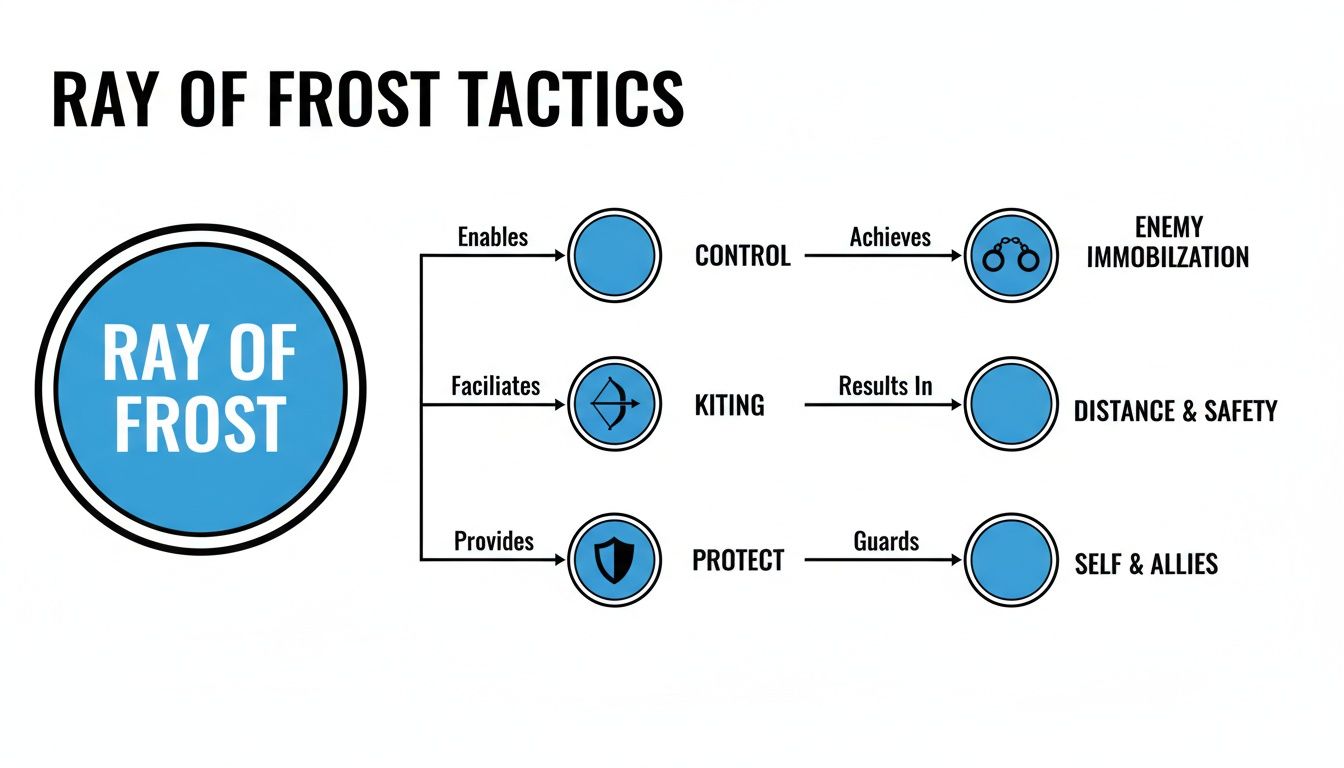
As you can see, the basic mechanics of controlling an enemy's movement and kiting them from a distance create a powerful loop that helps keep the whole party safe.
A spell is but a tool. It is the hand that wields it, the mind that guides it, and the blood that empowers it which defines its true strength.
These are but two of the most obvious synergies. An Arcane Trickster Rogue might use the chill to keep an enemy at the perfect distance for a Sneak Attack, or a Warlock could use it as a reliable backup when their higher-level spell slots are spent.
Understanding these interactions is the key to building a character you love to play. If you are just starting out, learning how to make a Dungeons and Dragons character is the perfect place to begin. Think of it like building a deck in a game like TerraClash; you are looking for the combinations that don't just work on paper, but also help you tell the story you wish to tell.
No spell exists in a vacuum. A truly skilled caster knows their full arsenal inside and out, always selecting the right tool for the job. A cantrip is a mage’s signature, and when you choose Ray of Frost, you make a clear statement about your preferred style of combat.
So, how does this icy beam stack up against the other heavy hitters of at-will magic? In the great arcane stand-offs, casters often fall back on two other legendary cantrips: the searing Fire Bolt and the crackling Eldritch Blast. Each is a masterpiece in its own right, but they serve entirely different purposes on the battlefield.
Figuring out these trade-offs is much like learning the key cards in a deck-building game. You must know when to play the card that deals raw damage versus the one that completely disrupts your opponent's turn. It is the core of good strategy, a principle we have woven into our own game, TerraClash, where every single card shapes the outcome of the battle.
Fire Bolt is the go-to for casters who believe the best solution is simply more power. It is direct, uncomplicated, and brutally effective.
Its main advantage is pure damage potential, packing a hefty 1d10 fire damage. That makes it, on average, the hardest-hitting cantrip most spellcasters can wield. But that power comes at a price. Fire Bolt is a one-trick pony; it offers no secondary effects, no control, no tactical nuance. It just burns.
Then you have Eldritch Blast, the Warlock’s signature spell. This cantrip is a marvel of arcane design, scaling in a way no other does. Instead of its damage die growing larger, you fire more beams at higher levels—eventually launching up to four separate attacks.
When paired with Warlock invocations like Agonizing Blast, it becomes a relentless barrage of damage that can even pick off multiple foes. Its only real drawback is its exclusivity. This potent magic is a gift from a Warlock's otherworldly patron, not something your average Wizard or Sorcerer can simply pick up.
In the grand theatre of combat, a mage must decide their role. Are you the cannon, there to shatter enemy lines with pure force? Or are you the strategist, the one who freezes the enemy's advance and dictates the flow of battle?
Ray of Frost finds its home in that beautiful middle ground. It gives you reliable 1d8 cold damage, only a fraction less than Fire Bolt, but brings a guaranteed control effect that neither of the others can touch. It is the perfect balance of offense and battlefield manipulation—the choice for the tactician who knows that controlling the enemy is often far more valuable than simply scorching them.
If you seek to take your character beyond the fundamentals, you have come to the right place. A standard Ray of Frost is a fantastic tool, no doubt. But with creative thinking, you can twist this simple cantrip into the absolute cornerstone of your build. This is where feats and multiclassing come into play, allowing you to truly customize your hero.
Think of it like a master strategist building a deck for a high-stakes tournament. These advanced choices aren't just about grabbing the next cool thing; they are about having a vision for your character and deliberately picking the pieces that bring that vision to life.
Feats are those special talents that make an adventurer stand out from the crowd. For a caster who loves ice magic, a few specific feats can turn a simple freezing beam into something truly fearsome.
Consider Metamagic Adept. This feat lets you borrow a couple of tricks from the Sorcerer's spellbook, bending the rules of magic to your will. If you grab the 'Quickened Spell' option, you can suddenly fire off a Ray of Frost as a bonus action. Imagine that. You could slow a charging ogre with your bonus action, then still have your main action to drop a Wall of Fire to trap it. All in a single, jaw-dropping turn.
Another brilliant pick is Elemental Adept (Cold). This is your choice if you plan on facing creatures from the frozen wastes or anything that might shrug off cold damage. It lets your cold spells ignore resistance, ensuring your icy blasts always hit with full force. As a bonus, it also treats any 1 you roll on a damage die as a 2, smoothing out your damage and making you that tiny bit more reliable.
To truly master a spell is to see its potential not just for what it is, but for what it can become when combined with other powers. It is the art of synergy, the secret language of legendary heroes.
Beyond single feats lies the path of multiclassing – blending the skills of different classes to create something entirely new. The possibilities here are almost endless.
An Arcane Trickster Rogue who dabbles in Wizardry, for instance, becomes a nightmare on the battlefield. They can use Ray of Frost to slow a target, keeping them at the perfect distance to pepper them with Sneak Attacks from their bow, turn after turn.
Or what of a more martial character, like a Fighter, taking a couple of levels in Sorcerer? This not only grants them the cantrip but lets them combine it with their Action Surge. Imagine locking down two different enemies with a double blast of slowing ice in one go. That is serious battlefield control.
These are the kinds of creative combinations that make tabletop RPGs so special. It is this spirit of strategic freedom and deep customization that we adore, and it's a feeling we have worked hard to capture in our own deck-building adventure, TerraClash.
Even the most seasoned spellcasters have a query or two. Let us address some of the most common debates I have heard around the gaming table about this wonderfully chilly cantrip.
A classic question. The short answer is no. In the rules of D&D 5e, effects from the same named source do not stack.
If you strike a creature with Ray of Frost and your ally hits it again in the same round, the creature's speed is still only reduced by 10 feet, not 20. The second hit merely refreshes the duration of the slow effect until the start of your next turn.
By the letter of the law, the spell text is clear: you target 'one creature'. This means, technically, you cannot aim it at a puddle to freeze it solid or at a rusty lock to make it brittle.
However, this is where the 'Rule of Cool' often presides. Most Dungeon Masters I know would absolutely reward such clever thinking with a small, flavorful effect. It never hurts to ask!
It is a fantastic cantrip, but if raw, unadulterated damage is your only goal, then perhaps not. Its d8 damage die is respectable, but it cannot quite compete with the raw power of a d10 from something like Fire Bolt.
You do not choose Ray of Frost to be the top damage-dealer. You choose it for its brilliant mix of decent damage and guaranteed battlefield control. That slowing effect is a tactical tool, and sometimes, control is far more valuable than a few extra points of damage.
The strategic depth found in spells like Ray of Frost is the same spirit we have woven into our own tabletop adventure. If you enjoy tactical choices with big impacts, keep an eye on TerraClash. Our Kickstarter campaign will be launching very soon! You can follow our journey at https://terraclash.co.uk. For those seeking other great indie tales, consider exploring campaigns for games like Frosthaven or Gloomhaven: Jaws of the Lion.

