Hark, adventurer, and draw near. Before you lies not mere paper, but a portal—a quiet promise of myth and legend yet unwritten. This is your DnD character creation sheet, the sacred scroll upon which a hero's soul is first etched. Do not see it as a form to be filled, but as the loom upon which you shall weave the very first threads of a grand tapestry.
Gather 'round, for we are about to begin the time-honoured ritual of transforming these empty lines into a being brimming with ambition, history, and a touch of destiny. This initial spark—the core idea of who your hero is—is the very heartstone of the saga to come. It is a magic as potent as the compelling narratives found in beloved campaigns, from the shadowed dungeons of Gloomhaven to the arcane lore of Magic: The Gathering. At the end of any tale, a well-forged character is the lens through which you shall witness worlds of wonder and peril.
This simple diagram captures the flow of breathing life into a hero, from a fleeting thought to a fully-realised soul.
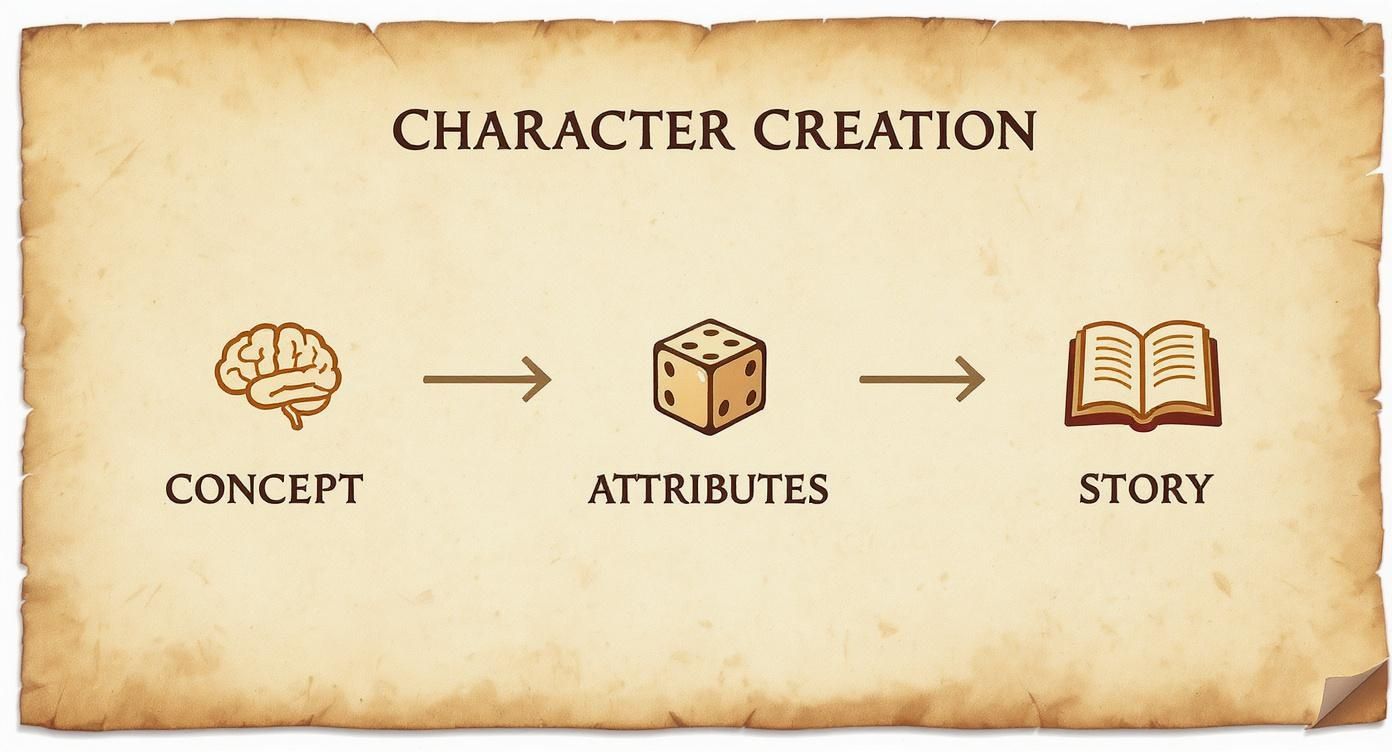
As you can see, a strong character is always born from that core concept first. The mechanics and the backstory all branch out from that initial, powerful idea.
To begin the incantation, every adventurer's journey starts with three fundamental choices. Think of these as the ancient pillars that hold up your entire character concept.
Here is a glimpse of the essential first choices every adventurer must make upon their character sheet.
| Pillar of Origin | What It Represents | Example Choice |
|---|---|---|
| Race | Your character's ancestry and inherent traits. | Elf, Dwarf, Human |
| Class | Your character's profession, skills, and combat style. | Wizard, Rogue, Barbarian |
| Background | Your character's life story and experiences before adventuring. | Soldier, Sage, Urchin |
Mastering these three elements grants you a solid framework upon which to build the rest of your hero, making every subsequent decision that much easier.
While the feel of parchment and ink holds a certain old-world magic, the ways we chronicle our heroes have evolved. The rise of virtual tabletops (VTTs) and other digital tools has changed how DnD character creation sheets are used. A recent missive found that 58% of tabletop RPG players now use some form of digital character sheet, whether on enchanted platforms like D&D Beyond, Roll20, or a simple fillable PDF.
For those just starting their quest, our guide on D and D for beginners can help you navigate the leap from classic pen-and-paper to these newer scrying tools.
Beyond the sheet itself, today's adventurers might also explore tools to help visualise their character, like generating AI Character Sprite Sheets to get a feel for their hero's look. Among all the digital options, D&D Beyond is a clear favourite, used by 44% of D&D players for character creation.
The character sheet is more than a record of statistics; it is the first chapter of your hero's chronicle. Every number, every trait, and every piece of equipment is a story prompt waiting for you to answer it.
This shift towards digital chronicles does not diminish the art of creation. It simply offers new quills and inks for a new generation of storytellers. The essence is the same: transforming a blank space into a living, breathing hero. It's a process not unlike building a strategic deck in games like our tale, TerraClash, where every choice you make at the start informs the grand strategy of your entire adventure.
Let us now begin this sacred process.
Below your character's name and race on that sprawling sheet of paper are six numbers. Do not underestimate them. These are the absolute core of your character, the very essence of their physical and mental capabilities. Whether you are forging a hulking barbarian or a silver-tongued rogue, it all begins here with Strength, Dexterity, Constitution, Intelligence, Wisdom, and Charisma.
These scores are raw potential. What is your approach? Are you the type to leave it to fate and let the dice fall where they may? Or do you prefer to meticulously assign each point, sculpting your champion with the precision of a master artisan? I have seen both methods create legendary heroes at my table.
Every decision you make in this section will echo through your entire campaign. A high Strength score is what puts the devastating crunch behind a warhammer's blow. A sharp Intelligence is what lets you decipher the ancient runes on a long-forgotten tomb. This is the moment when the mechanics of the game start breathing real life into the hero you've been picturing.
Think of these six stats as the primary colours on your character's palette. How you mix and prioritise them is what will create the unique champion you are about to unleash on the world.
Figuring out where to place your highest numbers is your first great strategic choice. A Barbarian will want to channel their power into Strength and Constitution, while a Rogue will almost certainly lean into Dexterity and perhaps Charisma. It is a balancing act, not unlike building a deck in a game like Ascension or our own chronicle, TerraClash. You must pick the stats that best serve your overall destiny. There is no single "right" way to do it, only the way that best brings your character's story to life.
Once you have your six ability scores sorted, you must discover their ability modifiers. This is a small number, but it is arguably the most important one on your sheet. It is what you will actually be adding to (or subtracting from) most of your dice rolls. This is where your raw potential turns into a real, tangible chance of success or failure.
An ability score of 10 is the average for a common person, granting a +0 modifier. For every two points your score is above 10, your modifier rises by +1. Likewise, for every two points below 10, it falls by -1.
For instance, a mighty Strength score of 16 grants you a sweet +3 modifier on your attack and damage rolls with that greatsword. But an unfortunate Wisdom of 8 saddles you with a -1 modifier on your perception checks, making you more likely to walk right into a goblin ambush. These modifiers are the engine that drives your character sheet, constantly nudging the threads of fate. Understanding them is the first real step to mastering the game.
Right, you’ve got the numbers down. Your character has their core stats sorted, but right now, they are but a collection of figures on a page. It is time to breathe some life into them, to give them a place and a purpose. This is the fun part, where your dnd character creation sheet starts to tell a story. The three pillars of that story are your Class, Race, and Background.
Let us start with your Class. This is not just a job title; it is your character's entire vocation, the very essence of how they solve problems. Are they a battle-hardened Fighter, whose entire world is viewed through the lens of tactics and the swing of a sword? Or do they see reality as a weave of magical energy, just waiting for a clever Wizard to pull at its threads?
Think of it like choosing your starting champion or the core cards for your deck. Your Class grants you a unique toolkit of abilities and skills, defining your fundamental strategy for every challenge ahead. It is a momentous decision that sets the tone for everything to come.
Next up is Race. This is your character’s ancestry, their lineage. It is so much more than a cosmetic choice. Being an Elf grants you sharp senses that might spot a goblin ambush before it springs, while a Dwarf's legendary toughness could be the only thing keeping them on their feet after a blast of dragon fire. Each race comes with its own history, culture, and innate talents.
Finally, we layer on their Background. This crucial piece answers the question: "What were you doing before you started kicking down dungeon doors?" Maybe you were a world-weary Soldier, whose scars tell a thousand tales. Or perhaps a sheltered Sage, who knows more about ancient tombs than the outside world. You could even have been a street-smart Urchin, with a map of the city's rooftops etched into your memory.
These three elements—Class, Race, and Background—don’t just sit next to each other on the sheet. They intertwine. A Tiefling Warlock with a Noble background has a profoundly different outlook and set of connections than a Halfling Rogue who grew up as an Entertainer.
This blend of vocation, heritage, and personal history is what makes a character truly compelling. It is a ritual that players all over the world love. The tabletop scene is a huge slice of the £1.2 billion board game market. While exact numbers are as elusive as a forest spirit, it is thought that somewhere between 360,000 and 550,000 D&D character creation sheets get filled out by players every year. Each one is the birth of a brand-new hero. You can get a better sense of the D&D community's makeup over on EN World.
While you can mix and match to create something wildly unique, you will find certain combinations just feel right. These classic archetypes are powerful because they resonate so deeply with the fantasy stories we all know and love.
Below is a quick look at some of the most popular combinations you'll see at gaming tables. They provide a fantastic starting point for new players and a familiar canvas for veterans to add their own unique twist.
| Archetype | Popular Class | Common Race | Frequent Background |
|---|---|---|---|
| The Stoic Guardian | Fighter | Dwarf | Soldier |
| The Wild Wanderer | Ranger | Elf (Wood) | Outlander |
| The Cunning Shadow | Rogue | Human | Criminal / Urchin |
| The Arcane Scholar | Wizard | Elf (High) | Sage |
| The Divine Healer | Cleric | Human | Acolyte |
| The Nature's Chosen | Druid | Halfling | Hermit |
These archetypes are well-trodden paths for a reason—they work brilliantly. You can either lean into the fantasy trope for a classic experience or use it as a foundation to deliberately subvert expectations. What if that Dwarf Fighter is actually a flamboyant poet?
Ultimately, these are the choices that elevate a set of stats into a living, breathing character, one as memorable as any you'd find in your favourite fantasy novel. It is a creative act, much like building a killer deck in TerraClash, where the cards you choose tell the story of your strategy before the first move is even made.
No adventurer worth their salt walks out of the tavern empty-handed. We have now reached the part of your character sheet that feels the most real—your equipment. The gear you carry is not just a list of stats; these items are a direct link to who your character is, where they've been, and what they can do. That worn-out shield is not just a +2 to your Armour Class; it is a story, a testament to battles survived.
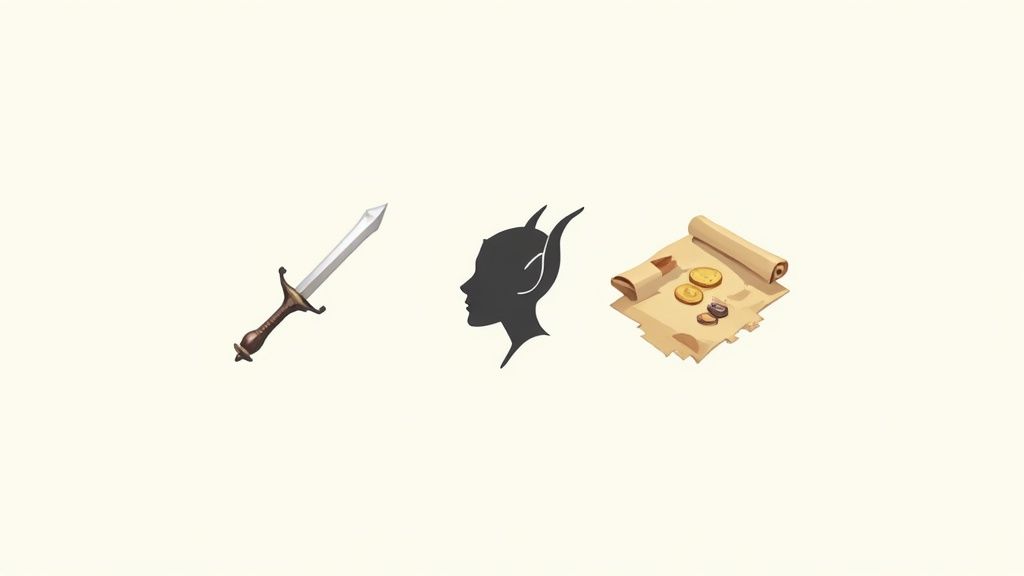
To start, your class and background will grant you a pre-selected bundle of gear. A devout Cleric, for instance, might start their journey with a solid mace and a holy symbol, while a sly Rogue will probably have some leather armour, a couple of daggers, and their trusty thieves' tools. This starting loadout is your bread and butter, giving you a solid foundation to build from.
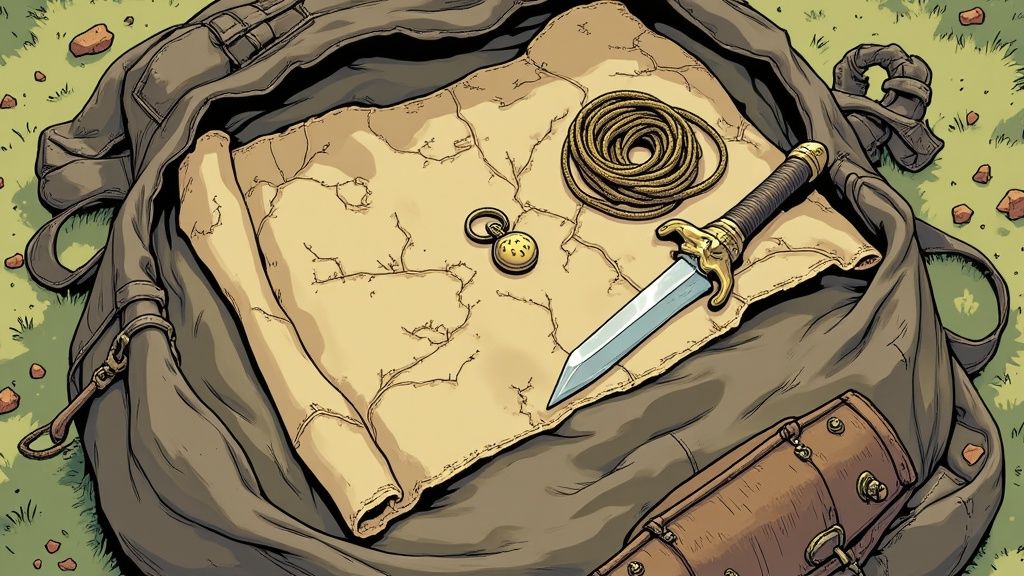
But a seasoned adventurer’s pack is filled with more than just things to smite monsters with. This is where you can sprinkle in real flavour and show off your character's personality. What little trinkets and oddities have they picked up along the way?
These small, seemingly insignificant items are what make a character come alive. They are fantastic hooks for roleplaying and often spark clever, out-of-the-box solutions when a direct approach just won't cut it. A sharp blade is great, but sometimes it is a simple ball of twine that saves the day. If you want to get serious about your choice of steel, our guide to the most effective DnD martial weapons can point you in the right direction.
Think of your inventory as a puzzle—a game of resource management that starts before the first die is ever rolled. Every item you carry is a choice that says something about how you plan to face the world.
Deciding what to carry and what to leave behind quickly becomes a strategic challenge, not unlike building your deck in a game like our own TerraClash. Every slot in your backpack is precious. Do you pack that extra healing potion, or save the space for a weird magical artefact you found? These choices have real consequences, turning what could be a boring list into a dynamic part of the adventure. So choose wisely; your gear will be your most loyal companion through the trials ahead.
Right, the numbers are down and the mechanics are sorted. We have built the chassis of your hero, but now it is time for the truly enchanting part: breathing life into them. This is where a collection of stats transforms into a person you will actually be at the table.
We shall capture their spirit using four key story hooks: Personality Traits, Ideals, Bonds, and Flaws. These are not just bits of flavour text; they are the bedrock of your character's identity and, frankly, the best gift you can give your Dungeon Master. What secret fear makes your hero act so bravely? Who did they swear a life-altering oath to?
These details are what make a character memorable. A flaw, like a crippling fear of tight spaces, often creates far more interesting moments than a high Strength score ever will.
Think of it like the narrative design behind a TerraClash hero. Their inner conflicts and motivations are just as crucial as the abilities they wield. These personality details become your guide for role-playing when the tough choices inevitably come up.
Let us quickly break down these essential elements. They are what give your character a unique voice and a real place in the world.
If you are to be a spellcaster, this is also where you jot down your starting spells. Think of this as your opening hand in a massive, ongoing card game. The spells you pick right now define your immediate capabilities and set the tone for how your power will grow.
This first selection is a big deal. It dictates whether you start as a master of illusion, a wellspring of healing magic, or a walking conduit of fiery destruction. Your choice of spells, along with understanding how they work—like getting a handle on your spell save DC in 5e—will shape how effective you are in the trials to come.
With these final details locked in, your character is complete. They are no longer just a sheet of paper, but a fusion of compelling motivations and powerful abilities, ready for whatever story awaits.
Every adventurer, whether it is their first quest or their hundredth, has questions when starting a new story. Let us pull up a stool by the tavern fire and tackle some of the common things I hear from players as they get their character sheets ready.
Hands down, it is glossing over the personality section. I see it all the time. Players get laser-focused on their combat stats and abilities, but they just pencil in a few generic words for their Personality Traits, Ideals, Bonds, and Flaws.
That section is pure gold. It is not just fluff; it is the very soul of your character. It gives your Dungeon Master incredible hooks to weave you into the narrative and provides you with a clear guide on how to act when you're put on the spot.
A hero with a truly compelling flaw will always be remembered long after the one with perfect, but forgettable, stats.
These details are what turn a collection of numbers on a page into a person worth rooting for.
True uniqueness comes from the story you build, not just the mechanics you choose. A Human Fighter is a classic, but yours doesn't have to be the classic. Are they a grizzled mercenary with a dark past? A disgraced noble trying to reclaim their honour? Maybe they're a fresh-faced idealist who's never seen a real battle.
Use your background, your flaws, and even your starting equipment to tell that story. Perhaps your Fighter uses a strange, ancestral weapon instead of a standard longsword, or their armour is dented and carries the crest of a fallen kingdom. It is these little details, the things you decide, that make your hero stand out.
Honestly, there is no single right answer here—it is all about what works for you and your group.
Digital sheets, like the ones on D&D Beyond, are a godsend for managing complex characters. They handle all the maths for you, track your spell slots, and make managing inventory a breeze, which is brilliant for online campaigns.
But there is an undeniable charm to a physical paper sheet. The simple act of writing things down with a pencil, erasing smudges, and seeing the page get worn over a long campaign... it connects you to your character in a very tangible way. Go with whichever option helps you feel most immersed in the game.
Once your sheet is filled out, a lot of players want to put a face to the name, especially for online games. It can be a lot of fun to create a unique avatar that perfectly matches the hero you've imagined.
That journey—from a blank piece of paper to a fully-fledged hero ready for adventure—is one of the best parts of any tabletop RPG. It is a creative spark we've tried to capture in our own game, TerraClash. It is a deck-building adventure for ages 12 and up that channels that same feeling of strategic thinking, rich storytelling, and personal discovery. If crafting a character and forging your own legend sounds like your kind of fun, come see the world we're building over at https://terraclash.co.uk.
We admire many other indie creators forging their own paths. Consider exploring the worlds of Frosthaven or the beautiful card game Everdell. Many great adventures are born from the passion of small teams, just like ours, often brought to life through platforms like Kickstarter.

