Hark, adventurer, for you have heard the call. A whisper on the wind, a murmur in the shadows, beckoning you toward realms of slain dragons, plundered dungeons, and epic sagas waiting to be woven. Welcome, traveler, to the world of Dungeons & Dragons.
At its heart, D&D is a pact of collaborative storytelling. It is a circle of allies, you and your friends, forging heroes from imagination and embarking on grand quests, all guided by a master storyteller known as the Dungeon Master or DM. Cast aside your notions of video games; here, the only limit is the horizon of your mind. To begin this journey, you need only a few enchanted dice, a quill, and a scroll of parchment.
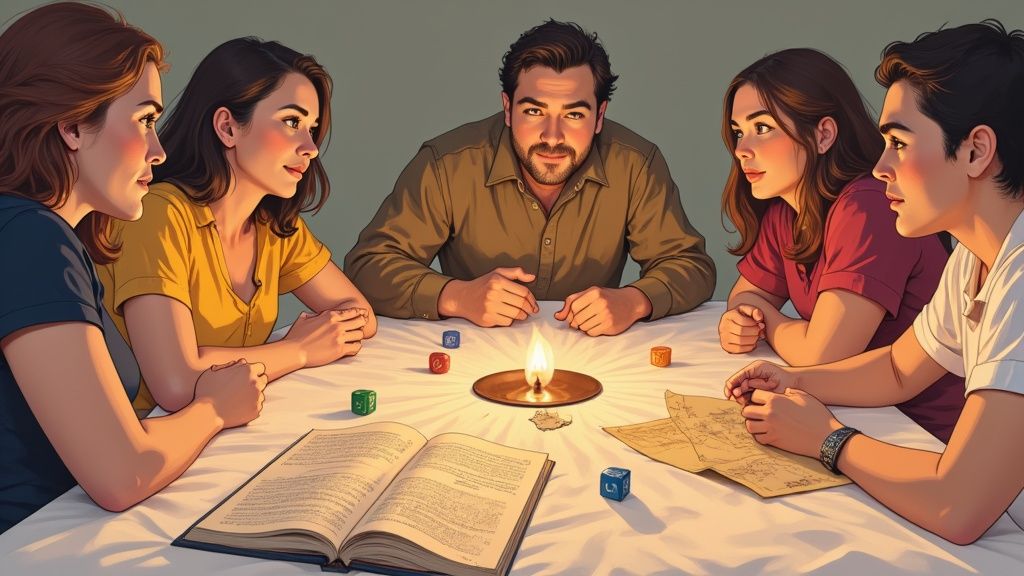
Consider this guide your first mystical map, charting a course into the boundless realms of fantasy that D&D offers. In this grand game, you are not a mere spectator to a story unfolding – you are its architect. You are the hero.
We shall illuminate the path, covering all you must know, from conjuring your very own character to understanding the pivotal role of the Dungeon Master—the weaver of worlds who breathes life into its monsters, mysteries, and forgotten lore. You will soon see how a simple collection of tools can give rise to unforgettable legends. D&D is more than a game; it is a crucible for forging memories with your fellowship.
The spirit of shared adventure that beats at the heart of D&D is but one star in a vast, vibrant cosmos of tabletop gaming. This ancient tradition of fantasy and cooperative storytelling has inspired countless other creations, from epic board game campaigns like Gloomhaven to innovative deck-building games where strategy is paramount. Many of these, like TerraClash, share the same core tenet: gather your allies, think strategically, and etch your legend into history.
There has never been a more auspicious time to begin your quest. The game's renown has grown beyond measure, and its gates are wide open to newcomers.
Heed the portents! Dungeons & Dragons has become an increasingly accessible pastime, with sales of introductory box sets—forged specifically for new players—surging by a staggering 300 percent in recent years.
What does this omen mean for you? It means that if you are in the UK and seek to begin your D&D journey, there are more resources, welcoming guilds, and starter sets available than at any other time in the game's storied history. You do not embark on this quest alone. To witness how the fellowship has swelled, you may explore the history of D&D's growth.
Every D&D chronicle, from a swift one-shot adventure to a campaign spanning ages, revolves around two fundamental roles: the Player and the Dungeon Master. See these not as rigid duties but as a creative covenant. This sacred collaboration is what kindles the magic.
As a Player, you stand in the spotlight. You are the hero of this tale. You are granted the power to dream up a character, inhabit their being, and decree their actions. You will speak for them, fight for them, and react to the world through their eyes. It is your choices that propel the narrative forward and shape the destiny of your adventuring party.
The Dungeon Master, or DM, is the breath of the world and everything within it. They are the narrator describing ancient ruins, the voice of the wise old tavern keeper, and the guttural growl of the beast lurking in the dark. The DM sets the stage, presents the trials, and acts as a neutral arbiter of the sacred rules.
They do not play against you; they weave the tapestry of fate with you. Their charge is to create a compelling world and make your actions echo with consequence. Together, the Players and the DM craft a story that could not exist without every soul at the table. It is this shared creation that forges powerful fellowships and unforgettable memories.
Your first rite as a player is often the most thrilling: the conjuring of your character. Are you a stoic dwarven cleric, channeling divine power to shield your companions? A flamboyant tiefling bard whose wit is as sharp as their rapier? Or perhaps a clumsy but brilliant wizard who keeps accidentally setting their own robes ablaze? The possibilities are as limitless as the stars.
You need not be a master thespian or a tactical genius. Simply ask yourself what your character would do in any given situation. What are their ambitions? Their fears? When the DM reveals that a rickety rope bridge sways over a bottomless chasm, it falls to you to decide whether your character charges across, cautiously tests the ropes, or seeks another path. Your agency is paramount – the saga is about you and the choices you make.
If the players are the stars of the performance, the Dungeon Master is the director, the set designer, and the entire supporting cast rolled into one. It is a grand responsibility, yet it is also one of the most rewarding experiences in all of gaming. The DM prepares the adventure, whether it be a pre-written chronicle or a completely original 'homebrew' world born of their own imagination.
They guide the flow of the game, ensuring the challenges are fair but thrilling, and grant every player a moment to shine. A great DM listens, weaving elements from the players' backstories into the grander plot to make the adventure feel personal. They are the ultimate world-builder, a skill that proves invaluable in all manner of fantasy games, from sprawling board games to deck-builders like TerraClash, which also demand that you adapt to a world in constant flux.
This collaborative journey summons all manner of folk to the table. D&D today is a far cry from the niche hobby it once was. The community is incredibly diverse and welcoming, with the player base split almost evenly between men and women. A great host of players are new to the chronicle, with 40 percent being from Generation Z, most of whom began with the current, beginner-friendly 5th Edition. You can gain a better sense of this wondrous community and see how the player demographics have shifted. For a UK beginner, this means you are not alone – you join a massive, growing, and incredibly supportive fellowship.
Now, this is where the true magic begins. It is time to breathe life into a legend: your hero. Creating a character is a sacred rite for every D&D player, a creative pilgrimage that starts long before you ever roll a die in anger. This is where your story truly takes root, transforming a collection of numbers and notes on a page into someone you will guide through monster-infested dungeons and forgotten lands.
Your character sheet is your grimoire, your hero's chronicle, and the closest thing they have to a soul. At first glance, it may seem a scroll of confusing boxes and arcane jargon, but fear not. We shall decipher it together, step-by-step, so you may build an adventurer you are genuinely excited to embody. This entire process is the very heart of roleplaying.
Your first great decisions are your character’s Race and Class. These two pillars form the bedrock of who your character is and what they excel at.
Race speaks of their ancestry. Are they a stout, stubborn Dwarf from a mountain citadel, or a graceful, long-lived Elf who has watched empires rise and fall? Each race comes with its own unique gifts and perspectives on the world.
Class, on the other hand, is their vocation—their calling. This is what determines their special skills. Will you be a mighty Barbarian, whose fury is a weapon? Or perhaps a clever Rogue, who flits through the shadows with daggers at the ready? This choice shapes how you will overcome challenges, whether with brute force, powerful magic, or a silver-tongued lie.
To better grasp how this all intertwines, gaze upon this diagram. It illustrates the sacred flow between the Dungeon Master, who describes the world, and the Players, who act within it through their characters.
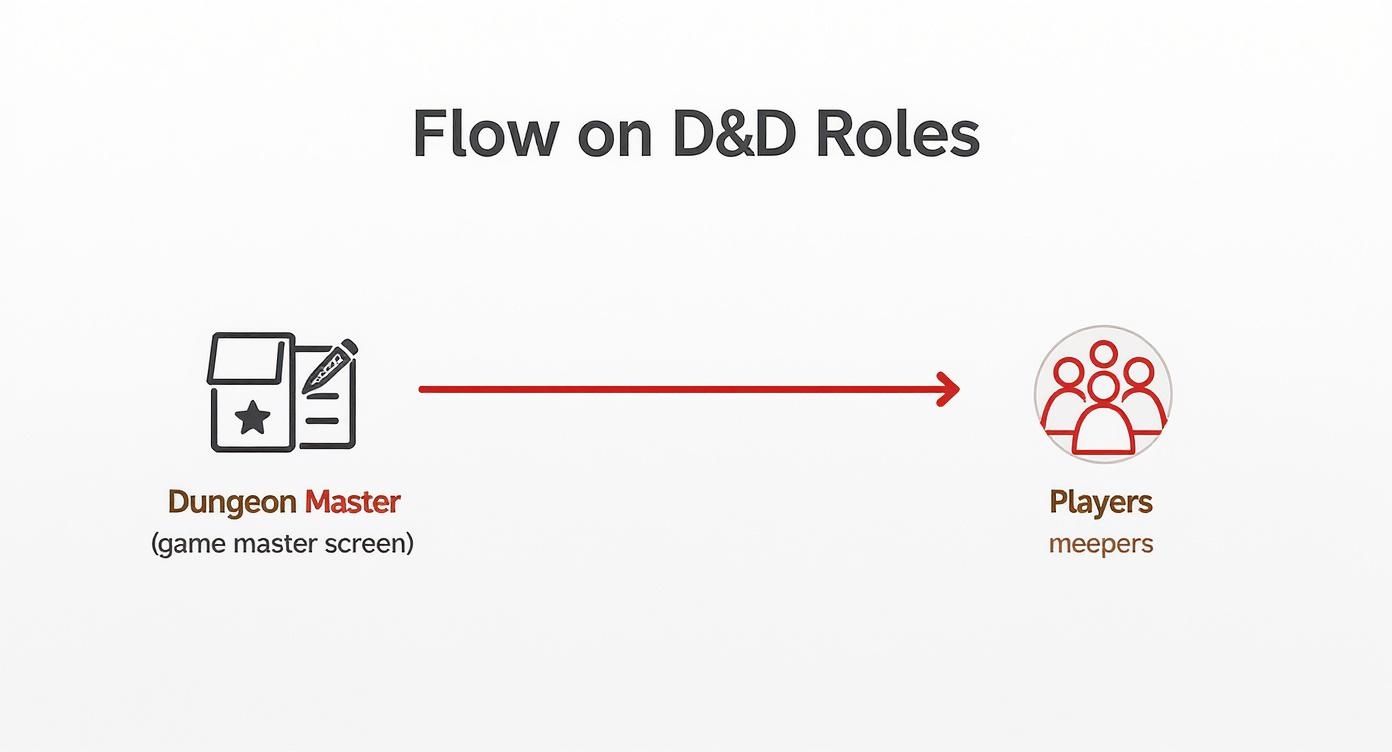
This is the core loop of the game: the DM sets the stage, and your characters' choices propel the story ever forward.
Every character, from the mightiest warrior to the most cunning wizard, is built upon six core Ability Scores. These numbers represent their raw talent and their vulnerabilities, defining what they can (and cannot) do well.
This table deciphers what each of the six scores represents.
| Ability Score | Represents | Key Classes |
|---|---|---|
| Strength (STR) | Physical power, brute force, and athleticism. | Barbarian, Fighter, Paladin |
| Dexterity (DEX) | Agility, reflexes, stealth, and finesse. | Rogue, Ranger, Monk |
| Constitution (CON) | Health, stamina, and resilience. | All classes, especially front-line fighters |
| Intelligence (INT) | Memory, reasoning, and arcane knowledge. | Wizard, Artificer |
| Wisdom (WIS) | Awareness, intuition, and perception. | Cleric, Druid, Ranger |
| Charisma (CHA) | Force of personality, persuasion, and leadership. | Bard, Sorcerer, Warlock |
These scores grant you boons (or banes!) on almost every action you attempt, from swinging a sword (Strength) to charming your way past a guard (Charisma).
Finally, you must gift them a story. A rich backstory is what transforms a pile of stats into a true person. Where did they come from? What drives them to risk life and limb? Granting your hero a clear purpose, a few personality quirks, and perhaps a flaw or two makes it far easier to decide what they would do in any situation. It is what makes every character feel truly unique.
For a more detailed walkthrough, you can learn more about how to make a Dungeons and Dragons character and truly bring them to life. Getting this first step right sets the stage for all the epic adventures to come.
So, your hero is forged, your dice are poised, and you sit at the table with your companions. What happens now? How does this grand tapestry unfold? Let us walk through the rhythm of a typical D&D game.
Everything begins with the Dungeon Master. See them as your guide and the narrator of a living, breathing saga. They will set the scene, describing the world around you – perhaps it’s the musty scent of a forgotten crypt, the roar of a waterfall in a deep forest, or the din of a raucous tavern.
Once the DM has painted the picture, the spotlight turns to you and your fellow players. The game flows in a simple, repeating cycle: the DM tells you what's happening, you decide what your character does, and then the DM describes the consequences of your actions. This sacred exchange is the engine that drives your entire adventure.
Every D&D adventure, whether you're solving a small-town mystery or hunting a fearsome dragon, is built upon three core activities. Understanding how these intertwine is the key to an amazing experience. We call them the pillars of gameplay: exploration, social interaction, and combat. They are the heart of what makes D&D for beginners so enthralling.
This flow is a shared language for adventure games. You will even see echoes of it in other tabletop genres, like strategy card games where you must explore your hand, interact with your opponent’s board, and wage tactical battles with your cards.
Let us see how this works in practice. Imagine your DM begins the session thus: "You stand at the edge of the Gloomwood, a forest twisted by ancient magic. The locals have warned you of a ghostly light that leads travellers to their doom. What do you do?"
Here you might begin with exploration. Your group's Ranger could declare, "I'll search for any unusual tracks at the forest's edge," while the Rogue announces, "I'm going to sneak ahead and see if I can spot this light without being seen."
Suddenly, a shimmering, otherworldly creature blocks your path. The game has just shifted to social interaction. The Bard, ever the diplomat, might step forward and say, "I shall play a soothing melody and ask the creature why it guards this forest." Their success will depend on their charm and a favorable roll of the dice.
But if the creature is not in a talking mood and attacks, you are thrown into combat. The Fighter hefts their shield, the Wizard begins muttering an incantation, and everyone rolls for initiative to see who acts first.
The true beauty of tabletop gaming lies in this freedom. In any situation, you have near-infinite choices. The combination of player agency and the whims of fate, introduced by the dice, is what creates truly unforgettable moments unique to your table.
This simple rhythm – description, action, and outcome – is the essence of D&D. If you are eager to begin, acquiring a worthy Dungeons and Dragons RPG Starter Set is the perfect first quest to undertake.
A life of adventure is a delicate balance, often teetering between a sharp blade and an even sharper wit. In Dungeons & Dragons, your story is forged in the heat of battle just as much as it is in the quiet moments of conversation. These are the two grand stages where heroes are truly made.
When swords are drawn and spells begin to fly, the game's tempo shifts into a more structured, turn-based rhythm. Combat can seem a daunting trial at first, but it all rests upon a simple foundation. The core of any conflict is the turn—a chance for every character, friend or foe, to make their move.
On your turn, you are granted a small pool of resources to spend. The great three are your Action, your Bonus Action, and your Movement.
Your Action is the main event of your round. This is where you swing your sword, unleash a powerful spell, or attempt something heroic like shoving an orc from a cliff. Consider it your grand moment in the spotlight.
Bonus Actions are swifter, secondary deeds, usually granted by a specific class feature or spell. A Rogue might use one to deftly duck out of an enemy's reach, or a Cleric might utter a swift prayer to heal an ally. You will not always have a Bonus Action to use, but when you do, it can be a tide-turner.
Finally, you have your Movement, which is simply how far you can travel. You can break this up however you wish, perhaps moving into position before your Action and then ducking behind cover after.
The moment of truth in any attack comes down to a single roll. You will grasp a 20-sided die (the d20), cast it, and add your character's boons. If your total meets or exceeds the enemy's Armour Class (AC), you have landed a blow! Then you roll different dice to see how much damage your strike has dealt. It is a simple, thrilling loop of risk and reward.
The weapon you wield can completely alter how you approach a fight. For any who wish to delve into the difference between a simple club and a mighty greataxe, you may explore the intricacies of the various D&D martial weapons to find the perfect tool for your budding warrior.
Just as vital as knowing how to fight is roleplaying—the art of truly becoming your character. This is not about affecting a strange voice (though you absolutely may if you wish!). It is about making choices that feel true to the hero you have created.
When the Dungeon Master describes a situation, take a moment and ponder: what would my character do here? Would your fiercely honourable Paladin accept a bag of gold from a corrupt official? Would your covetous Rogue risk setting off a trap for a rumoured treasure chest?
There are no right or wrong answers in roleplaying. The only goal is to add to the story everyone is building together and have a grand time doing it. Chatting with the locals, wrestling with tough decisions, and reacting to the world based on your character’s personality—that is where the game truly comes alive. It is this dynamic blend of tactical combat and meaningful choice that lies at the heart of all great fantasy games, from cooperative board games to strategic deck-builders like TerraClash, where every decision shapes your path to victory.
So, you have a character itching for adventure and a grasp of the game's flow. Now for the most crucial part: finding your party. After all, a quest is always better when shared with companions. Fortunately, finding a group of fellow adventurers is easier today than it has ever been.
Your first port of call might be right under your nose. Gathering a few friends to learn the sacred rites is a brilliant way to start, letting you all decipher the mysteries at your own pace without any pressure. If that is not an option, seek out your local game shop. Most are hubs for the community and often host "Adventurers League" nights, which are specifically designed for newcomers.
These organised events are perfect for dropping in, playing a session, and meeting other players. It is a fantastic, low-stakes way to find a more permanent fellowship. The spirit of adventure is out there—you just need to know where to look.
Deciding how you play is almost as significant a choice as who you play with. For many, nothing surpasses the classic experience: everyone gathered around a table, rolling physical dice, and sharing provisions. There is a special kind of magic in seeing the look on your friends' faces when you land a critical blow or your character says something utterly ridiculous.
But you need not be in the same chamber to share an adventure. The rise of virtual tabletops (VTTs) like Roll20 or Foundry means you can connect with players from across the land or even around the globe. These platforms are incredible, offering digital maps, character sheets, and virtual dice rollers that bring the tabletop experience right to your scrying screen. As you look for a group, you might want to explore alternative platforms for finding groups to see what fits your style.
Whether you love the clatter of real dice or the convenience of playing from your desk, there is a game out there for you. While recent polls show 70% of players prefer to play mostly in person, a great many people play exclusively online or use a mix of both. This flexibility makes it almost certain you will find a group that clicks with your schedule and preferences.
Just as there are countless ways to play, there are endless worlds to explore. You might begin a game in a well-known, official D&D setting like the Forgotten Realms, but do not be surprised if your DM has conjured something entirely new. In fact, nearly half of all campaigns take place in unique "homebrew" settings lovingly crafted by the Dungeon Master.
This incredible spirit of creation is the lifeblood of the tabletop roleplaying world. It fuels not just D&D campaigns, but the explosion of new indie games you see on platforms like Kickstarter. It is in these community-driven forges that new legends are born, whether it's a sprawling D&D saga or the tactical deck-building of a game like TerraClash.
Your perfect game is out there, hero. It is just waiting for you to find it.
Embarking on any new adventure is bound to conjure a few questions. It is completely normal. You stand at the threshold of a new world, and it is only natural to wonder what lies beyond the horizon. Fear not, for we have all been there, and I have heard just about every query in the book.
A great one I hear oft is, “Must I be a grand actor to roleplay?” The answer is a firm no. You absolutely do not need to be a thespian. Roleplaying is simply about making choices as your character. You can speak in your normal voice, you can describe what your character does in the third person ("Grok swings his axe at the goblin"), whatever feels comfortable. The only goal is to think from your hero's perspective, not to win an award.
Another classic is, “But what if I make a 'wrong' choice?” Herein lies a secret: in D&D, there are no wrong choices, only different outcomes. In truth, the most unexpected decisions often create the best and most memorable moments. A "bad" choice can lead to a hilarious detour or an epic side quest you never saw coming. So go forth, embrace the chaos. It is where the real stories are made.
You may have seen images of gaming tables overflowing with elaborate maps, painted miniatures, and custom dice towers. It looks magnificent, but you truly do not need any of it to begin. The barrier to entry for your first D&D game, for those aged 12 and up, is surprisingly low.
Here is the absolute bare-minimum adventurer's kit:
And that is all. Truly. Everything else is but a bonus. Fancy miniatures and 3D-printed terrain are brilliant fun, but they are not what makes the game work. The real magic happens in your collective imagination.
This focus on imagination and strategy is what makes tabletop games so compelling, whether you're delving into dungeons, conquering continents in a board game, or duelling with a deck of cards. It is all about creating stories and friendships together.
Ultimately, the most important thing you can bring to the table is an open mind and a spirit of cooperation. Just say “yes” to the adventure, build upon what your friends do, and you are already playing the game right.
If building a unique strategy and leading your forces to victory sounds like your kind of thrill, a new challenge is on its way. The world of TerraClash is preparing to launch its own saga, offering a fresh realm of tactical adventure for you to explore. Ready your deck and keep an eye out for the call at https://terraclash.co.uk.
For those interested in exploring other independent tabletop creations, platforms like Kickstarter are treasure troves of innovation and passion, featuring games like Frosthaven or The Witcher: Old World.

