Hark, adventurer, and gather 'round. Let us speak of maps. A true map of the Forgotten Realms is more than mere parchment and ink; it is the very lifeblood of your quest. It is your scrying glass into Faerûn, a land teeming with ancient magic, forgotten dungeons, and sagas yearning to be written. This chart, be it on a screen or a well-worn scroll, is the single most essential tool for any hero hoping to carve their name into the annals of these storied lands.
Welcome, fellow storyteller. Before any grand quest can begin, you must understand the world laid out before you. Consider this humble guide your personal cartographer, ready to unlock the secrets held within the legendary maps of the Forgotten Realms.
We shall travel together, from the icy peaks of the Spine of the World down to the chaotic, bustling ports of the Sword Coast. Think of this less as a simple collection of maps and more as a lesson in reading the hidden stories they tell. And if you are but a squire on your first quest, our guide on D&D for beginners is the perfect place to take those first crucial steps.
The Forgotten Realms has always been famed for its incredibly detailed and sprawling maps. The lore is so rich that entire atlases have been published, filled with intricate regional charts and symbolic maps covering every corner of the world. You shall find that key areas like the Western Heartlands and the Sword Coast appear again and again in the sacred tomes of D&D, and for good reason. For a truly deep dive, the legendary Forgotten Realms Atlas is an absolute treasure hoard.
A map is a promise of adventure yet to come. It whispers of lost tombs, hidden treasures, and cities waiting to be discovered. It is the silent storyteller that sets the stage for every great quest.
By the time our tale is told, you will be a master navigator, ready to lead your party on the most epic of quests. The skills you glean here—understanding world-building and using maps strategically—are universal. They will even grant you an edge when crafting new worlds for other brilliant games, from the co-operative dungeon crawls of Gloomhaven to the dynamic battlegrounds of the deckbuilder, TerraClash, a realm for adventurers aged 12 and up.
When you begin your search for a map of the forgotten realms, you will quickly realise not all parchments are created equal. They generally fall into two camps: the official maps straight from the source, and the incredible, sprawling world of fan-made creations. Knowing the difference is key to finding the perfect map for your table.
Official maps are the bedrock. These are the charts you will find in the glossy pages of sourcebooks published by Wizards of the Coast. Think of them as the gospel truth of the setting—they show the political borders, the major cities, and the ancient ruins exactly as the game’s creators have laid them out. For a Dungeon Master just starting out, the maps included in something like the Dungeons and Dragons RPG Starter Set are invaluable for rooting your first adventures in established, official lore.
Then, you have the amazing work of the fan community. These maps are born from a pure love of the game. They are crafted by DMs and players who wished to fill in a blank space on an official map, add a bit more flavour to a city, or simply create something beautiful for their own campaign.
These are not just copies; they are interpretations. You will find everything from hyper-detailed street maps of Waterdeep, perfect for a rooftop chase, to gorgeous regional maps that imagine what lies in the uncharted lands beyond the Sword Coast. They often bring a fresh perspective and an artistic flair that can be incredibly inspiring.
This map here gives a great sense of that classic adventure flow, charting a course through some of Faerûn's most legendary locales.
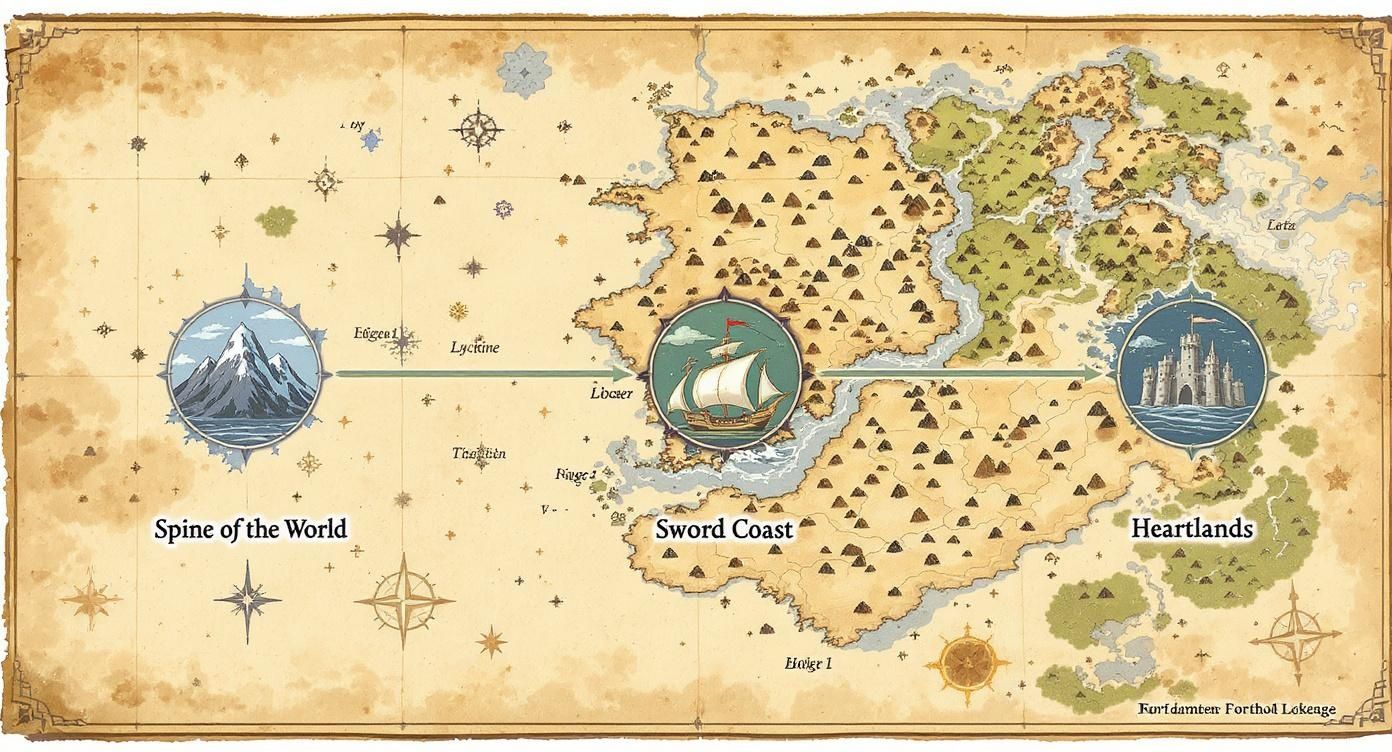
You can almost feel the journey, from the icy peaks of the Spine of the World down through the bustling Sword Coast and into the ancient Heartlands. It shows how these distinct environments weave together to form the tapestry of a grand campaign.
So, which should you use? Truly, it all comes down to the kind of story you wish to tell. An official map gives you a solid, lore-accurate foundation, which is perfect for hewing close to the canon. A fan-made map, on the other hand, can be the creative spark that ignites a truly unique, homebrewed adventure.
To make it a bit clearer, here is a quick look at how the two stack up.
A look at the characteristics, sources, and best uses for official and fan-created maps of Faerûn.
| Attribute | Official Maps | Fan-Made Maps |
|---|---|---|
| Source | Wizards of the Coast (sourcebooks, adventure modules) | Community artists, DMs, fans (Patreon, Reddit, forums) |
| Accuracy | Canonically accurate, lore-compliant | Varies; often creative interpretations or expansions |
| Detail Level | Often broad; focused on key locations for an adventure | Can be incredibly detailed, down to individual buildings |
| Art Style | Consistent with the current D&D branding | Hugely varied; from photorealistic to hand-drawn sketches |
| Best For | Campaigns sticking close to official lore, new DMs | Homebrew campaigns, filling in gaps, unique visual styles |
| Availability | Included with purchased products, some digital releases | Widely available online, often for free or via artist support |
Ultimately, there is no "better" option, only the right tool for the right quest.
Many of the best DMs I know use a hybrid approach. They will use the official world map to keep the big picture straight, but then pull in a beautifully rendered fan map for a specific city or a custom-made dungeon layout for a particular encounter. It is the best of both worlds—you get the rock-solid foundation of the official lore combined with the artistic freedom and creativity of the community.
This very idea of blending established rules with fresh, dynamic elements is what gets us excited about game design. It is the same spirit that drove us to create worlds like TerraClash, where the realm itself can be reshaped by the will of the players.
When you think of a map for the Forgotten Realms, you are not really thinking of a single piece of parchment. It is more like a collection of nested scrolls, each one revealing a more detailed, focused piece of the world. Understanding how to move between these different scales is the real secret to bringing your adventures to life. It is about shifting your perspective from a god's-eye view of the entire planet down to the dusty, claustrophobic corridors of a long-lost tomb.
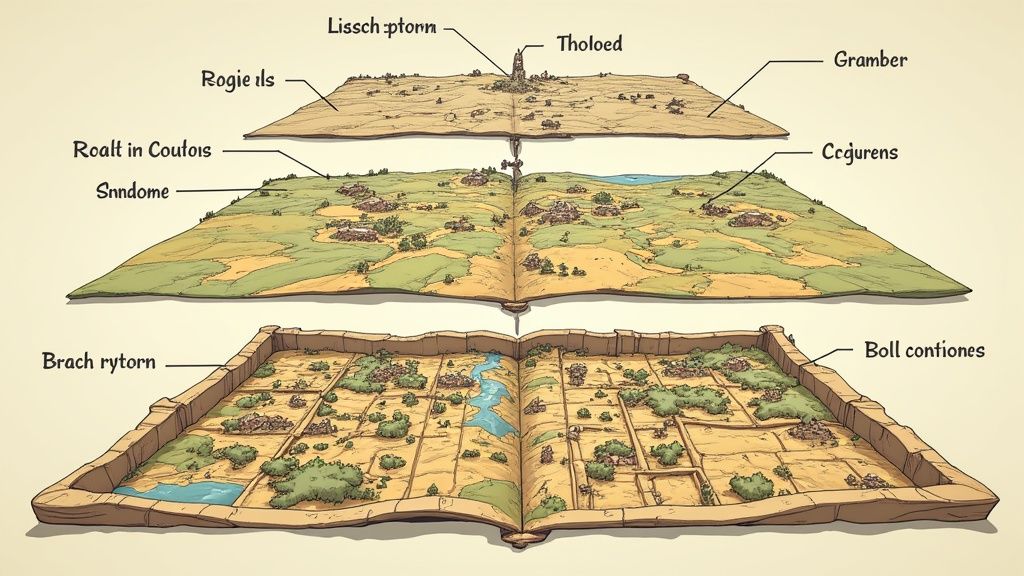
This idea of layered perspectives is what makes a world feel both impossibly vast and intimately real. It is a foundational bit of magic you will see in any great tabletop campaign.
Your grandest adventures always begin with the widest possible lens. The world map is where epics are born. It is the canvas you use to plot a long, perilous sea journey from the shores of Calimshan to the Moonshae Isles, or to track the relentless advance of an orc horde sweeping in from the Endless Wastes. This is the map that whispers of boundless possibility.
But then you zoom in, and the regional map gives that world its flesh and bone. On this scale, the High Forest is not just a patch of green; it is a living, breathing domain with its own internal politics, ancient dangers, and hidden secrets. You start to see the contested borders between warring city-states, the vital trade routes that are their lifeblood, and the untamed wilderness that lies between them all. This is where your campaign truly finds its footing.
It is worth remembering that these maps are built for storytelling, not for pinpoint geographical accuracy. You will not find precise population data like you would for a real-world country, because that is not their purpose. They are tools to fire up the imagination, and the classic Forgotten Realms Atlas is probably the best deep dive into this philosophy you can find.
As the focus of your quest tightens, so does the map. A sprawling urban adventure in a place like Baldur's Gate or Waterdeep absolutely needs a good city map. This becomes your foundation for everything from high-society intrigue to desperate rooftop chases through the grimy dock wards. A city map answers the crucial questions: Who holds power here? Where can we find a fence for stolen goods? And which alleyways should we avoid after dark?
And finally, we arrive at the most immediate and dangerous scale of them all: the dungeon map. This could be anything from an ancient crypt to a wizard's chaotic tower, but its purpose is always the same—it is the grid for tactical combat, clever traps, and mind-bending puzzles. Down here, every ten-foot square matters. Every corner could hide an ambush, and every chamber presents a new life-or-death challenge.
It is in these tight spaces that heroes are truly forged. The ability to read a tactical map and react is a core skill that stretches beyond just D&D; it is crucial in card and board games where the play area itself becomes a battlefield to command.
A map of the Forgotten Realms is really just a promise. On its own, it is an inert collection of lines and names on a page, waiting for a storyteller—a Dungeon Master—to breathe some life into it. This is where the real magic happens, when you transform a static image into a breathing, evolving world that reacts to your players' every move.
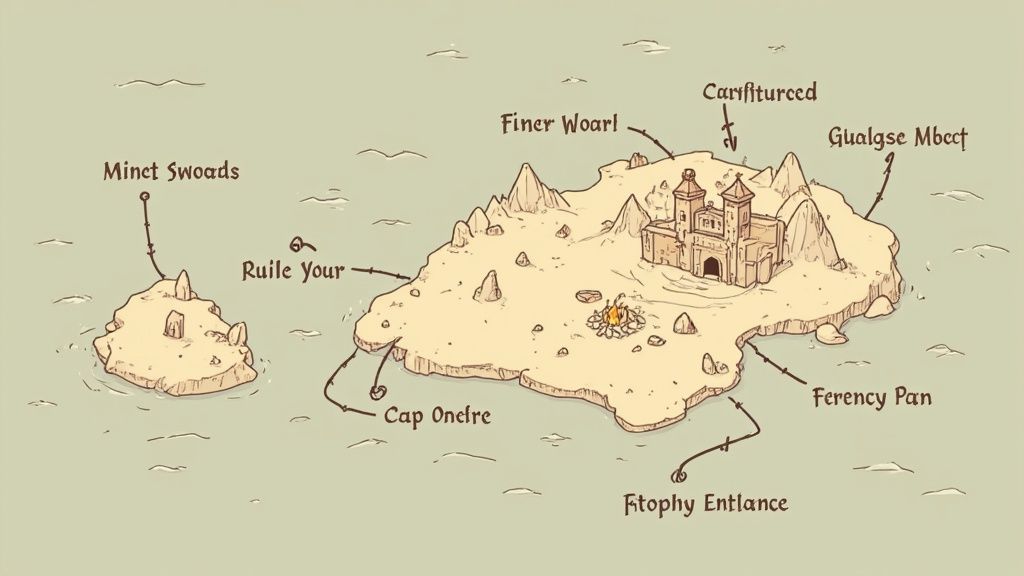
This is your canvas, so do not be afraid to take a well-known map and make it your own. Let your story spill ink across the parchment, forever altering its geography. Did a cataclysmic spell sink the coastline near Baldur’s Gate? Grab a pen and draw the new, jagged shoreline. Has a secret druid circle raised a hidden grove in the High Forest? Place a subtle, new symbol there for your players to find.
A truly masterful map does more than just show places; it foreshadows future events and rewards the players who are paying attention. Your customisations are the hooks that will snag your party’s curiosity and pull them deeper into the story. Think about trying these techniques:
Little additions like these turn the map from a simple guide into an interactive part of the game itself—a puzzle waiting to be solved. To make sure your custom maps are not just beautiful but also clear and easy to read, it is worth brushing up on some data visualization best practices.
This idea of strategic geography goes far beyond the realms of D&D. In a board game like Root, for example, controlling key clearings on the map is the very heart of the conflict. The board itself dictates the flow of power and strategy.
A map becomes a living document when it reflects the consequences of the players' actions. A town they saved might get a golden star next to its name; a forest they angered might become a place of dark, thorny overgrowth.
You see a similar principle in deckbuilding games, where managing your personal play area—your 'board'—is just as crucial as navigating a physical map. This idea of a dynamic, player-influenced map is a core pillar of what we are building with TerraClash. Every move can alter the landscape, making the map an active participant in the unfolding drama. For anyone wanting to truly master the art of storytelling and world-building, our comprehensive Dungeon Master guide offers a much deeper dive into these techniques.
Even a timeless, well-loved map of the Forgotten Realms can be given a new lease on life with a bit of modern magic. If you are a storyteller itching to put your own stamp on Faerûn, there is a whole treasure chest of digital cartography tools out there just waiting for you. Think of them as a modern scribe's spellbook, giving you the power to not just look at the world, but to actively reshape it.
With these tools, you can redraw a coastline to show the aftermath of a magical cataclysm, thrust a long-forgotten mountain range up from the plains, or meticulously plot out a brand-new city bristling with political intrigue. It is a chance to build a version of the Realms that is uniquely yours.
This kind of world-building is an invaluable skill for any creator, whether you are planning a sprawling TTRPG campaign or designing a tactical board game where the very landscape can shift with the turn of a card.
A new generation of software has completely changed the game, giving us world-building power we could only dream of a decade ago. These programs run the gamut from simple editors—perfect for adding a quick label to an existing map—to incredibly powerful platforms that let you create entire continents from scratch, complete with custom weather patterns and sprawling political borders.
Take a look at the creative hub of a popular tool like Inkarnate, where fantasy worlds are born.
You can see the incredible potential right there on the screen. Blending terrain, placing cities, and painting forests becomes an intuitive, almost artistic process. It proves that you need not be a professional artist to create a stunning, professional-quality map anymore; it is an accessible craft for any dedicated storyteller.
What is truly great is that many of these tools come with features designed specifically for tabletop gaming, making it a breeze to go from creation to gameplay. Imagine what you could do:
When you get comfortable with these digital instruments, you stop being just a map-reader and become a world-forger. The version of Faerûn you have in your head no longer has to stay there—you can bring it to life for everyone at the table to see and explore.
For those moments when you wish to zoom in on smaller, more intimate locations, learning some techniques for creating rendered site plans can add an unbelievable amount of detail and realism. This kind of focus can turn a simple village square or a ruined temple into a truly memorable, immersive location.
Ultimately, the goal is to create a map that does not just guide your players, but tells a story all by itself.
Faerûn is massive, a world brimming with untold millions of souls, but it is just one world in a whole cosmos of creative settings. Any Dungeon Master worth their salt knows that the best way to breathe life into your own campaigns is to peek over the fence and see what other creators are doing. Real inspiration often strikes when you explore worlds far beyond the Sword Coast.
Let your mind wander to the iconic, rolling hills of Middle-earth, brought to life in the co-operative board game Journeys in Middle-earth. Every single hex on that board is steeped in the lore Tolkien imagined. Or you could plunge into the tactical, monster-filled dungeons of Terrinoth in a classic crawler like Descent. Each of these games is a masterclass in how a map can drive not just the story, but the very mechanics of play.
The real creative fire, though? You will find it burning brightest in the indie scene, especially on platforms like Kickstarter. New worlds are being dreamed up constantly, each with a completely unique vision and its own gorgeous, bespoke cartography. Diving into these up-and-coming titles feels like discovering uncharted territory; you find fresh ideas, novel themes, and a raw, infectious passion for world-building.
Exploring another game's world is like learning a new dialect of storytelling. It gives you a fresh vocabulary for your own adventures, letting you describe familiar challenges in thrilling, unexpected ways.
This constant churn of new ideas is what keeps the hobby exciting. It is a powerful reminder that every great journey, whether it is a sprawling TTRPG campaign or a tight, strategic card game, begins with that first step onto a well-drawn map. It is exactly that spirit we have tried to capture with projects like TerraClash, where the goal is not just to explore a world, but to give players the power to help shape it, map in hand.
As we conclude our journey through the maps of Faerûn, a few common questions always seem to arise from the mists. Let us tackle some of the most frequent queries from DMs and players looking to get their hands on the best maps out there.
For official missives, your first stop should always be the digital sourcebooks on platforms like D&D Beyond or the map packs created specifically for virtual tabletops. They are crisp, clean, and straight from the source.
But if you seek something with a bit more unique flair, the fan community is where the real treasure lies. Subreddits like r/dndmaps are bustling with incredible artists sharing their work. You will also find endless inspiration on Pinterest and, for the absolute top-tier stuff, by supporting creators directly on Patreon. Many artists there offer entire libraries of high-resolution maps for a small monthly pledge.
Ah, the million-gold-piece question! The accuracy can be all over the place, but that is not necessarily a bad thing.
Many fan cartographers are absolute die-hards for lore, meticulously crafting maps that align perfectly with established canon. Others, however, use their creative freedom to flesh out uncharted territories or design a location to perfectly fit their homebrew adventure. If sticking strictly to the official lore is crucial for your campaign, it is always wise to double-check details against a reliable source like the Forgotten Realms Wiki.
At the end of the day, a map is just a tool. Its true value isn't in its perfect accuracy, but in how it helps you tell a great story, inspire epic exploration, or set the stage for a nail-biting combat encounter.
The goal is to make your world feel alive and to make your players feel like their choices matter within it.
This same passion for dynamic, meaningful world-building is exactly what drives us at TerraClash. If a game where the map is a living, breathing part of the adventure sounds exciting, you will want to keep an eye on our Kickstarter campaign, launching soon.
Find out more by visiting us at https://terraclash.co.uk.

