Hark, adventurer, and listen close. A realm of myth, steel, and sorcery calls to you. If you have ever dreamt of facing down dragons, unearthing forgotten lore, or becoming a hero of legend, this scroll is the first step upon your fated path. Dungeons & Dragons is more than a mere game; it is a saga you and your comrades weave together, where the boundless power of your imagination is your most potent weapon.
Let us pull back the mystic veil and reveal the workings of this world. We begin with the two sacred roles that breathe life into every D&D chronicle: the Player, who dons the mantle of a hero, and the Dungeon Master (or DM), the loremaster who shapes the world and summons its wonders and perils.
You and your fellow players shall spin a tale of danger and glory together. It is this shared storytelling, this collaborative fantasy, that gives tabletop games their unique magic. You can feel this same arcane energy in all manner of games, from sprawling roleplaying campaigns to strategic deckbuilders like TerraClash, where every choice you make forges a new path to victory.
Take heart, for you do not walk this path alone. Since its first incantation back in 1974, Dungeons & Dragons has summoned millions to its banner. The game has seen a grand resurgence of late, especially across the UK, with fresh-faced heroes joining the quest each day. It is all part of a great awakening in tabletop gaming, aided by digital scrying tools and vibrant communities that make finding a fellowship easier than ever.
Today's adventuring parties are more diverse than ever before. Across the realms, about 39% of players are female. And this call to adventure knows no age; 40% are under 25, proving the game’s appeal grows with each new generation. You may read more of the game's incredible history and its players in the great library of Wikipedia.
I have conjured this guide to prepare any Dungeons and Dragons beginner for the trials ahead. We shall walk through the ritual of creating your first champion, grasp the fundamental laws of the world, and see how a single session can blossom into a saga for the ages.
At its heart, Dungeons & Dragons is a conversation. The Dungeon Master describes the world and its inhabitants. The other players say what they want their characters to do. The DM, in turn, tells the players whether their characters succeed or fail and what happens as a result.
A fine way to prepare your mind is to immerse yourself in tales of unforgettable quests and grand adventures. Reading such sagas can spark the inspiration needed to dream up a hero worthy of song.
Every legend must begin somewhere. If you wonder what artefacts you must gather to set forth, you can learn of the essentials in a Dungeons and Dragons Starter Set. Now, let us proceed. Your destiny awaits.
So, how does this grand tapestry unfold? How do you move from telling a story to truly playing a game? Every swing of a sword, every whispered incantation, every desperate leap across a chasm comes down to a few core principles. Understanding these is your first step into the world of D&D, and it all begins with the fateful clatter of dice upon the table.
At the very centre of the game is the iconic 20-sided die, the mighty d20. This arcane artifact is your connection to fate itself. Whenever you attempt an action where the outcome is uncertain, the Dungeon Master (DM) will call for a check. Can you persuade the queen to lend you her army? Can you decipher the ancient runes on the tomb door? Roll the d20. A high roll signals glorious success. A low roll... well, that is where the tale takes an interesting turn.
This simple ritual—rolling a die to determine what happens—is the engine of countless tabletop adventures. It is that moment of pure chance and suspense you will find across the gaming world, from the epic scope of D&D to the thrilling tension of card games like TerraClash, where a single draw can alter the course of battle.
Before you can challenge fate, you must first know who it is that acts. What are your character's innate strengths and weaknesses? Here, we consult the six Ability Scores. Think of them as the fundamental essence of your hero—the raw material that defines their potential.
These scores offer a glimpse into your character’s natural talents. Every hero, from the mightiest barbarian to the wisest wizard, is defined by these six numbers.
Here is a brief grimoire of what each ability score represents and the skills it governs.
| Ability Score | What It Measures | Common Skills |
|---|---|---|
| Strength (STR) | Brute force, athleticism, and physical power. | Athletics (climbing, jumping), lifting heavy things. |
| Dexterity (DEX) | Agility, reflexes, balance, and finesse. | Acrobatics, Sleight of Hand (pickpocketing), Stealth. |
| Constitution (CON) | Health, stamina, and resilience. | Determines your hit points and ability to resist poison. |
| Intelligence (INT) | Logic, memory, and analytical reasoning. | Arcana (magic knowledge), History, Investigation. |
| Wisdom (WIS) | Awareness, intuition, perception, and willpower. | Insight (reading people), Perception (noticing details), Survival. |
| Charisma (CHA) | Force of personality, confidence, and social influence. | Deception, Intimidation, Persuasion, Performance. |
Each score will be a number, typically between 3 and 20 at the start of your journey. But it is not the number itself you will use most often. Instead, that score grants you an ability modifier—a small bonus (like +2 or +3) or penalty (-1) that you will add to many of your d20 rolls. It is an elegant rite that ensures your character’s natural gifts directly influence their chance of success.
So, we have our hero's ability scores and a gleaming d20. How do they work in concert? The most common ritual you will perform is a Skill Check. This is when you declare your character's intent, and the DM must consult the fates to see if you succeed.
The entire process is a simple, three-step invocation:
Let us scry an example: Imagine your rogue wishes to sneak past a slumbering dragon. The DM deems this a difficult feat, setting the DC at 15.
You roll your d20 and get a 12. A promising start! Your rogue is incredibly nimble, with a high Dexterity that grants them a +5 modifier to Stealth checks. You add this to your roll.
12 (roll) + 5 (modifier) = 17.
Your total of 17 easily bests the DC of 15. Success! The DM describes how you tiptoe past the snoring beast, your footfalls lighter than a falling leaf.
This fundamental loop—roll, add, compare—is what keeps the saga moving. It is a simple system that allows for an infinite variety of thrilling, tense, and often hilarious outcomes. Once you master this, you have unlocked the core of D&D and are prepared for any challenge the adventure may cast your way.
Hark! This is where the true magic begins. It is time to breathe life into the hero you are destined to become. Creating a character is not merely filling out a scroll; it is the moment you weave a piece of your own spirit into the fabric of the world, forging a persona ready to face down hydras and uncover ancient secrets.
This process—transforming a simple concept into a character sheet—is a sacred rite in the tabletop realm. It is a joy you will find in many games, even in strategic deckbuilders like TerraClash, where the cards you choose become your identity upon the field of battle.
First, you must choose your character's Race, or lineage. Are you a stoic, steadfast Dwarf from the heart of a mountain? Or perhaps a graceful Elf, possessed of ancient wisdom and a deep connection to the wild? You could even be a versatile Human, filled with ambition and ready to adapt to any fate.
With your ancestry decided, you must choose your Class. Consider this your hero’s vocation or calling. It dictates how you will solve conflicts, vanquish monsters, and interact with the world. This choice is monumental and will define your entire adventure.
A few classic archetypes to spark your imagination:
These are but a few of the paths you might walk. Each class brings a unique power to the fellowship, defining your role in the party, much as choosing a specific commander or faction in a card game dictates your entire strategy.
Now that you have the core concept, it is time for the finer details: your Ability Scores. You shall be granted a pool of points to assign to six attributes: Strength, Dexterity, Constitution, Intelligence, Wisdom, and Charisma. These numbers define your character's raw potential. Are they a titan of pure Strength, or a silver-tongued orator with legendary Charisma? The choice is yours.
Once your abilities are set, you will gather your starting gear—your first blade, a weathered spellbook, or a set of trusty lockpicks. These are the tools that will see you through your first trials. We have crafted a detailed walkthrough to guide you through these steps, so be sure to consult our complete scroll on how to make a Dungeons and Dragons character.
Interestingly, the way we forge heroes in the UK today has been shaped by D&D's long and storied past. The release of the Monster Manual way back in 1977 was a pivotal moment, unleashing over 350 fantastical creatures upon the world. This tome captured the imagination of a UK audience already steeped in fantasy lore and truly solidified the game's identity. The rules have since been refined, making it a wondrous entry point for new players. For a deeper delve, you can explore the origins of the game's iconic bestiary.
Last, but certainly not least, is your hero's chronicle. From whence did they come? What fire drives them onward? A good backstory is what transforms a page of numbers into a living, breathing soul. This is your moment to be a storyteller.
Your character’s backstory is not merely a history lesson; it is the wellspring of their motivation. It shapes their fears, their ambitions, and how they bond with others. Often, a simple, strong concept is the most powerful.
As you flesh out your hero's past, considering the fundamentals of how to craft engaging fantasy narratives can give you a richer character with more believable ambitions. A well-realised backstory also gives your Dungeon Master incredible material to weave into the campaign, making the story feel truly yours.
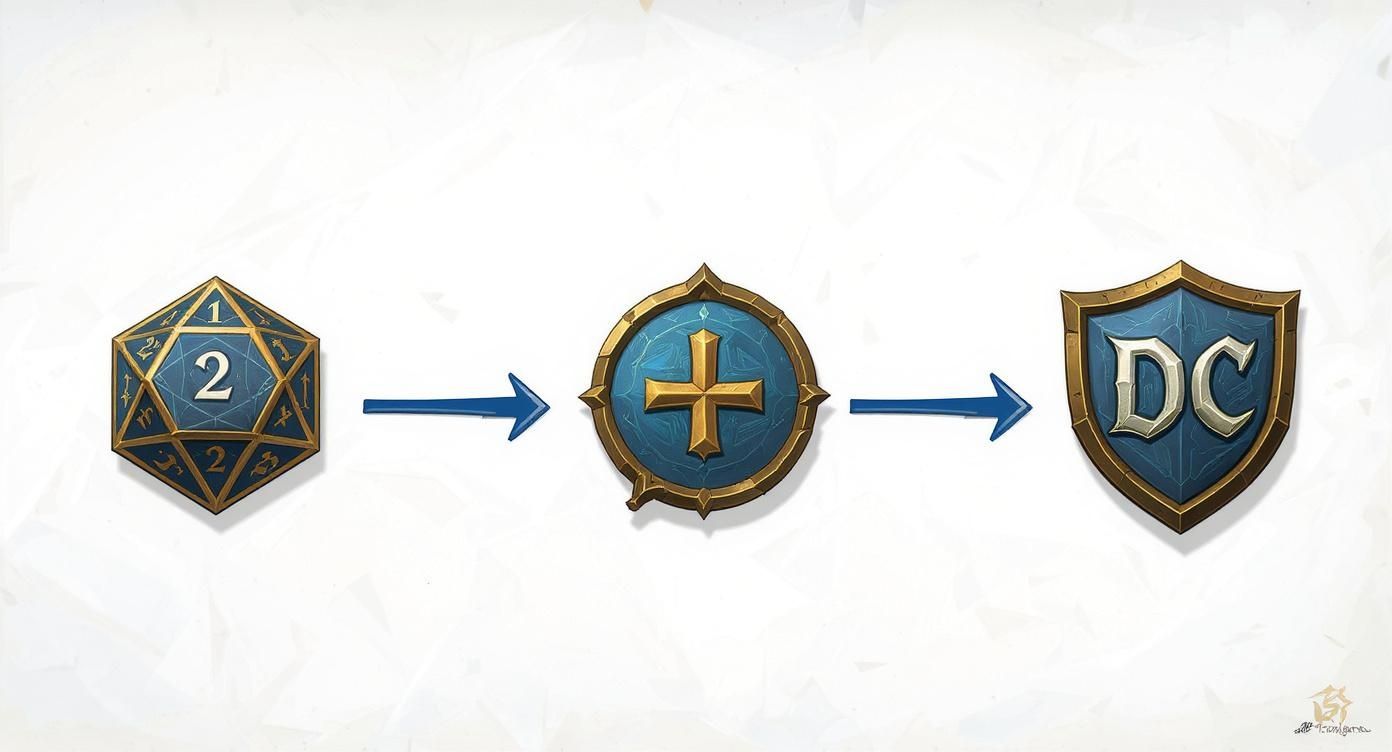
This simple three-step flow—roll the d20, add your hero's unique bonuses, and see if you overcome the challenge—is the engine behind every dramatic moment in the game.
By the end of this sacred process, you will hold a finished character sheet. It is more than mere parchment; it is a passport to adventure and a testament to your own creativity. Your hero is ready to step forth and begin their legend.
So, you have brought your gleaming new hero into the world. What truly happens when you gather at the table? A game of Dungeons & Dragons is a living saga, typically woven from three core threads: exploration, social interaction, and combat. Let us part the mists and see what a night of adventure truly feels like.
Imagine the Dungeon Master (DM) leans forward, their voice a conspiratorial whisper. "You stand at the edge of the Whisperwood, an ancient forest whose trees are said to remember the birth of the world. A gnarled path, slick with moss, vanishes into the gloom. What do you do?" That is it. That is the heart of exploration. It is the thrill of discovery, the tension of stepping into the unknown, and the pure freedom to follow where your courage leads.
Of course, you will not simply wander through empty forests and dusty crypts. The world is filled with souls to meet—a grumpy dwarven blacksmith with a heart of gold, a mischievous pixie queen who speaks only in riddles, a cryptic oracle guarding a forgotten bridge. This is where social interaction comes to life. How you navigate these encounters can uncover vital clues, forge powerful alliances, or even create dangerous new foes.
This is the very essence of roleplaying: thinking, speaking, and acting as your character would. Do you attempt to charm the city guard with a silver-tongued plea? Or perhaps intimidate them with a display of raw strength? Your approach matters, and every conversation is a new opportunity to shape the chronicle.
A D&D session is truly a dynamic conversation. The DM sets a scene, and the players decide how to react. There are no right or wrong answers, only choices and their fascinating consequences. Your decisions are the ink with which the epic is written.
This kind of collaborative storytelling is the same magic found in other brilliant tabletop games. A well-placed bluff in a card game or a strategic alliance in a board game like Gloomhaven shares that spirit. Even in a competitive deckbuilder such as TerraClash, negotiating with other players can be as crucial as the cards in your hand.
Sooner or later, words will fail, and the time will come to draw your weapons. Combat in D&D is more than just rolling dice; it is a tactical puzzle that rewards teamwork and clever strategy. The entire conflict is organized into rounds to keep the action flowing like a well-choreographed dance of death.
Here is the breakdown of a typical battle:
This structure keeps combat thrilling without being overwhelming, making it easy for a dungeons and dragons beginner to follow the fray. Every round is a chance to be a hero, working with your friends to overcome impossible odds and create a story you’ll recount for years to come.
No legend is forged in isolation. Every great hero needs a fellowship, a loyal party to guard their back when the dragons descend and the dungeons deepen. But where does one find such companions? Where is the Dungeon Master waiting to spin your tale of destiny?
Fear not, for finding a group is not as daunting a quest as it sounds. Consider this your enchanted compass.
Your first port of call on the quest for a D&D group is often right in your own community. This is where alliances are forged over the clatter of dice and a shared love for adventure.
In truth, finding the right people is the most crucial part of any tabletop adventure. This holds true for a grand D&D campaign just as it does for gathering friends to try a thrilling new indie board game.
In this age of wonders, your quests need not be confined to your local shire. The magic of the internet has opened portals to countless adventuring parties, welcoming heroes from every corner of the globe.
These digital tools have completely changed how people, especially a dungeons and dragons beginner, can enter the game. In the UK, the boom in online campaigns has seen a massive surge in D&D's popularity, making it easier than ever for new players to find a welcoming group and learn the ropes in a friendly setting. You get the best of both worlds: virtual tabletops and a real social connection that keeps the spirit of the game alive. You can discover more about the modern evolution of D&D.
Powerful online platforms act like bustling digital taverns where new parties form every single day:
Once you have found a potential group, there is one final step: ensuring it is the right fellowship for you. A fantastic first experience is built upon a foundation of fun, comfort, and mutual support.
Before you commit your hero to a quest, have a parley with the Dungeon Master. This first meeting, often called a "Session Zero," is your chance to get a feel for the game's tone, the DM's style, and what's expected of the players. It’s all about making sure everyone is on the same page before the first die is even rolled.
When you speak to a potential DM or party, ask about their style of play. Do they favour epic combat, deep role-playing, or a more light-hearted, humorous adventure? Finding a group whose style aligns with your own is the true secret to unlocking an unforgettable gaming experience. This wisdom holds true for other great cooperative games, too, whether it's the tactical challenges of Frosthaven or the clever teamwork needed in a new deckbuilder like TerraClash.
Listen close, new adventurers. I have witnessed countless heroes take their first fateful steps, and I have gathered some wisdom along the way. Think of these as your guiding stars—they will help you evade common pitfalls and ensure your first Dungeons & Dragons game is a tale for the ages.
Your party is your greatest treasure. Truly. A lone wolf may seem formidable, but a team that works in concert? That is a force of nature. Always work with your fellow players. Share clues, guard each other’s backs in a fight, and celebrate your victories as one. This is not just a D&D tenet; it is the heart of what makes any great tabletop game sing.
Allow me to share a secret: not every roll of the dice will be a glorious 20. You will fail checks. Spells will fizzle. Your brilliant, foolproof plan will sometimes erupt in the most spectacular flames of failure. Do not be discouraged. This is not failure; it is the story twisting in a new and exciting direction.
The most memorable and amusing moments often spring from things going wonderfully awry. A failed attempt to charm a guard might spark a city-wide chase, and accidentally triggering a trap could reveal a hidden passage. Learn to embrace the chaos—it is where the real magic happens.
It is easy to see the Dungeon Master as your adversary, but they are not. They are your narrator, your guide, and secretly, your greatest champion. Open communication is the key. If you are confused by a rule, lost in the narrative, or have a brilliant idea for your hero, simply speak with them.
Their sacred duty is to ensure everyone at the table is having an incredible time. A strong bond with your DM makes the entire game better for all, trust me on this.
"A simple character concept is often the most powerful. You don't need a ten-page backstory to have fun. 'A stoic dwarf who loves gold and hates goblins' is a perfect starting point that gives you plenty to work with."
You will be bombarded with names, places, and cryptic prophecies. You will not remember it all. That is where your secret weapon comes in: a humble notebook and quill. Scribbling down key details can be the difference between solving the ancient riddle and being devoured by the dungeon's wandering horror.
Good notes will help you connect the threads of the story and might just save your party’s skin. If you seek other fine tools, you can discover more about handy D&D accessories that can truly elevate your game. These principles of teamwork and preparation will serve you well in any tabletop quest, be it your first D&D session or a nail-biting match in a game like TerraClash.
If you feel a little overwhelmed, do not fret—you are in good company. Every seasoned adventurer began with the same questions echoing in their mind. Let us shed some light on the most common queries whispered around the tavern fire.
Not in the slightest. While some players delight in adopting dramatic voices and theatrical flair, it is by no means a requirement. D&D is for everyone.
You can just as easily play by describing your character's actions, saying something like, "My rogue, Elara, will attempt to sneak past the guards." The only true 'rule' is to make choices for your character and have a grand time doing so.
Most fellowships find that a session of about three to four hours is the perfect length. That is usually enough time to journey through a decent portion of the story, be it clearing a dungeon level or winning a great battle, without feeling rushed.
Of course, this is entirely up to your group. Some prefer swift two-hour skirmishes, while others settle in for an all-day epic. You will discover what rhythm works best for your party together.
It may sound like a catastrophe, but a hero's fall is part of the game. In truth, it often leads to some of the most memorable moments in a campaign.
Depending on the DM and the power of your party, there may be ways to summon your hero back from the great beyond with potent magic. But if not? You get a fresh start! It is a fantastic chance to forge a brand-new character and dive back into the adventure from a new perspective.
There is a slight learning curve, to be sure, but the fundamental idea is incredibly simple. You need not be a Dungeons & Dragons beginner for long to grasp its essence.
The core of the game is this: you say what you wish to do, the DM tells you which dice to roll, and the dice reveal what happens next. You will learn the rest as you go, and veteran players are almost always eager to help a newcomer find their footing on the path.
The goal is not to memorize the rulebook overnight. Just remember that D&D is about telling a story together and finding clever ways out of perilous situations. Your DM and the other players are there to help you learn.
This spirit of shared adventure and clever thinking is what makes tabletop games so special. It matters not if you are holding the line against a dragon in D&D or piecing together the perfect hand in a deckbuilding game; the true fun lies in making smart choices and witnessing the outcome.
That thrill of unearthing forgotten lore, facing down terrifying monsters, and becoming a legend is what tabletop gaming is all about. If you love dreaming up new strategies and diving into fantasy worlds, you might want to keep an eye out for TerraClash. It's a new deckbuilding adventure for ages 12+, designed for endless replayability and tactical thinking. You can follow its journey over at https://terraclash.co.uk.

