Gather 'round, brave creators, and listen close. You stand before the great digital forge of D&D Beyond, a blank page shimmering before you like an unopened portal. It is a place of infinite possibility, where the echoes of your imagination can be given form and function. But where, you ask, does one begin such a grand quest?
Fear not, for this guide shall be your scrying pool. We will part the mists enshrouding the homebrew creator's tools, showing you how to shape everything from a humble enchanted dagger to a sprawling, mythic ancestry for your mightiest heroes.

Consider this your apprenticeship in the arcane arts of world-crafting. We shall delve deeper than the mere mechanics of the forge. We will explore the why—helping you conjure content that not only functions within the ancient laws of the game but genuinely deepens the saga you weave. This is about breathing your unique soul into a campaign, making it truly legendary.
It is this very spirit of creation that fuels the fires of the tabletop realm. It is the same passion that gives rise to brilliant indie games and daring Kickstarter campaigns. Whether you are dreaming up a single magic item for the next moon's session or architecting an entire universe for a new card game like TerraClash, it all begins with a single spark of an idea and the right arcane tools.
Every fabled artifact and every fearsome beast in your realm begins as a whisper in the mind. D&D Beyond is merely the anvil upon which you will hammer that whisper into reality. Before you lose yourself in menus and modifiers, pause and ask these questions to guide your hand:
Forging new content is an art. It is your chance to carve your own rune upon the sagas you and your companions tell. This is the ultimate expression of a Dungeon Master's power, allowing you to tailor the grand adventure to perfectly suit your players and your world.
The principles of good design are a universal magic. The careful thought that goes into balancing a homebrew monstrosity is the same art required to design a compelling card for a new deckbuilding game. The ritual is always the same: summon, test, refine, and balance. This skill is a bond shared across the entire spectrum of tabletop gaming, from grand map-sprawling epics to intimate, two-player card duels.
For those Loremasters wishing to innovate beyond classic fantasy, seek out scrolls on crafting an epic D&D Sci-Fi campaign for inspiration on blending genres. These skills are more versatile than you might imagine, and they will grant you a deeper understanding of the secret mechanics that make games truly sing.
If you wish to truly master the arts of world-building and narrative design, exploring a comprehensive Dungeon Master guide can offer priceless wisdom for any aspiring creator.
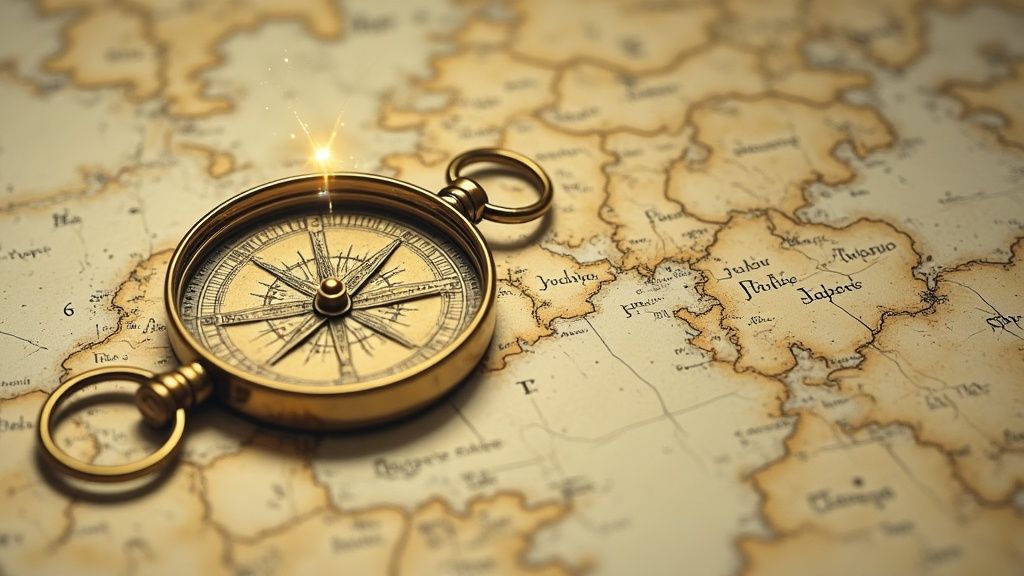
Come, let us approach the forge. Every great journey into the art of dnd beyond homebrew begins with a single step, and ours begins not with a world-shattering spell, but with a simple, wondrous magic item. One must learn the fundamentals of enchantment before attempting to rewrite the cosmos.
We shall bypass the common +1 swords for now. Instead, we will craft an artifact with a story, an item that whispers tales of adventure. Let us forge the Compass of Forgotten Paths, a wondrous device designed to conjure plot hooks, not merely end conflicts.
This is no mere lecture. By walking through this creation rite, you will learn the secret runes of the D&D Beyond editor. Think of it as learning the core rules of a game; once the foundation is understood, you can build any marvel you can imagine.
First, you must journey to the 'Create Magic Item' sanctum. You will face a choice: conjure a new item from raw ether or use an existing artifact as a template. For our Compass of Forgotten Paths, we shall create from scratch. This grants us a pure, untouched canvas for our art.
A form will appear, a skeleton awaiting flesh and soul.
These initial details hold more weight than they appear. This is how D&D Beyond deciphers your creation, allowing it to manifest correctly on a character's scroll.
Now for the true enchantment: breathing life into our compass. The description scrolls are where you weave its legend. The main description holds its mechanics, but do not neglect the flavour text. That small measure of lore is what makes an item feel real, a treasure with a past.
The true magic of homebrew is not found in balanced numbers alone; it is in the crafting of a compelling story. The history, appearance, and whispers surrounding an item are what ignite true desire in your players' hearts.
For our Compass, the mechanics will be subtle. We will add a modifier that grants a character Advantage on Wisdom (Survival) checks made to navigate the wilds. It is useful, but it will not shatter the balance of your world.
Then, in the description, we can inscribe something akin to: “While this brass compass is held, its needle points not to the magnetic north, but toward the most intriguing, undiscovered, or forgotten location within one mile.”
Instantly, this simple item becomes a potent tool in your DM's arsenal. It is a quest-giver that sits in your player's own pouch, ready to guide them when the path grows dim.
Finally, we must decide on attunement. Requiring a hero to attune to an item is a powerful way to control its magic, as one can only be bound to three such items at once. For our Compass, attunement feels correct; it forges a bond between the wielder and the item's strange enchantment. It is all a matter of balance, much like perfecting the ingredients of a potion. For more insight into how official items are designed, studying the humble D&D healing potion can be surprisingly illuminating.
Once you have inscribed all of this, strike 'save'. And just so, you have forged your first masterpiece of dnd beyond homebrew. You have created a key that can unlock innumerable new adventures at your table.
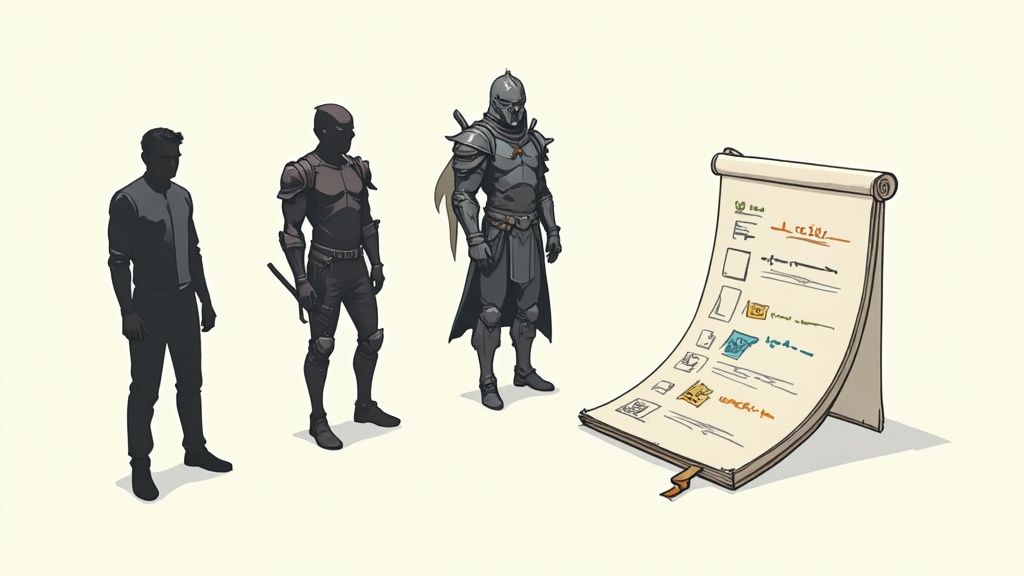
You have mastered the art of imbuing items with magic. Excellent. But now it is time to shape the very soul of your world: the peoples who inhabit it. Creating your own races and subclasses is where you truly leave your mark upon the chronicle of your game, but it is an art that demands a careful hand and a clear vision.
This is the moment you transcend a pre-written tale and begin to weave a true saga. The goal is not to create something that shatters the laws of the game, but to offer players new, thrilling, and distinct paths to walk. This challenge is one all creators face, whether a DM sketching a new lineage or an indie developer designing factions for a game like TerraClash, where each side must possess its own unique feel and tactical identity.
Before you even consider ability scores, pause and ask yourself: what is the story here? Are these a stoic, mountain-carved people? Agile guardians of the ancient woods? Or something far stranger? This core concept is the bedrock upon which you will build every mechanical trait.
A race’s features should flow naturally from its lore. For instance, if you are creating a race of deep-earth dwellers, granting them darkvision or resistance to poison is only logical. A subclass devoted to shadow magic should possess abilities built around stealth, illusion, or trickery.
When flavour and mechanics dance in harmony like this, your creation feels authentic. It becomes more than a collection of stats; it is a living part of your world. Here in the UK, we see a constant river of fresh ideas flowing into the homebrew community. With global release dates for core rulebooks now aligned, UK creators can begin tinkering with new mechanics at once, which always heralds a boom in brilliant content. You can learn more about the D&D release schedules for the EMEA region and see how this influences the creative landscape.
One of the most common missteps I witness from new creators is cramming too much power into the early levels. A 1st-level hero who can fly at will or vanish into thin air can completely unravel a low-level adventure. Pacing the growth of power is paramount.
Subclasses demand particular care. Their defining features typically awaken at 3rd level, but their power must scale as the character grows. Do not grant them their ultimate ability as soon as they set foot on their path.
The golden rule of homebrew balance is simple: compare, compare, compare. Hold your creation against the official races and subclasses in the Player's Handbook. Does your 3rd-level feature feel vastly more potent than a Battle Master's manoeuvres or a Gloom Stalker's Umbral Sight? If so, it is time to return to the forge.
Playtesting is not merely a suggestion; it is essential. Gather your fellowship and run a one-shot adventure. Witness how your creation performs at the table. Does it cast a shadow over the other heroes? Is it weaker than you foresaw? This real-world feedback is the crucible in which you will temper your creation into its final, perfectly balanced form.
Now, let us meddle with the very Weave of magic itself. Conjuring your own spells for a dnd beyond homebrew collection is a true art. It is a delicate dance between raw power, clever utility, and the precise incantation of its wording. Think of your spellbook as a blank scroll; every spell you inscribe can genuinely alter the feel and flow of your campaign.
Every cantrip, every 9th-level world-altering magic, has a distinct anatomy. You must consider its casting time, range, components, duration, and, of course, its effect. Each of these is a dial you can turn to tune the spell's balance and flavour.
Often, a spell’s true power lies not in its damage, but in its creative potential. It is like those cards in deckbuilding games such as TerraClash that do not strike the heaviest blow but open up an entirely new strategy. One clever effect can completely reshape how your players confront a challenge.
Let us walk this path by designing a simple, flavourful utility cantrip. We shall call it Echoing Whispers.
The purpose is to grant players a tool for roleplaying and investigation. The description is where the true enchantment lies: “You create a faint, spectral echo of a sound that occurred in the last minute within range. The whisper is audible only to you and up to three creatures you choose, and it is a perfect recreation of a single sound, such as a spoken word, a closing door, or the snap of a twig.”
Suddenly, your players have a subtle means to replay a vital clue or pass a secret message right under a guard's nose. It is not flashy, but it brims with untold creative potential.
When you begin designing spells that unleash destructive force, the Player’s Handbook must be your sacred text. Measure your creation against official spells of the same level. If your new 1st-level spell makes Magic Missile or Guiding Bolt seem feeble, you have likely strayed too far.
The wording of your incantation is just as vital. I have seen games grind to a halt because of one ambiguously phrased spell. Be precise. Instead of saying "the target is frightened," state clearly: "the target must make a Wisdom saving throw. On a failed save, it is frightened of you for 1 minute." Crisp, clear language will save you a world of future turmoil. If you intend to create effects that require a saving throw, you must understand how a spell save DC in 5e is calculated.
Remember, your spells should feel distinct. Does the world truly need another fire-based damage cantrip? Perhaps a spell that manipulates shadows, communicates with beasts, or temporarily enchants an object would add more unique wonder to your game.
Finally, consider how your spell scales. What happens when it is cast using a higher-level spell slot? The classic approach for damage spells is to add an extra die for each level above its base. For utility magic, you might increase the duration, the number of targets, or the area of effect. This ensures your homebrew creations remain valuable as your heroes grow in power.
The work is done. You have forged something new from pure imagination, weaving custom lore, unique mechanics, and powerful magic into the fabric of your game. But a brilliant creation hidden away does no one any good. It is time to share it—first with your players, and then, if you feel bold, with the wider world of adventurers.
This is the very lifeblood of our hobby. Sharing transforms a private notion into a communal saga, enriching the game for all. It is the same spirit that fuels incredible indie game Kickstarters, building a community around a shared vision before a single component is forged.
Once you have put the finishing touches on your creation, D&D Beyond offers you a choice: who may gaze upon this work?
You can keep your creation entirely private, accessible only to you and the players in a specific campaign. This is perfect for a magic item tied to a character's destiny or a monster unique to your world. It keeps the public archives uncluttered and your campaign secrets safe.
The other path is to submit your work for public view. This means your creation goes before the D&D Beyond moderators for review. If it gains their favour, any adventurer on the platform can find and wield your masterpiece. This is how you connect with a global fellowship of creators, allowing your ideas to find life in games all over the world.
For any creator seeking to build a name for themselves, this is a worthy quest. If you are serious about sharing your work more broadly, it is also wise to explore different creator support platforms like Ko-fi or Patreon to see what might suit your grand design.
Take creating a new spell, for instance. There is a definite process to getting it right, from the first flicker of an idea to the final, polished incantation.
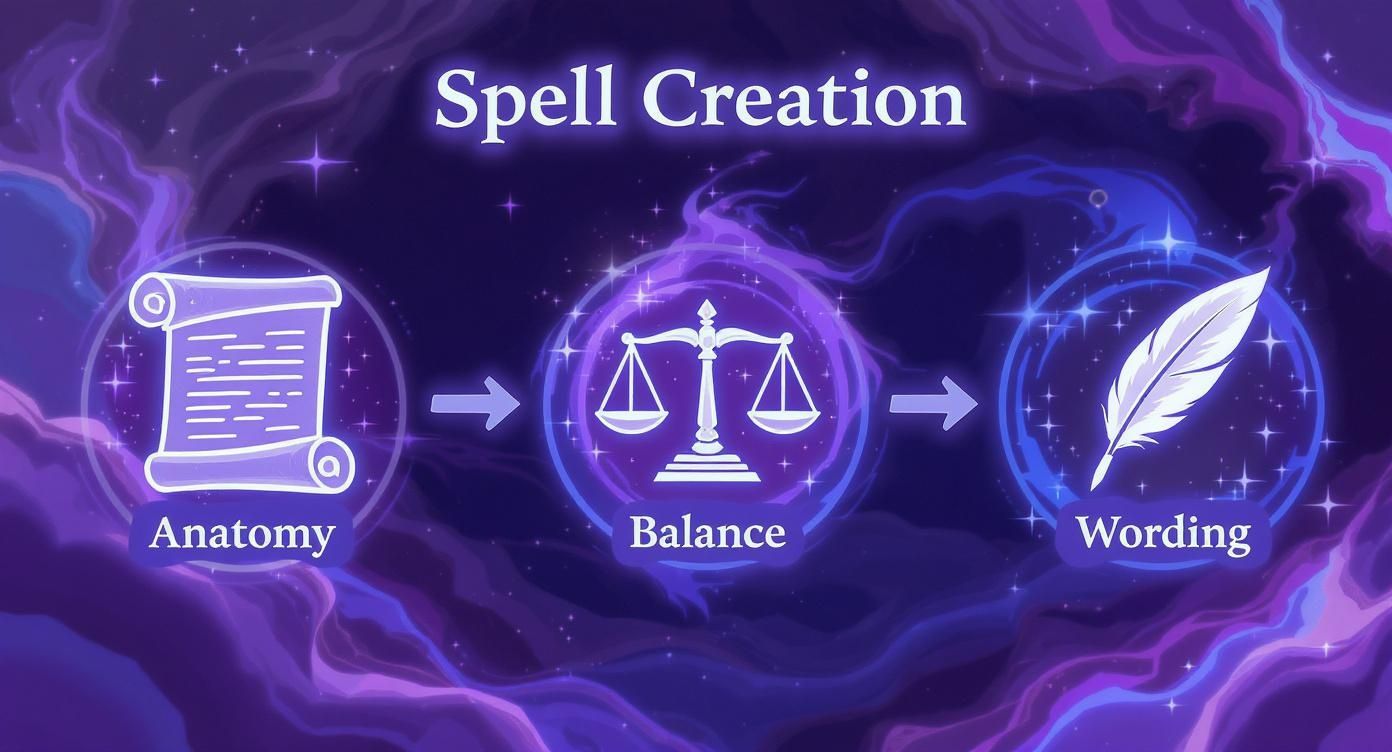
This process—mastering the anatomy, checking the balance, and perfecting the wording—is what separates a confusing, game-breaking spell from one that feels like a natural extension of the magic system. It is this rigour that earns approval and appreciation.
Deciding how to share your work is a significant step, so here is a simple breakdown of what each status means and who may see your creations.
| Status | Who Can View It | Who Can Add to Character | Ideal Use Case |
|---|---|---|---|
| Private | Only you. | Only you and players in your campaigns (if you enable sharing). | Tailoring content for a specific campaign; early drafts and personal notes. |
| Public | Anyone on D&D Beyond. | Anyone on D&D Beyond. | Polished, playtested content you wish to share with the entire community. |
Ultimately, whether you keep your homebrew secret or share it with the world depends on your goals as a creator and a Dungeon Master.
Having your homebrew approved for public use is not complex, but it requires care. The moderators are guardians of quality, and they seek a few key things:
The UK D&D scene is a fantastic example of the power of these sharing tools. An estimated 1.06 million people in the United Kingdom use D&D Beyond, comprising about 5.08% of the platform's global user base. That is a vast fellowship of Dungeon Masters and players empowered to create, experiment, and contribute their unique visions back into the global homebrew community.
Even the most seasoned loremasters encounter a puzzle when tinkering with homebrew. It is part of the creative quest. As you delve into building your own content, you are bound to face a few common riddles. Let us address some that I see emerge most often.
A frequent query is, "Can I alter my homebrew after it is published?" Indeed, you can. Think of your creations as living things. You can always return to fine-tune a spell, adjust a monster's might, or add more flavour. Just know that significant changes will require you to create a new version. Your players must then remove the old from their character sheets and add the new.
Then there is the matter of copyright. It is vital to remember that anything you offer to the public must be 100% your own original work. You cannot lift text, mechanics, or art from official tomes or other creators' works. The goal is to be inspired by the rich lore, not to simply copy it.
It is a uniquely vexing moment: you have perfected a wondrous magic item, but when your player tries to add it... it is gone. Nine times out of ten, the solution is simple.
First, have your players consult their character sheets. In the 'Preferences' tab, a toggle for 'Homebrew Content' must be switched on. It is an easy detail to overlook.
If that fails, and you hold a Master Tier subscription, ensure you have enabled content sharing for the campaign. This is the magic key that allows everyone in your game to see and use your private homebrew, without needing to publish it for all the world to see.
The passion for creating custom content is a global phenomenon, and the UK has a truly strong, active community. If you are based here, you will find many forums and fellowships where creators share their works, offer feedback, and celebrate the art of game design. It is the perfect environment to test your ideas and gain fresh perspectives.
You can sense the global nature of the community in discussions like this one on the D&D Beyond forums. Seeing creators from all corners of the world unite to build new things is what keeps the fires of tabletop gaming burning so brightly.
Your homebrew journey is a continuous cycle of creation, testing, and refinement. Do not fear mistakes—every error is a lesson that makes your next creation even stronger.
This very spirit of crafting unique gaming experiences is what drives our own quest.
Here at TerraClash, we are pouring that same creative energy into a brand new fantasy deck-building game. It is built for adventurers aged 12 and up who seek new sagas and strategic depth. If you feel the call to build your own worlds, we believe you will love the one we are creating. Our Kickstarter is launching very soon, and we would be honored if you joined our fellowship. You can follow our quest over at https://terraclash.co.uk.
We also recommend exploring other fantastic indie tabletop projects, such as the beautiful narrative adventure of Everdell or the cooperative fantasy of Gloomhaven: Jaws of the Lion. Supporting independent creators is the best way to keep our shared hobby vibrant and full of new stories to tell. You can find many such quests awaiting your pledge on platforms like Kickstarter and Gamefound.

