Hark, adventurer, and draw near. Lend thine ear to a tale not of quests that end, but of legends that are endlessly reborn. You know the thrill of a critical die roll, the satisfaction of drawing the perfect card from your deck. Now, imagine a dungeon that reshapes itself with your every footstep, a world where defeat is not an end, but merely a lesson learned on a grander journey. This, my friend, is the very soul of roguelite games.
Picture your most cherished tabletop campaign—a world woven with intricate maps, cunning beasts, and lore as deep as a dragon's hoard. Now, envision that realm magically reassembling itself each time you gather for a session. This is the essence of roguelites; they channel the spirit of endless adventure from our beloved board and card games, infusing it with a potent dose of digital alchemy.
Every attempt, every "run," is a new saga waiting to unfold. The dungeon corridors twist into unfamiliar patterns, treasure chests offer different boons, and the monsters guarding them present fresh challenges. For any of us who've charted paths in Dungeons & Dragons or managed a hand of cards in a tense deck-builder, this realm feels both wondrously new and comfortably familiar.
A crucial truth of these enchanted realms is that failure is never the final word. When your hero falls, their current foray may be over, but their legend is far from finished. This is the core tenet that separates them from their unforgiving cousins, the roguelikes.
Instead of being cast back to the beginning with naught to show for your efforts, you carry forth hard-won knowledge and, often, some permanent boon into your next attempt. It is like a warrior returning from a lost battle; they are bruised, aye, but they return wiser, stronger, and better prepared for the next conflict. This cycle of trial, failure, and growth forges an incredibly rewarding loop that values persistence and cunning.
In the world of roguelites, every defeat is a lesson etched into your soul. You bring back not just scars, but wisdom, unlocking permanent strength that turns future failures into stepping stones towards ultimate victory.
The translation of these ideals from the physical table to the glowing screen has allowed them to blossom in truly magical ways. The core elements that make tabletop gaming so captivating are all present, alive and well in the best roguelite games:
These principles are the bedrock of countless digital adventures. It is this very spirit that fuels new legends like TerraClash, a game forged for those who cherish the tactical depth of card games but crave the endless replayability of a world in constant flux. If you’ve ever dreamed of seeing your strategies come alive in a world that never grows old, you might wish to witness the early stages of the TerraClash adventure. The path of endless quests is a calling for any tabletop strategist, promising countless stories just waiting to be told.
Every worthy roguelite, much like a classic tabletop campaign, is built upon a few core principles. These are not mere features; they are the pillars that create that addictive "just one more run" enchantment. Once you grasp them, you shall see how they weave together to create an experience that is always challenging, always different, and always rewarding.
First, we have Procedural Generation. Imagine your Dungeon Master tearing up the map after every session and conjuring a new one from scratch. That is essentially what this is. The game's strange magic algorithmically builds the levels, shuffles enemy placements, and randomises loot with every attempt. This means no two forays are ever the same. You cannot simply memorise patterns; you must think on your feet, adventurer.
Then comes the mechanic that gives the genre its notorious bite: Permadeath. It is a simple, brutal rule. When you perish, that run is over. Vanquished. You lose all temporary boons, the fine gear, and the progress you made in that specific life. It feels like a total party kill, sending you right back to the starting tavern.
But here is the clever magic – it is not truly the end. This is where Meta-Progression enters the fray, and it is what truly defines the 'lite' in roguelite. While your character’s journey for that run is over, you keep something permanent. Perhaps it is a special currency to purchase lasting upgrades, a new hero to try, or a shortcut that lets you skip the first few levels. You always return a little stronger, a little wiser.
This loop is the heart and soul of the genre. You delve into the dungeon, you learn a hard lesson when you inevitably fall, and you return to the hub world just a little better prepared for the next venture. Failure isn't a dead end; it is the main path to progress.
It is this cycle of trial, error, and gradual improvement that makes roguelites so compelling. You are constantly refining your approach with every attempt. This kind of learning and adaptation is a key skill, and you can find more ways to hone it in our guide on how to improve strategic thinking.
So, you have these three elements working in perfect harmony. The ever-changing world keeps things fresh, the threat of permadeath makes every choice feel important, and the promise of permanent upgrades ensures no run is ever a waste of time. It is a powerful formula that has hooked players across the realms.
And that popularity is growing. The roguelike and dungeon crawler genres saw a significant 6.1% bump in engagement in just one year, which is a big deal in such a crowded market. It just goes to show that this mix of replayability and tangible progress truly resonates with people.
Of course, grand mechanics are only part of the saga. The best games know that mastering sound in game design is crucial for pulling you into their world. A fantastic soundscape can make a simple dungeon feel ancient and foreboding. It is that dedication to the entire experience, from deep mechanics to immersive world-building, that inspires us at TerraClash as we build our own deckbuilding adventure for fans of tabletop strategy.
Long before we delved into procedurally generated dungeons on our glowing scrying pools, we gathered around tables, our adventures lit by candlelight and guided by the roll of dice. The very soul of modern roguelite games was forged there, in the heart of classic tabletop experiences where strategy, luck, and storytelling collide.
Consider a legacy game like Gloomhaven. Every choice, every sticker placed upon the world map, permanently alters the campaign. This idea of a persistent, evolving world that remembers your triumphs and failures is a direct ancestor of the meta-progression that defines today's finest digital roguelites. It is the feeling of a journey that learns from you.
The rise of deckbuilding board games laid another crucial foundation stone. Look at a masterpiece like Slay the Spire, which brilliantly captured the tactile joy of building a potent deck and moved it into the digital realm. It captured the feeling of starting with a handful of simple cards and carefully sculpting them into a finely tuned engine of victory.
This core loop—weighing new cards, culling weaker ones, and uncovering powerful synergies—is a language every card game player speaks. It is the same spark you feel when drawing the perfect combo in Magic: The Gathering or planning your turn in a classic deckbuilder like Dominion. Digital roguelites simply spun this concept into an endlessly replayable adventure.
The greatest tabletop adventures and digital roguelites share a common soul. They grant players the freedom to experiment, to build something unique with the tools they're given, and to tell a story through the strategic choices they make along the way.
These pillars—the unpredictable world, the harsh sting of failure, and the rewarding sense of permanent growth—are what hold the entire roguelite experience together.
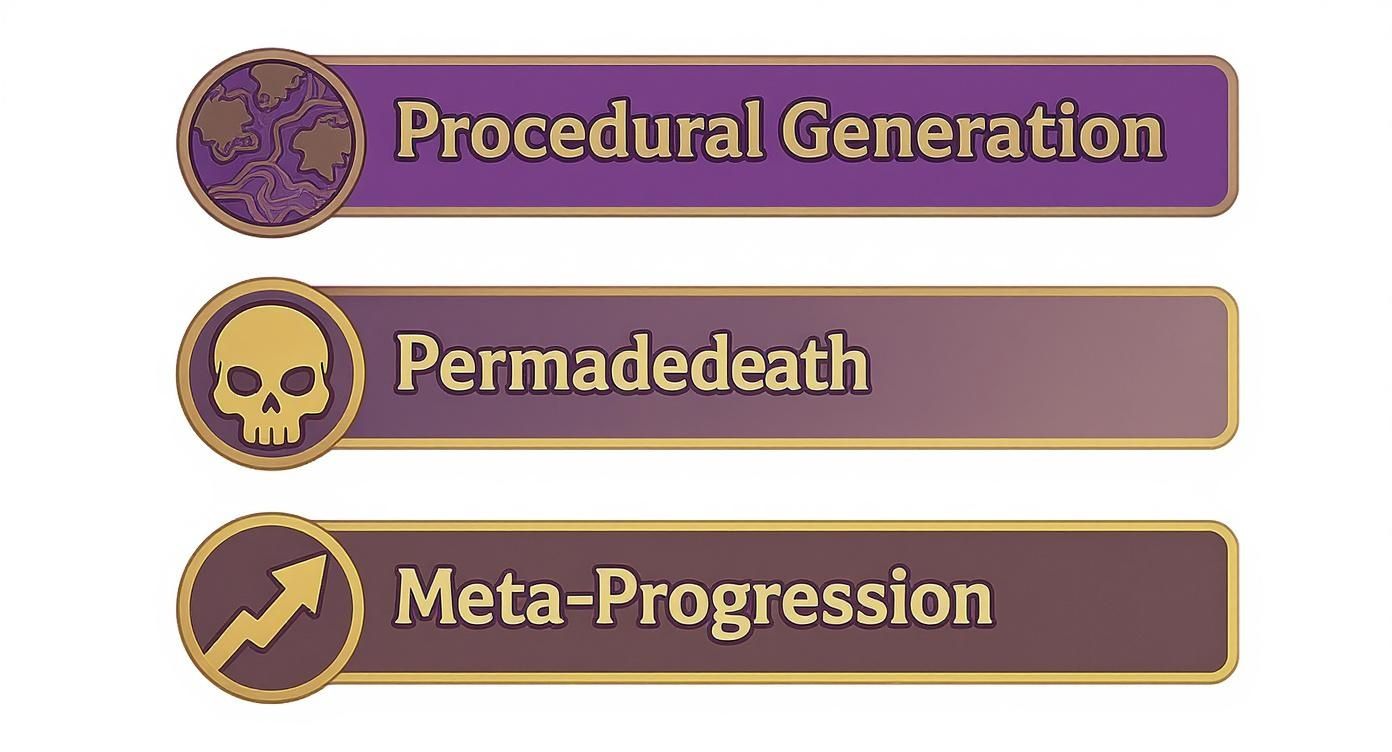
You can see how this core loop works, with each element feeding into the next to create that compelling cycle of challenge and mastery the genre is famous for.
The parallels between tabletop classics and digital roguelites become clear when you examine their core mechanics. The thrill of adapting your strategy on the fly is a shared language, connecting dice rolls and card draws across different eras of gaming.
| Mechanic | Tabletop Example (e.g., Gloomhaven) | Digital Roguelite Example (e.g., Slay the Spire) | Shared Player Experience |
|---|---|---|---|
| Meta-Progression | Unlocking new characters and placing permanent stickers on the world map. | Unlocking new cards, relics, and characters between runs. | A sense of lasting impact and growth beyond a single session. |
| Deck/Hand Management | Carefully choosing ability cards to play and managing your hand size. | Building a synergistic deck by adding and removing cards. | The satisfaction of crafting a powerful engine from simple parts. |
| Random Encounters | Drawing random encounter cards or monster ability modifiers. | Facing procedurally generated maps, enemies, and events. | The thrill of unpredictability and the need for flexible strategies. |
| Permadeath/Exhaustion | A character becomes exhausted and is removed from the current scenario. | A player's death ends the run, forcing a restart. | The high stakes of making every decision count. |
This shared lineage is precisely why so many tabletop fans feel at home with roguelites—we are all speaking the same language of risk, reward, and strategic adaptation.
What truly binds these two worlds is the power of emergent storytelling. No two campaigns of Dungeons & Dragons are ever alike, even with the same adventure module. The mix of player choices, the whims of the dice, and a Dungeon Master’s improvisation creates a unique story every time.
Roguelites achieve this same magic through their mechanics.
This heritage is vital. It’s why so many of us who love tabletop gaming instinctively understand roguelite games. We grasp the thrill of adapting to an unexpected challenge because we've been doing it for years. If you've ever felt that spark guiding a hero on a quest, you can discover where it all began by exploring the classic Dungeons and Dragons roleplaying starter set.
It is this shared ancestry of strategic choice and emergent storytelling that forms the bedrock for new adventures like TerraClash, which honours its tabletop roots while forging its own epic path.
Let us now turn our gaze from the tabletop to the glowing screen, where the roguelite genre has truly flourished. These are not mere copies of our favourite board games; they are vibrant, breathing worlds built on the very foundations of strategy, luck, and the thrill of the unknown. Consider them living sagas, demonstrating how the spirit of a tabletop campaign can be perfectly captured in code.
Countless legendary tales have been told in these digital realms, and each one offers a unique challenge for those brave enough to undertake it. They are fantastic examples of how the core mechanics we've discussed create experiences that are both intensely difficult and impossible to abandon, speaking directly to the strategist in all of us.
First, let us journey to the Greek underworld in Hades. You are Zagreus, rebellious son of the god Hades himself, and your sole quest is to claw your way out of the abyss. Every attempt is a lightning-fast run through ever-changing chambers teeming with mythological beasts. When you die—and you will die, adventurer—you are sent straight back to your father’s court. But this is not failure.
This is what makes Hades so brilliant. Each time you return, you advance a deep, character-driven story. You will converse with Achilles, trade barbs with Hypnos, and forge pacts with the gods of Olympus who grant you powerful boons. The game masterfully blends its meta-progression into the plot, making every defeat feel less like an ending and more like turning the page of an epic saga. It is storytelling through repetition, a concept any campaign veteran will understand.
The true genius of games like Hades is how they turn the story into a reward for simply trying again. Being defeated isn't a penalty; it is a plot point that drives the narrative and fuels your determination for the next attempt.
This unique approach has struck a chord with players and is a major reason for the genre's booming popularity. The roguelite market in the United Kingdom, for instance, has seen some incredible growth. One major title saw its active player numbers jump from 9,200 to 19,100 in just three months, which shows just how much these addictive gameplay loops are grabbing people. You can find more insights into the growing UK market for roguelite games and their performance.
Now, let us venture into a much weirder, darker dungeon with The Binding of Isaac. This game is a masterwork of procedural generation and item synergies. You guide a small, crying boy named Isaac through a monster-infested basement, acquiring hundreds of bizarre items that alter his abilities in wild and often hilarious ways.
You will never have two runs of Isaac that feel the same. One moment you're firing gigantic, screen-clearing tears, and the next you've sprouted angelic wings and are commanding a swarm of loyal flies. The sheer number of items and the completely unpredictable ways they interact creates an almost infinite strategic puzzle.
It perfectly captures that wondrous chaos from a tabletop game when a random card draw or a lucky dice roll completely upends your best-laid plans. It forces you to think on your feet and build a new strategy from the strange tools you have been given. This is the very essence of adapting to the unpredictable, a skill we all sharpen around the gaming table.
Both Hades and The Binding of Isaac are a celebration of what makes tabletop gaming so fantastic. They require smart planning, reward clever thinking, and create unforgettable stories simply through playing. They are proof that the spirit of adventure we love is thriving in the digital world, and they have set the stage for new legends like TerraClash to carry that torch forward.
https://www.youtube.com/embed/rtXHiAxQZpE
If you have ever journeyed through a shifting dungeon or revelled in the mastery of a perfect card combo, listen closely. A new quest is being forged, one that captures the very soul of tabletop gaming and gives it a fresh, digital life. That new saga is called TerraClash.
This is a world born from a genuine love for epic fantasy, the deep tactics of deckbuilding, and the endless replayability that makes roguelite games so compelling. Think of it as a meeting ground for all who love the satisfying weight of a well-built deck and the thrill of stepping into an unknown dungeon. If your heart races at the thought of a grand campaign, then this is a story being written for you.
We have all played games that have taught us the value of a perfectly timed card or the cunning needed to adapt when the dice do not roll our way. You will see the echoes of those timeless tabletop traditions in TerraClash's design. It is a game that honours the legacy of both physical and digital classics that truly challenge the mind.
Remember the satisfaction of drawing the perfect hand, or the careful planning it takes to navigate a board filled with monsters? That is the feeling we are bottling. The game is being carefully built for players aged 12 and up, offering a challenge that respects a young strategist's intelligence while providing enough depth for a seasoned veteran to truly sink their teeth into.
This new world is a tribute to every adventurer who has ever spent hours agonising over a single move, knowing that one clever choice could turn the tide of an entire campaign. It is a challenge of wits, not just reflexes.
The goal here is to build something that feels both comfortingly familiar to board game fans and excitingly new. It is a bridge between the stories we tell around a table with friends and the personal quests we embark upon alone. Every single element is being designed with the tabletop player in mind, linking its world to the spirit of the adventures we all know and love.
Journeys like this do not begin in grand corporate halls; they start in the humble workshops of passionate creators. Much like the legendary indie tabletop campaigns brought to life by dedicated communities, TerraClash is setting out on its own quest. Platforms like Kickstarter have become the modern patrons for creators with bold new ideas.
Following an indie game's development is like watching a world take shape in real time. It is a chance to be part of something from the very beginning, to see a spark of an idea grow into a blazing legend. It is a path many incredible games have walked before, including:
These campaigns show the incredible power of a community coming together over a shared passion. They prove that gamers crave deep, meaningful experiences. As TerraClash prepares to take its first steps, it hopes to follow in the footsteps of these inspiring sagas, inviting you to witness the birth of a new adventure. Keep an eye on its journey—a new legend is about to begin.
And so, our tale of the twisting corridors of the roguelite genre comes to a close. But yours, adventurer, is just beginning. We have delved into the arcane mechanics that make these games tick, paid homage to the tabletop legends that blazed the trail, and even glimpsed the future with sagas like TerraClash. The call to adventure echoes across the realms, and it is for strategists, storytellers, and heroes just like you.
Whether you find your thrill in the satisfying snap of a freshly shuffled deck or the click of a mouse that seals your fate, the spirit of the game is the same. It is a battle of wits and a dance with destiny, where every choice spins a new thread in your tale. That feeling of snatching victory from the jaws of defeat? It connects us all, from the kitchen table to the digital battlefield.
Keep your wits sharp and your eyes on the horizon. Great adventures often begin as a mere whisper, carried on platforms like Kickstarter, where you will likely hear the first tidings of TerraClash and other fantastic indie sagas. Following a project from its inception is like joining an adventuring party on day one—you are there as a new legend takes its first steps.
This is where passionate creators, not unlike a seasoned Dungeon Master, build entire worlds for us to lose ourselves in. Supporting them is an investment in the future of the games we love to play.
The greatest sagas are not just told; they are experienced. Every choice you make, from the cards you play to the paths you follow, writes another line in your own heroic epic. Your legend awaits.
The world of roguelite games is always shifting, with new dungeons to crawl and treasures to discover. For those of us with a deep love for the strategy of board games, it is a frontier of endless possibility. So, steel your resolve, adventurer.
May the dice roll in your favour, and may your campaigns be legendary.
We get all sorts of queries at the guild hall. Whether you are a grizzled veteran with a hundred campaigns under your belt or a fresh-faced recruit polishing your first sword, some questions arise time and again. Let us dispel the fog on a few common curiosities about roguelite games.
One of the most frequent riddles is the difference between a "roguelike" and a "roguelite." The answer is simpler than you might think. A classic roguelike is the ultimate test of skill—one misstep, and you are done. Your character is gone for good, and you begin the next run from scratch. It is brutal, but that is the nature of the challenge.
A roguelite is a bit more forgiving. You are still sent back to the start when you fall, but you do not lose everything. You keep some progress, like permanent upgrades or new items you have unlocked. Each failed run makes you a little stronger for the next, turning failure into a stepping stone. It is less about punishment and more about gradual mastery.
Younger recruits often ask if these adventures are for them, especially those aged 12 and up. Absolutely! While some games tell darker tales, the core challenge of a roguelite is fantastic for any who wish to sharpen their strategic thinking.
You are constantly planning your next move, adapting to whatever the game throws at you, and learning to rise again from defeat. These are worthy skills for any adventurer. It is precisely why games like TerraClash are being built with that age group in mind—offering a true tactical challenge without becoming too grim.
The real magic of a roguelite isn't just about vanquishing the final foe. It is about the strength and wisdom you gain from every single attempt, celebrating the small victories along the way.
Finally, let us speak of deckbuilding. It is a popular enchantment upon the roguelite formula, and for good reason. Imagine this: you begin your journey with a simple deck of cards representing your abilities—a basic sword slash here, a minor block there.
As you battle through dungeons and vanquish foes, you find new, more powerful cards. Perhaps it is a devastating fireball spell or a clever counter-attack. You add these to your deck, slowly building a hand that reflects your chosen strategy. It is a brilliant fusion of classic dungeon-crawling and tactical card play, ensuring no two runs ever feel the same.
Your own legendary quest is on the horizon. If you want to follow the creation of a new fantasy deck-building roguelite made for tabletop adventurers, keep an eye on TerraClash. Prepare for your next adventure at https://terraclash.co.uk.

