Hark, adventurer, and welcome. Your quest into the sprawling multiverse of Magic: The Gathering begins with the very tools of your arcane trade: the cards themselves. Before you may sling spells and summon epic beasts, you must first comprehend the ancient lore of the seven core Magic The Gathering card types.
These fundamental pillars—Lands, Creatures, Sorceries, Instants, Artifacts, Enchantments, and Planeswalkers—are the mystical DNA woven into every deck ever assembled.
Consider this guide your first spellbook. It contains not just rules, but a grimoire filled with the secrets that bind the entire game together. Each card type has a sacred duty, a unique role to play in the grand theatre of magical combat.
Mastering how these arcane components fit together is the foundation of every triumphant strategy. It is the wisdom that separates a mere novice from a seasoned archmage. This core concept—of distinct elements combining to create something far greater—is the same spark that ignites so many grand tabletop sagas, from the perilous dungeons of Gloomhaven to the countless new worlds being forged on the anvils of Kickstarter.
To begin our quest, let us gaze upon the fundamental division of all magic.
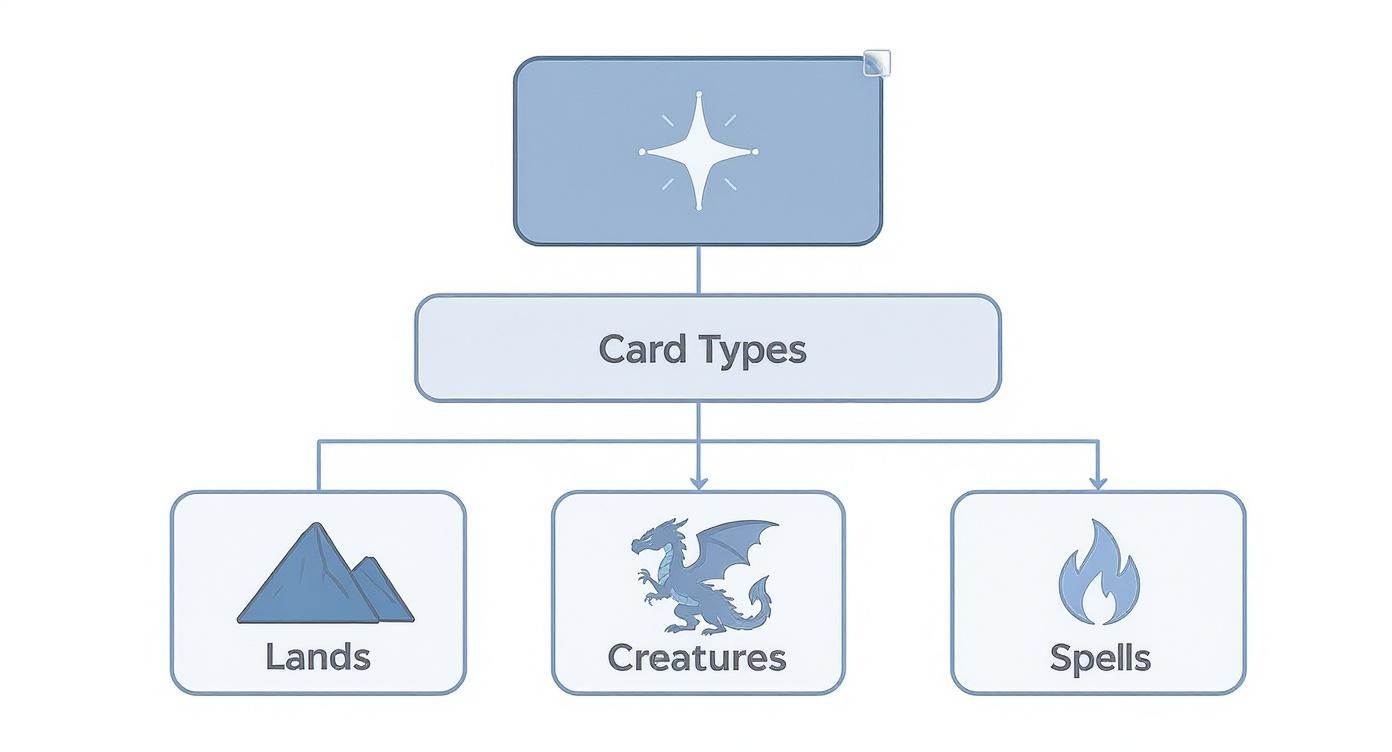
As you can see, all power flows from two sources: the enduring might of Lands and the potent spells you cast. Grasping this simple truth is your first step toward becoming a master strategist.
A mage learns to draw power from the land just as a general learns to command their forces. Both must understand the tools at their disposal before they can ever hope to claim victory. Your deck is your army, your spellbook, and your kingdom all rolled into one.
This is your map to the multiverse. It will guide you as we explore the lands that fuel your magic, the creatures that fight as your champions, and the spells that will turn the tide of battle. These are the timeless concepts that inspire countless new sagas, including our own adventure, TerraClash, a realm crafted for heroes aged 12 and above. Your path to mastery begins now.

Every mighty spell you cast, every monstrous creature you summon, every clever trick you conjure—it all begins with a connection to the world itself. In Magic, that connection is forged through your Lands. They are the source of mana, the raw, mystical energy that fuels your entire strategy and breathes life into all other Magic The Gathering card types. Without lands, your hand is but a collection of unreadable scrolls, filled with silent potential.
Think of lands as the bedrock of your magical arsenal. If your foundation is not solid, even your most towering plans will crumble to dust. Deciding upon your land count is one of the very first, and most critical, rituals in building any deck.
Draw too few, and you shall be starved for power, a frustrated spectator in your own duel. Pack in too many, and you'll be flush with energy but have naught to spend it on. Nailing that balance—often around 40% of your deck—is a rite of passage for every new Planeswalker.
Of course, this energy is not all the same. It flows in five distinct colours, each with its own philosophy and flavour.
The type of mana you generate dictates the kind of magic you can wield, shaping your very identity on the battlefield. Each colour represents a different philosophy and a unique path to victory:
Just as a warrior chooses their weapon, a mage chooses their mana. Your lands are not merely resources; they are a declaration of your intent upon the battlefield.
While your basic lands are the reliable heart of your mana supply, the multiverse is brimming with special territories that offer so much more. Non-basic lands are unique locations with their own abilities. Some can tap for multiple colours of mana, letting you blend different magical disciplines. Others might grant your creatures a boon or even throw a spanner in your opponent’s schemes.
Some non-basic lands are so potent they can completely shut down certain strategies. You can learn more about the reality-warping power of the Blood Moon magic card to see how a single land can twist the entire battlefield to your will. Mastering these special lands adds a whole new layer of strategy to your deckbuilding—a principle of using the world itself as a weapon that inspires games like our own TerraClash.
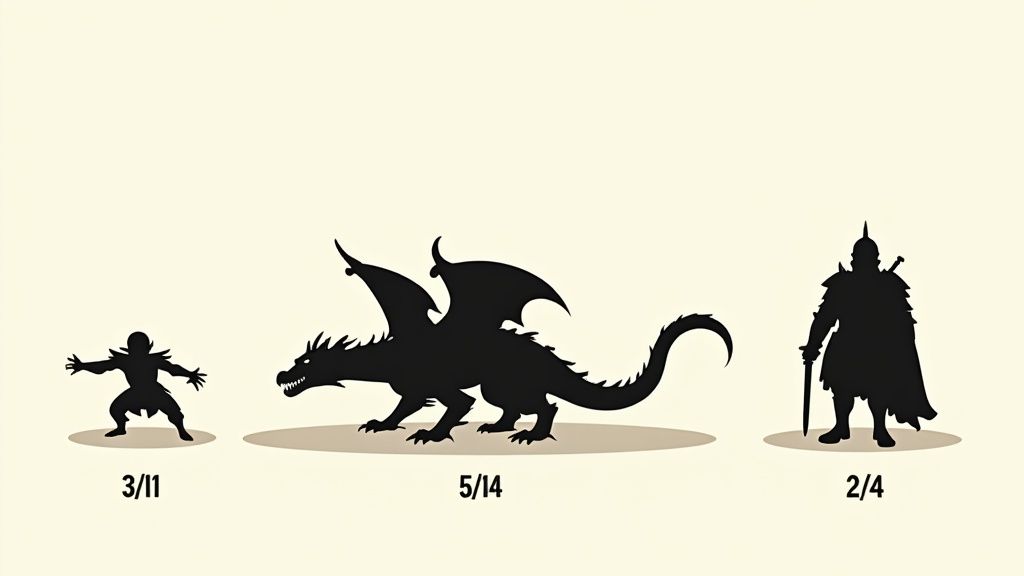
No Planeswalker wins a war alone. While lands provide the fuel, it is your Creatures that actually march onto the battlefield. They are your warriors, beasts, mages, and monstrosities, forming the very soul of most strategies in the game. From a lowly goblin scout to a world-ending elder dragon, these are the cards that will attack your rival and defend your life total.
Creatures are the most common of all Magic The Gathering card types for good reason—they are the primary way Planeswalkers clash. This principle of summoning champions to fight your battles is a cornerstone of so many great fantasy adventures and deckbuilding games that bring heroic tales to your tabletop.
Look to the bottom right corner of any creature card and you shall find two crucial numbers separated by a slash: Power and Toughness. This is often written as "P/T" (for example, 2/2).
A creature with 3 Power and 2 Toughness (a "3/2") hits hard but might not survive a scrap with a sturdier foe. On the other hand, a 1/4 creature won't win any accolades for its attack, but it can happily block most early-game threats without breaking a sweat. Balancing these stats across your army is one of the first strategic lessons you'll learn on your journey.
Beyond their raw stats, many creatures possess special abilities, often written as keywords. These can completely warp the rules of combat, turning a simple soldier into a game-winning powerhouse.
Think of creature abilities as the unique skills of your champions. A warrior with a sharp sword is one thing; a warrior who can fly over enemy lines is something else entirely.
🎲 Want to try a solo card and dice RPG tonight? Get TerraClash Lite free: a print-and-play game you can play with ordinary dice.
Learning these abilities is where the real strategy begins. A creature with Flying can only be blocked by other flyers, letting it soar right over ground-based armies. One with Haste can attack the very turn it is summoned, catching an opponent completely off guard.
Some of the most iconic combatants are the Magic The Gathering legendary creatures, who often come laden with multiple powerful abilities. Understanding how these skills interact is vital for building a truly versatile force—a concept we’ve woven into the very fabric of our game, TerraClash, where heroes wield unique skills to shape their destiny.
True power in Magic is not just about the creatures you summon; it is about the spells you weave. If creatures are your army on the battlefield, then Instants and Sorceries are the pages of your grimoire—the raw, arcane energy you unleash to bend the game to your will. These two core Magic: The Gathering card types are the heart of your magical arsenal, but their true power is unlocked through one critical element: timing.
Think of it thus: a Sorcery is a grand, deliberate ritual. It demands your full attention and preparation, meaning you can only cast it during the main phase of your own turn when no other magic is afoot. These are your great, show-stopping effects—spells that wipe the board clean with a fiery cataclysm or conjure a game-ending beast that blots out the sun.
Instants, on the other hand, are your secret weapon. They are the quick, whispered incantations you can cast at almost any moment, even in the midst of your opponent's turn. This incredible flexibility is their greatest strength, allowing you to react to your opponent’s schemes with surgical precision. They are the very essence of interactive gameplay, turning a straightforward duel into a complex dance of strategy and counter-play.
Mastering the ebb and flow of a duel means knowing when to be patient and when to pounce. The fundamental difference between these two spell types will shape your entire approach.
A Sorcery requires you to be proactive. You cast it on your turn to set the stage, develop your board, and force your opponent to react to your plan. An Instant is the opposite; it is a purely reactive tool. It is the trump card you use to dismantle your rival’s perfectly laid plans just as they believe victory is within their grasp.
The greatest mages know that a single, well-timed spell can be more powerful than an entire army. It is the art of seeing not just the board as it is, but as it could be in the next crucial moment.
Picture this: your opponent taps all their mana to summon their mightiest dragon. With an Instant, you can cast a spell to send it back to their hand or banish it from reality before it even has a chance to breathe fire. That is the kind of game-swinging potential that makes Instants so thrilling to play. This dynamic of action and reaction is a cornerstone of great card games, and it's what inspired the strategic depth in newer titles like our very own TerraClash.
For any apprentice mage, understanding the nuances between these two spell types is the first step toward mastery. Here is a quick-reference scroll to keep in your spellbook.
| Attribute | Instants | Sorceries |
|---|---|---|
| Casting Speed | Can be cast at almost any time, including on an opponent's turn. | Can only be cast during your main phase when the stack is empty. |
| Primary Role | Reactive and tactical. Used for surprises, counters, and combat tricks. | Proactive and strategic. Used for major, board-altering effects. |
| Gameplay Feel | Flexible, sneaky, and controlling. Keeps opponents on their toes. | Deliberate, powerful, and decisive. Sets the pace of the game. |
| Key Example | A Counterspell to stop an opponent's spell before it resolves. | A Wrath of God to destroy all creatures on the battlefield. |
Ultimately, this scroll highlights the core trade-off: Sorceries offer raw power, while Instants provide unmatched flexibility. A truly skilled Planeswalker knows how to leverage both.
While they function very differently, the best mages learn to use Sorceries and Instants together to create a symphony of destruction. You might cast a Sorcery to put your opponent in a tough spot, forcing them to act. Then, you can pass your turn with mana open, representing the threat of an Instant and keeping them guessing about the tricks you have up your sleeve.
This interplay between proactive threats and reactive answers is what makes spellcasting in Magic so incredibly deep and rewarding. Your spellbook isn't just a list of effects; it is a toolbox for outsmarting your rival at every turn.
A lightning bolt sizzles and is gone in an instant. A summoned beast can be slain and sent to the graveyard. But some magic is built to last. It settles onto the battlefield and changes the very fabric of the game, a constant presence that can shape the course of the entire duel. This is the world of Artifacts and Enchantments, two of the most strategic Magic: The Gathering card types. We call them "permanents" for a reason—they stick around to grant you a lasting edge.
Think of Artifacts as magical items. They are the enchanted swords, the mystical power sources, the clockwork automatons. What makes them so special is that they are usually colourless. This means any wizard, no matter what colour of mana they draw upon, can use them. One turn you could be equipping a simple 1/1 creature with a colossal warhammer, turning a nobody into a legitimate threat. The next, you might uncover an ancient power-stone that doubles your mana output every single turn.
Enchantments, on the other hand, are pure, raw magic woven directly into the battlefield. They're lingering spells and powerful auras that can either supercharge your side of the board or lay a debilitating curse upon your opponent. You might cast an Enchantment that gives all your creatures the ability to fly, or one that slowly, painfully siphons your opponent's life away, one point at a time.
The true beauty of Artifacts and Enchantments is how they work together to build an "engine". By carefully playing several of these permanents, you can construct a powerful, interlocking system that snowballs in power turn after turn. It is less about one big punch and more about building a strategic machine that your opponent eventually just cannot keep up with.
An Artifact is the crafted marvel, the enduring tool that outlives its master. An Enchantment is the binding oath, the lingering whisper that shapes reality long after the words are spoken. Both offer a path to victory built not on fleeting moments, but on unyielding presence.
This idea of building a lasting advantage is a fundamental part of deep, strategic play and lies at the heart of many incredible tabletop games. It's that satisfying feeling of assembling your game-winning machine piece by piece that inspires so many new deckbuilding games, including our own adventure, [TerraClash], where your choices build upon each other to forge a unique path to victory.
So, they both linger and warp the game, but what is the difference? While they serve a similar role, their flavour and typical functions give them unique identities. Grasping this is key to using them well.
When you start weaving the right Artifacts and Enchantments into your deck, you stop just reacting to your opponent's plays and start dictating the flow of the game yourself. You are building a strategic puzzle your rival has to solve, often leading them right where you want them. It is this intricate dance of setup and payoff that makes these cards so incredibly fun and rewarding to play with.
Here is a fundamental truth of the multiverse: you are not the only Planeswalker out there. The most legendary figures from Magic's story can be summoned to fight by your side. They are not creatures, but something more—powerful allies who can single-handedly turn the tide of a game. These are the Planeswalkers, one of the rarest and most impactful Magic: The Gathering card types you can play.
When a Planeswalker enters the battlefield, they arrive with a set amount of loyalty, which you'll see in the bottom-right corner of the card. Think of this as their health pool, but it is also the resource you'll spend to activate their abilities. Each turn, you can use one of their abilities, which will either add or subtract from their loyalty total in exchange for a powerful effect.
This introduces a whole new dimension to the game. Suddenly, your opponent has a choice: they can attack you, or they can direct their creatures to attack your Planeswalker. This creates a fascinating sub-game where protecting your new ally becomes just as important as protecting your own life total. It’s a constant tug-of-war between offence and defence.
So, why go to all the trouble of defending them? Because most Planeswalkers are hiding an "ultimate" ability. This is a game-shattering effect that costs a huge amount of loyalty to activate. Getting there means you must patiently use their other abilities to build up that loyalty, turn after turn, all while keeping them safe from harm.
A Planeswalker is more than just a card; it’s a declaration that the game has fundamentally changed. The battlefield is no longer a simple clash of creatures. It becomes a battle of wills, where loyalty is the ultimate currency of power.
Learning when to summon a Planeswalker and how to keep them alive is a true mark of a skilled player. This idea of summoning a unique champion who grows in power is a thrilling concept that has inspired countless modern tabletop games, including the hero-focused strategies you’ll find in our own quest, TerraClash.
And so, our lesson concludes. You have journeyed through the core of what makes Magic: The Gathering tick—the lands that power your spells, the creatures that fight your battles, and the arcane energies that can turn the tide in a heartbeat. This is not just about learning the rules for one game; it is about understanding a language of strategy that opens up a whole universe of tabletop adventures.
The very essence of Magic—that thrill of brewing up a new deck, diving into rich fantasy lore, and pulling off a brilliant play—is the same spark that drives the incredible indie game scene. If this guide has stirred your creative spirit, you should know there are countless new worlds out there being built by people with that exact same passion.
Think of platforms like Kickstarter as a modern-day adventurer's guild. It's where epic tales like Frosthaven are brought to life, powered by nothing more than a great idea and a passionate community. It is on this kind of hallowed ground that our own story, TerraClash, will soon begin its journey, offering a brand new world for you to explore.
Getting to grips with these card types has given you more than just a rulebook; it has given you a foundation in strategic thinking. You are now ready to explore not just the planes of Magic, but any game world that catches your eye. As you start putting this knowledge into practice, our guide on how to build an MTG deck is the perfect next scroll to help you craft your first masterpiece.
Every duel is a story, every deck a testament to its creator's vision. The end of one campaign is merely the beginning of the next grand tale waiting to be told.
Your adventure is truly just beginning. Whether you decide to stick with the familiar planes of Magic or venture into the uncharted territory of a new indie game, the skills you've learned—strategy, creativity, and good sportsmanship—will always be your guide. Your next great quest is out there, just waiting to be discovered.
Your next adventure awaits with TerraClash. To be the first to hear when our quest begins, follow our journey.

