Hark, adventurer, and listen close. Have you ever felt that flicker of magic? That pull to bend the elements to your will and reshape reality with a single, whispered word? Every hero who's ever cast a spell started their journey right there, not with some grand, world-shattering incantation, but with the simple desire to understand the flow of magic itself. This is where your own saga begins.
Before you're slinging fireballs or closing grievous wounds with a touch, you must first learn to see the unseen. Consider this your apprenticeship. It is a time for quieting your mind and sensing the invisible currents of power that run through all things. Every legendary mage, from the most studious wizard in a Dungeons & Dragons campaign to the most instinctive planeswalker in Magic: The Gathering, started in this exact place—with a spark of curiosity and the drive to learn.
This first step is not about memorising complicated gestures or ancient words. It’s about grasping the core philosophies behind magic. Different games, and the worlds they inhabit, have wonderfully unique takes on spellcraft. Understanding these systems is what truly unlocks your potential, no matter which realm you find yourself adventuring in.
This arcane map breaks down the different roads to power you might find on your travels.
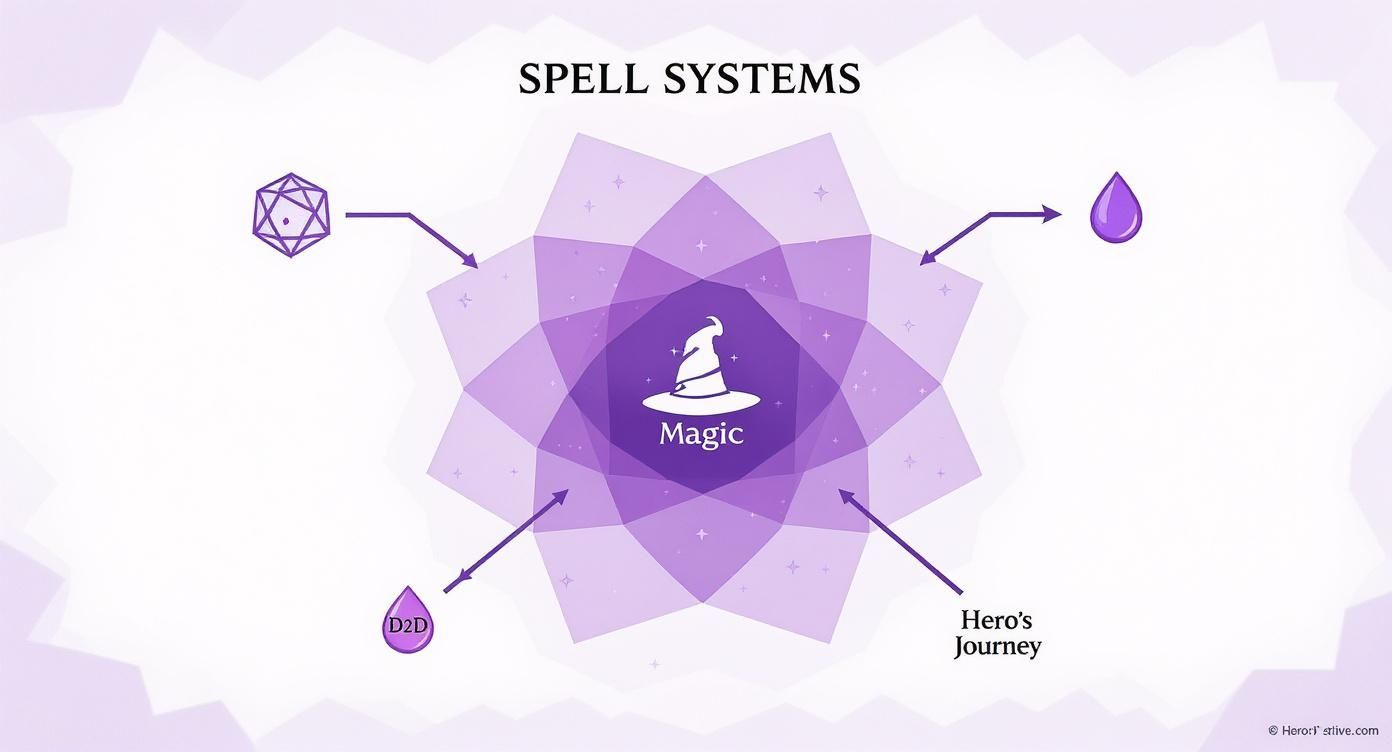
As you can see, arcane power flows from many sources, whether through years of intense study, tapping into the raw energies of nature, or setting out on a personal quest for knowledge.
To grant you a clearer vision, let us examine how different games approach the art of spellcasting. Each system is built upon a unique idea of where magical power originates, and understanding these can help you find the style that resonates with your soul.
| Magical System | Core Mechanic | Where to Find It |
|---|---|---|
| Vancian Magic | Memorising a set number of spells from a spellbook after a long rest. | Classic Dungeons & Dragons |
| Mana/Resource Pool | Spending points from a regenerating pool (mana, magicka) to cast spells. | The Elder Scrolls, World of Warcraft |
| Innate Talent | Power is a birthright; spells are learned instinctively as the character grows. | The Witcher (Sorcerers) |
| Pact Magic | Gaining limited but powerful spells from a patron in exchange for service. | D&D 5e (Warlocks) |
These are but a few examples, of course. The true beauty lies in how these different philosophies shape not just the rules, but the entire feel of playing a magic-user.
So, which path calls to you, traveler? Are you drawn to structured, academic magic, or does a more chaotic and instinctual power sing to your spirit? Most systems boil down to a few core approaches:
I have always found that a hero's first spell isn't fire or ice, but understanding. It is the moment they learn to see the world not just for what it is, but for what it could be. That is the true beginning of any magical education.
Picking a philosophy that resonates with you will completely shape the kind of spellcaster you become. In a game like TerraClash, leaning into these ideas makes the experience so much richer, connecting your in-game strategy to the deep lore of the world you’re exploring.

Every earth-shattering spell begins not with a bang, but with a whisper. It starts as a quiet symbol: a rune etched into ancient stone, a glyph glowing on a card, a word of power scrawled onto a brittle page. To learn magic is to become a student of these arcane languages, a journey that calls for focus and a solid plan of attack.
When you crack open a new spellbook or shuffle a fresh deck, the wall of symbols can feel like a tidal wave. The secret is not to try and memorise everything at once. Instead, you must break it down into smaller, more manageable pieces.
Think of it as designing your own course of study. You would not attempt to learn every school of magic at the same time. You would pick one—say, Abjuration or Evocation—and truly master its principles. This deliberate approach helps you build a strong foundation, turning what was once a confusing mess of symbols into an arsenal you can command with confidence.
The first true step is to stop seeing spells as just a set of rules and start seeing them as a language. Every symbol, keyword, and component is part of a grander conversation. You must learn the grammar of magic before you can begin to write your own epic poems of power.
This goes far beyond simple memorisation. To truly gain a feel for the ancient scripts, exploring multisensory learning techniques can make a world of difference. Try tracing the symbols with your finger as you study, saying the incantations aloud, or closing your eyes and picturing the spell’s effect in your mind.
The most potent spellcasters are not those who know the most spells, but those who deeply understand the principles behind a few. True mastery comes from seeing the invisible thread that connects a simple cantrip to a world-altering ritual.
This focused method is not so different from how specialised skills are taught in the mortal realm. In the UK, for instance, structured learning environments with individualised plans have been proven to massively boost learning outcomes. By January 2025, there were 638,745 Education, Health and Care (EHC) plans in place for young people—a rise of 10.8% from the year before. It just goes to show that personalised learning paths are crucial for mastering complex subjects, whether they be magical or mundane.
Once you have begun to grasp the language, it is time to build. Start with the absolute basics in your chosen game—the cantrips, the Level 1 abilities. Do not dismiss them as weak; these are the fundamental building blocks of your entire strategy.
This is how you turn a page of bewildering symbols into a familiar set of tools. It is the path every great mage walks, whether they are in the pages of a fantasy novel or sitting across the table in a game like TerraClash.
An incantation without power is but a string of empty words. What truly separates a novice from a true archmage is the ability to channel the world's raw magical energy—what we call mana—and breathe life into your spells. This is the absolute core of being a magical strategist.
Learning new spells is one thing, but knowing how to fuel them is where the real game begins. Every tabletop game or deckbuilder with a magic system hinges on this single, vital resource. It is a game of patience and foresight; knowing when to hold back and when to unleash a devastating torrent of power that can completely change the course of a battle.
Consider those heart-pounding decisions in an indie classic like Slay the Spire. In that game, every single point of energy is precious. Waste it, and you leave yourself wide open. But use it wisely, and you can pull off a glorious victory against seemingly impossible odds. It forces you to think several moves ahead, constantly weighing every card in your hand against the limited power you have each turn.
I like to think of managing mana as conducting an orchestra. You must feel the rhythm of the battle, building everything up to a powerful crescendo at just the right moment. Go all-in too early, and you will have nothing left for the grand finale. But wait too long, and you might miss your chance entirely.
This delicate balancing act is captured perfectly in the brilliant campaign game Gloomhaven. Here, your hand of cards is everything—it dictates your actions, but it also represents your stamina.
The strategic depth is immense, with every card you play inching your character closer to exhaustion. What you learn from games like this is that power isn't just about casting the biggest, flashiest spells. It's about endurance and efficiency over the course of a long, gruelling adventure.
True power isn't found in the spell that makes the loudest noise, but in the quiet wisdom of knowing when not to cast a spell at all. It is the art of turning latent energy into decisive victory.
This philosophy is central to so many of the best fantasy games out there. It is a skill that translates across countless systems, whether you're tapping lands in Magic: The Gathering or preparing your hero's abilities in a game like TerraClash.
Mastering mana requires you to think like a strategist. You are not just spending a resource; you are investing it. I always try to keep a few key principles in mind:
Once you internalise these ideas, you stop just casting spells. You start weaving them together, conducting the flow of magic itself. This is the skill that will truly define your journey as a spellcaster.
As your understanding of magic deepens, your personal grimoire must keep pace. This is where the true art of being a spellcaster comes into its own—it is not just about knowing spells, but about carefully curating your entire magical arsenal. We are moving into the realm of deckbuilding, a sacred ritual for players of games like the fantastic Arkham Horror: The Card Game and, of course, TerraClash.
This craft is so much more than just throwing the most powerful spells you can find into one tome. It is a delicate dance of synergy. Think on it: how can that simple cantrip you learned ages ago set up a devastating fireball later? Which defensive ward works best with a hyper-aggressive, all-out assault? You are no longer just a student; you are an architect of magical power.
A truly great spell deck tells a story. It is a reflection of your character, your chosen strategy, and your personal flair for magic. Are you a pyromancer, with every spell crackling with elemental fire? Or perhaps a shadowmancer, one who weaves illusions and curses to leave your foes completely bewildered?
Consider the narrative of your power. A well-built grimoire isn't just a list; it is a coherent collection where every single spell has a purpose. It's a curious thing, but the principles of how to master the book writing process can actually help you structure your collection, turning a jumble of separate incantations into a unified masterpiece.
A warlock, for example, would have a spell list brimming with dark pacts and soul-sapping curses, where every choice reinforces their lore. If you seek inspiration, we have a great resource exploring ideas for a potent warlock spells list that shows just how flavourful a thematic deck can be.
A mage’s spellbook is their autobiography. Every chosen spell is a chapter, every combo a plot twist. The goal is to craft an arsenal that is far greater than the sum of its parts, a testament to your unique magical signature.
Traditionally, learning spells has always been a literary game—it’s all about a mage’s ability to read, understand, and memorise complex texts. This makes a solid foundation in reading incredibly important for adventurers aged 12 and up. However, recent findings from The National Literacy Trust's 2025 survey paint a slightly worrying picture here in the UK. The survey showed that only 32.7% of children said they enjoyed reading in their free time, a significant drop since 2005.
On top of that, daily reading rates for 8- to 18-year-olds have fallen to just 18.7%, the lowest figure ever recorded. For an activity like learning spells, which often means delving into instruction-heavy rulebooks and cards, this trend could be a real barrier for younger adventurers. You can dig into the full literacy research here for more details. It truly highlights how valuable it is when games can make complex rules feel engaging and accessible for everyone.
Building your grimoire is a deeply personal quest. It’s the space where you get to mix raw knowledge with pure creativity, transforming a simple collection of spells into a finely tuned engine of magical might.
To know a spell is one thing; to master it is something else entirely. An uncast spell is merely an idea—ink on a page with no true power. To make an incantation your own, you need a sanctum, a personal space dedicated to honing your craft.
Fear not, I do not speak of some grand wizard's tower. Your sanctum can be a quiet corner of your gaming room, a dedicated solo session, or even a digital simulator where you can test your spells against imaginary foes. The important part is having a place where you can experiment without the pressure of a real match.
This idea of a personal practice space isn't just for fantasy mages. We see it everywhere, especially in how people learn complex skills. Today’s adventurers can grasp intricate magical systems from their own homes, a trend that has truly taken off.
The whole point of a sanctum is to allow for deep, focused practice. This is your laboratory, where you can properly understand the complex card interactions that separate a decent spellcaster from a truly legendary one.
Think of it as your personal training ground. Here, you can run drills, try out those wild card combinations you've been dreaming up, and uncover hidden synergies you'd never risk revealing in a high-stakes duel. It’s how theory becomes instinct.
This shift towards self-paced, flexible learning is becoming the norm. In the UK, the educational technology sector has rocketed to a value of around £3.2 billion. What's more, surveys show that a whopping 90% of learners prefer having that flexibility. It’s the perfect environment for the kind of repetition needed to master spells. You can dig into more UK education statistics to see just how big this trend is.
So, you have your sanctum. How do you make the most of it? A little structure goes a long way.
The sanctum is where a spellcaster’s confidence is forged. It is in those quiet moments of repetition and discovery that you truly begin to believe in your own power, turning hesitant actions into decisive, masterful plays.
This is the work that prepares you for anything, whether you're staring down a dragon in a roleplaying campaign or a rival player in TerraClash. It is the final, and most important, step on your journey.
And so, you have the keys to unlocking your power. You have walked the path from fresh-faced apprentice to confident adept, learning how to read ancient runes, channel the flow of mana, and carefully build your very own grimoire. With these skills, your true magical education is about to begin.
To be a spellcaster is to live a life of constant discovery. It is an endless hunt for knowledge and power, and that is what makes it so rewarding. Every new game you unbox, whether it's a household name in the tabletop world or a thrilling indie project, presents a fresh school of magic to master and a new world to get lost in. This constant evolution is the true joy of the craft.
The tabletop universe is overflowing with arcane lore, tucked away in rulebooks, campaign guides, and the flavour text of countless cards. It is all there, waiting for a curious mage like you to uncover it. Do not let your journey stop here.
The most powerful magic isn't found in a dusty spellbook or a deck of cards. It’s the community we build around the gaming table, the shared stories, and the collective thrill of an adventure.
The path ahead is yours to forge. Every spell you cast, every deck you build, and every game you play adds another page to your personal legend. It’s a journey that exciting new games like TerraClash are designed to enrich, offering fresh mechanics and deep lore to challenge even the most seasoned archmage.
May your spells always find their mark.
Your next great adventure is just over the horizon. To be among the first to explore a world shaped by powerful spells and tactical deckbuilding, keep your scrying orb fixed on TerraClash. Discover more about our campaign at https://terraclash.co.uk. For more tales of indie tabletop adventures, check out other great projects like Frosthaven and The Witcher: Old World.

