Greetings, adventurer. If you have found your way here, you have felt the call of the solitary quest, the silent challenge of a solo card game. Within these scrolls, you will find the wisdom to decipher their rules—the sacred pact between you and the game's creators. This guide is your enchanted map, charting the course from the first shuffle to the final, triumphant cry of victory.
There is a unique magic in a game that is yours and yours alone. It is more than a way to pass the hours; it is an act of will, a test of strategy where you alone shape your fate. This solitary journey, whether a classic game of Patience or a sprawling epic like Gloomhaven: Jaws of the Lion, offers a challenge as profound as any grand multiplayer saga.
Consider this guide your wizened mentor, here to illuminate the common threads woven through the fabric of any solo game. We shall delve into the rituals of setup, the rhythm of a game's phases, and the true meaning of victory. Whether you are a veteran of countless campaigns or a fledgling hero, you will find the knowledge needed to face any challenge the box dares to present.
Why, you may ask, do we choose to venture forth alone? The reasons are as varied as the myriad realms of fantasy. For many, it is the pure, undiluted puzzle—a battle of wits between you and the game's unseen puppet master. Every decision is yours alone; thus, every victory is earned, every triumph a testament to your skill. For others, it is a chance to lose oneself in a deep, unfolding story, unbound by the schedules of a fellowship.
It is no wonder that so many modern tabletop chronicles now offer magnificent solo modes. Game designers have heeded the call for this personal challenge. Games like Dune: Imperium and Lost Ruins of Arnak employ cunning automated opponents—often called 'automas'—to simulate a thinking adversary, ensuring every playthrough feels fresh and unpredictable.
Grasping these fundamentals will prepare you for nearly any solo adventure, even for new realms on the horizon like our own TerraClash, a tale for heroes aged 12 and up. If you are just beginning and seek guidance, our tome on easy-to-learn card games is an excellent place to start your quest.
Every great solo session begins long before the first card is drawn. View the setup not as a chore, but as the opening ritual that transports you from your world into the one upon the table. Here, you lay the foundations for the epic tale you are about to weave.
A well-ordered play area is more than mere tidiness; it is a strategic advantage. Before all else, bring order to your components. Sort your tokens, marshal your various decks, and give each element its own sacred space. Believe me, adventurer, nothing shatters the illusion more than fumbling for a crucial resource as the doom clock ticks onward.
I regard my play area as a kind of war room. Your hero's card, naturally, should be placed front and centre—the heart of your operation. Your hand of cards can be fanned out nearby, a council of trusted advisors awaiting your command.
One of the most common blunders I see neophytes make is confusing their draw deck with their discard pile. Keep them entirely separate! This is not just a matter of neatness; it is about maintaining clarity of purpose. A clean setup allows you to focus wholly on the game's narrative and your next move, free from mundane distractions.
To better grasp how these elements flow together, consult this quick visual guide.
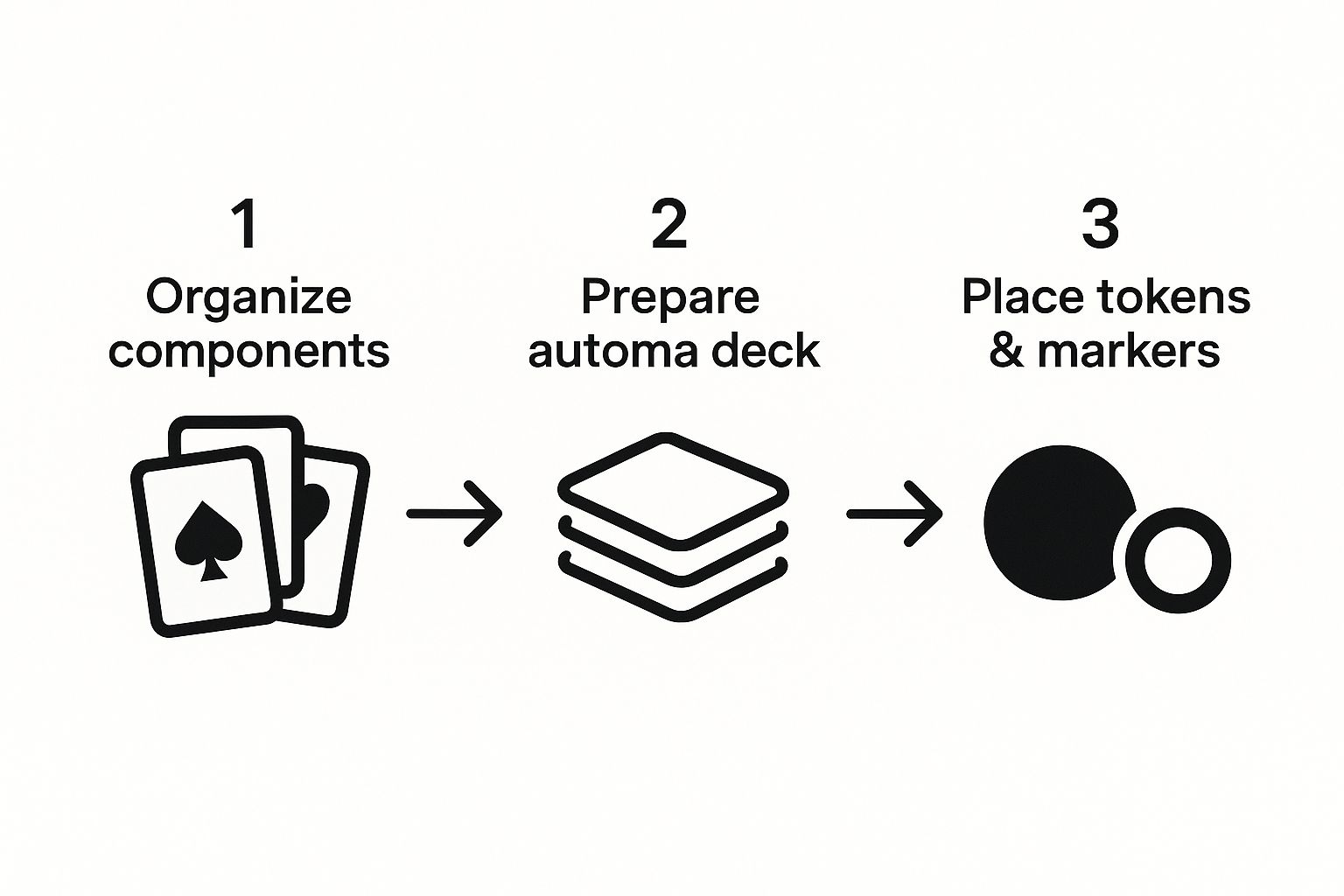
Following such a logical sequence means that once the conflict begins, your mind is on strategy, not on finding a misplaced relic.
Many of the finest modern solo games, such as Lost Ruins of Arnak or Dune: Imperium, use an automa deck. This is your automated adversary, dictating the 'AI's' moves. Preparing this deck is a critical step. Grant it the same respect you would a living opponent: shuffle it well, place it where it belongs, and take a moment to understand its unique symbols and actions. The automa is your rival, your challenge, and often, your greatest teacher.
The automa is the heart of the solo experience. It is not merely a deck of cards spitting out random actions; it is a cunning system designed to test your resolve at every turn. Learning its patterns is like discerning a dragon's attack patterns before charging into its lair.
With the main components arrayed, it is time for the final details that breathe life into the game world. Lay out the quest markers, place the monster tokens upon the board, and prepare any other scenario-specific artifacts. This is your final declaration that you are ready to commit to the adventure, whatever fate may hold.
This very concept of playing against the game itself has a long and storied history. Traditional card games like Patience have been part of our culture for centuries, evolving from simple pastimes into the rich, story-driven experiences we cherish today.
It is a burgeoning passion, as well. The UK's market for playing cards and board games was valued at a mighty USD 1,049 million in 2024, and its growth shows no signs of waning. Our thirst for these solo adventures is as strong as ever. You can delve into more of this lore over at Statista.com.
Now, with your world laid out before you, you are no longer just a player at a table. You are a hero on the precipice of a grand saga, ready for whatever destiny the cards may reveal.
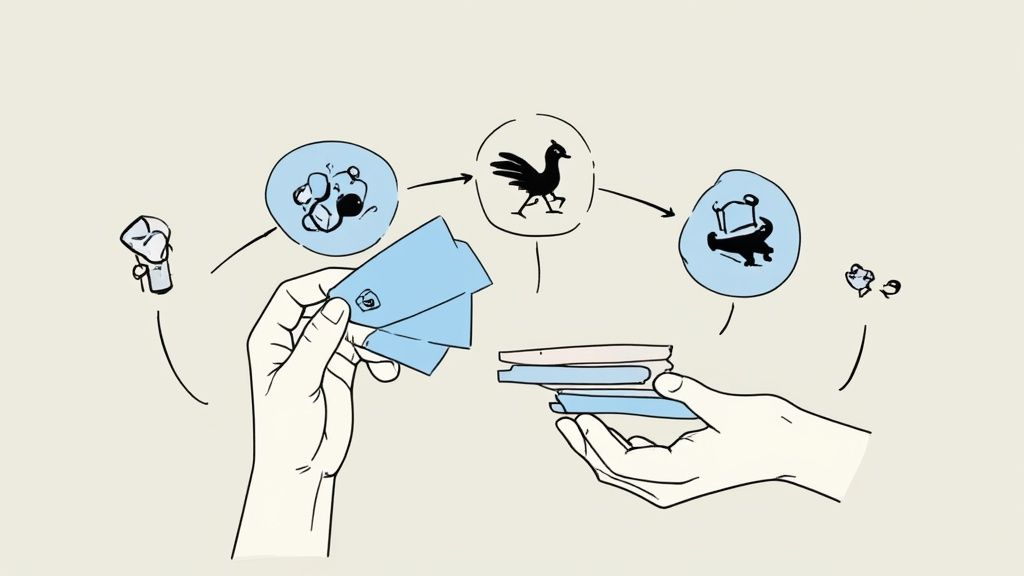
So, the ritual is complete, and the board lies before you. Here, the true trial begins. A solo game is no frantic dash to the finish; it is a dance of rhythm and timing, the steady beat of turns and phases that propel the story forward. Mastering this flow is the first great step toward victory.
Envision each turn as a short chapter in your epic. It is broken into smaller, manageable parts that grant you the chance to plan, to act, and then to react. It is this structure that transforms a simple card game into a strategic puzzle against a cunning, albeit cardboard, foe.
Most solo games follow a similar pattern for each turn. The specific incantations may change from one rulebook to the next, but the core principles remain constant. You will see this in great, complex beasts like Mage Knight or in more streamlined adventures like Gloomhaven: Jaws of the Lion. A turn is not just about "doing something"—it is a sequence of distinct, crucial moments.
Typically, you will face a structure that resembles this:
This structure prevents the game from descending into chaos. It compels you to consider timing as much as the cards in your hand. Truly mastering this cycle is what elevates your play from mere participation to true tactical command. To delve deeper into these fundamentals, our guide on how to play card games covers more of the ancient lore.
A well-designed game phase is a storytelling tool. The Upkeep Phase builds suspense, the Action Phase provides the climax, and the Clean-up Phase creates a moment of reflection. It is the narrative arc of your turn, played out in miniature.
🎲 Want to try a solo card and dice RPG tonight? Get TerraClash Lite free: a print-and-play game you can play with ordinary dice.
To help you visualise this, here is a quick breakdown of what a typical turn might look like in many solo chronicles.
This table breaks down the common phases you will encounter. While the specifics will vary between games, the general purpose of each phase is often quite similar.
| Phase of the Turn | What It Represents | Your Common Actions |
|---|---|---|
| Upkeep/Start of Turn | The game world advancing; new challenges emerging. | Drawing new event cards, resolving ongoing effects, adding new enemies. |
| Main Action | Your character's moment to act and influence the game. | Playing cards, moving on the board, attacking enemies, using abilities. |
| End of Turn/Clean-up | Resetting the board and preparing for the next round. | Discarding cards, resetting used powers, passing the turn to the automa. |
Understanding these distinct moments helps you break down what can sometimes feel like an overwhelming turn into a series of clear, simple choices.
Of course, you are not the only one taking a turn. The game’s automated opponent, or 'automa', gets to act as well. Its moves are usually determined by the flip of a card or the roll of a die, casting a shadow over even your most carefully laid plans.
Herein lies the true strategic depth of solo gaming. You are not just playing your own game; you are constantly reacting to a relentless, unpredictable foe.
Consider the automa in Dune: Imperium. It does not "think" in a human sense, but its actions can block you from vital resource spots or launch attacks that force you to completely change your strategy. The key skill to hone is learning to read the automa deck—to understand the range of what it can do, even if you do not know precisely what is coming next. It is what separates players who feel at the mercy of the game from those who can steer their own path to victory.
Before you even draw your first card, the most vital question to ask is: "How is this legend won?" In a solo game, the answer is not always as simple as vanquishing an opponent. The rules of victory are your North Star, guiding your every action.
Sometimes, victory is a pure and simple matter of survival. You might need only to hold out against overwhelming odds for a set number of rounds. In a game like Final Girl, victory is simply seeing the dawn. Other times, it is a test of pure efficiency.
Many solo games are less about a dramatic finish and more about achieving a specific goal. Your quest might be to amass a certain score, turning every move into a calculated puzzle where you strive to squeeze every last point from your hand.
But the path to glory can take many other forms:
This variety is a huge part of what makes modern solo gaming so compelling. It is not just a game of Patience anymore. Indeed, the market for these personal challenges has exploded. The UK card game app market alone summoned around US$285.84 million back in 2022. If you are interested in such chronicles, you can delve into more data on this trend at Statista.com.
Just as important as knowing how to win is understanding how you can lose. Do not think of it as failure; think of it as your early warning system. The solo card game rules will spell out the loss conditions in no uncertain terms.
Perhaps you lose if an automated opponent achieves its own goal first. Or maybe you will be defeated if your deck runs out of cards, or if a dreaded 'doom track' ticks all the way to zero.
Knowing your enemy is wise, but knowing your downfall is crucial. Understanding how you can lose is every bit as important as knowing how to win. It is what turns hopeful gambles into solid strategy.
Heeding these loss conditions is how you grow stronger. It helps you pinpoint where you faltered, learn from your missteps, and return to the table with a sharper mind. This is what transforms a simple game into a genuine challenge, a skill that will prove invaluable as you venture into more complex worlds like TerraClash.
So, you’ve read the ancient texts and mastered the basic rules. The board is no longer a strange, hostile land but a familiar territory ripe for conquest. Now it's time to delve into the arcane arts that separate a mere adventurer from a true legend. This is where you stop playing the game and start commanding it.
True mastery comes from seeing the patterns woven into the automa’s design. An automated opponent isn't really random; it operates on a cold, hard logic dictated by its deck. If you pay close enough attention, you can start to anticipate its moves—not with perfect certainty, but with calculated foresight.
Does your opponent’s automa hoard resources early on? Or does it always go for aggressive, board-clearing actions as soon as it can? Learning these tendencies is like a ranger reading tracks in the wild; it tells you what the beast is likely to do next, giving you a crucial edge.
When you forge a deck for solo play, you’re not preparing for a duel against a cunning human mind. You’re crafting a specialised toolset to solve a very particular puzzle. Your deck has to be a self-reliant engine, able to generate resources, mount a defence, and press the attack, all on its own.
A few truths I've learned over the years:
This thoughtful approach to building your arsenal is central to many of the best deckbuilding games. Tinkering with your deck until it feels just right is a massive part of the fun, and a core tenet of games like the much-celebrated Arkham Horror: The Card Game and the grand-daddy of them all, Dominion.
The greatest solo players don't just react to the board; they shape it. They take calculated risks, sacrificing a short-term gain for a long-term advantage that the automa is not programmed to foresee. This is the art of the gambit.
For me, the most enchanting aspect of solo gaming is its adaptability. You are the loremaster at your own table. If a rule feels too restrictive or an automa is just plain punishing, the community often has an answer. Fan-made variants and "house rules" can breathe incredible new life into a beloved game, offering fresh challenges and entirely new paths to victory.
This spirit of player-driven creation fuels so many brilliant indie games on Kickstarter, from sprawling dungeon-crawlers to intricate deckbuilders. It's a passion that has helped the global collectible card game market—which often includes solo modes—grow to an estimated value of USD 13.3 billion in 2024. The massive success of solo formats proves just how much we players enjoy tailoring the experience to our own liking. You can discover more about this market's growth and see just how strong the foundation for this kind of play is.
By embracing these advanced tactics and the community's creative spirit, you're not just playing a game anymore. You’re forging your own saga, one that will prepare you for the new legends waiting to be written in realms like TerraClash.
Even the most seasoned champions encounter moments of doubt. I have journeyed solo for years, and I see the same questions arise time and again in tavern forums and on Discord channels. Let us address some of the most common inquiries.
That is the grand question, is it not? The best place to begin is by considering what kind of experience you seek. Are you looking for a swift, mind-bending puzzle you can conquer in under an hour, or do you crave a massive campaign that will live upon your table for weeks?
My counsel is to seek out games known for a clear, well-written rulebook. Nothing extinguishes the flame of adventure faster than constantly deciphering ambiguous rules. It is also a great boon if an active online community exists to offer aid.
Crowdfunding realms are often treasure troves for this. Many indie games on Kickstarter, like the legendary Frosthaven, the acclaimed Final Girl, or chronicles such as TerraClash, are forged from the very beginning with a dedicated solo mode in mind. It is not merely an afterthought.
In truth, the best way to divine if a game is for you is to watch others play it. Witnessing a few playthroughs or reading the tales of other solo gamers is the closest you will come to trying before you pledge your coin.
First, do not lose heart! We have all been there, staring at the board in defeat, wondering, "How did that happen again?" Before you do anything else, give the rules a swift re-reading, focusing on the parts you interact with most. It is astounding how often a single, misinterpreted rule is the true villain.
If the rules are not the issue, it is time to reconsider your strategy. Were you focused wholly on attack, leaving your defenses wide open? Or perhaps you developed tunnel vision for one objective and ignored a crucial threat? On your next playthrough, try the complete opposite of what you did before. You will be astonished at what you learn.
And listen, there is no shame in lowering the difficulty. Most modern solo games have adjustable settings. Begin your journey on an easier mode to learn the game's flow and rhythms before you raise the stakes for the "true" challenge.
It is a different kind of fun, but for me, it is just as rewarding. A multiplayer game is about the social tapestry – the banter, the shared triumphs, the friendly rivalries. It is a collective story.
A solo game is a much more personal, focused experience. It is a deep, strategic puzzle laid out just for you by the game’s designer.
There is a unique sense of satisfaction that comes from knowing every clever play and hard-fought victory was yours alone. It is a different flavour of adventure, but it is magnificent in its own right.
Your own legend awaits. TerraClash is a new fantasy deck-building adventure designed for both solo and multiplayer quests. Prepare for the journey and learn more on the official TerraClash website.
You can find other amazing indie tabletop projects on sites like Kickstarter and Gamefound.

