Hark, adventurer, and draw near. You stand at the precipice of power, where a whispered word can unravel the very fabric of reality. But before you can command the cosmos, you must first comprehend its ancient laws—the eight great Dungeons and Dragons schools of magic. Consider this your first grimoire, a tome to reveal that magic is not merely a list of cantrips and fireballs; it is a living tapestry woven from distinct philosophies and arcane traditions.
The path of the spellcaster is one of eternal study and boundless discovery. Since it first ensnared our imaginations in 1974, Dungeons & Dragons has become a worldwide legend, with an estimated 13.7 million active players today. For countless of these heroes, the schools of magic are not just a game mechanic; they are the very soul of their character's identity. To truly grasp their meaning is the first step toward arcane mastery.
This is not about memorising what a spell does. It is about understanding the why behind each sacred discipline. Do you wish to shield your comrades with shimmering wards of force? Deceive your foes with illusions so potent they can taste the phantom steel? Or perhaps you dream of a greater destiny, of rewriting the laws of existence itself. These ancient schools are the key, the framework for all power, from the humblest apprentice to the mightiest archmage.
To wield magic is to see the world not as it is, but as a canvas of infinite possibility. Each school offers a different brush with which to paint your destiny, a unique lens through which to view the tapestry of reality.
This kind of deep, strategic thought—choosing a specialty, preparing for the unknown, and finding creative paths to power—is the essence of what makes tabletop gaming so rewarding. It's a skill that serves you well in any realm of fantasy and strategy, whether you're navigating a sprawling roleplaying campaign or a tense, tactical card game. Mastering a school of magic in D&D requires the same cunning as building a winning hand in a game like TerraClash, where controlling unique powers is your only path to victory.
Ready to take your first step? Before diving into the deep end, it's always a good idea to start at the beginning. You can learn more about the Dungeons and Dragons Roleplaying Game Starter Set.
Imagine raw magic as a wild, untamed river – a chaotic torrent of pure potential. To wield it without being swept away, the mages of old learned to carve channels, guiding its currents and organising its infinite expressions into eight distinct disciplines. These are the foundational pillars of arcane study, the very bedrock upon which all spellcasting is built. Understanding these Dungeons and Dragons schools of magic is your first true test as a budding spellcaster.
These schools are not mere labels; they represent entire philosophies of power. You have Abjuration, the unyielding shield, a school dedicated to magical defence, wards, and negation. At the other end of the spectrum, Evocation is a focused storm, channeling raw elemental fury to unleash devastating blasts of fire, ice, and lightning. Each school possesses its own unique flavour and plays a vital role in any adventuring party.
Traditionally, there are eight recognised schools of magic: Abjuration, Conjuration, Divination, Enchantment, Evocation, Illusion, Necromancy, and Transmutation. These are not just gameplay mechanics; they form a rich narrative framework that shapes how characters see and interact with the arcane. It is no surprise that Evocation and Necromancy often top the popularity polls, likely due to their iconic spells and immediate, high-impact effects in combat. For a deeper dive into the game's storied history, you can explore more about Dungeons & Dragons and its magical frameworks on Wikipedia.
To give you a sense of how a single school can branch out into myriad paths, let us gaze upon the sheer variety within Conjuration.
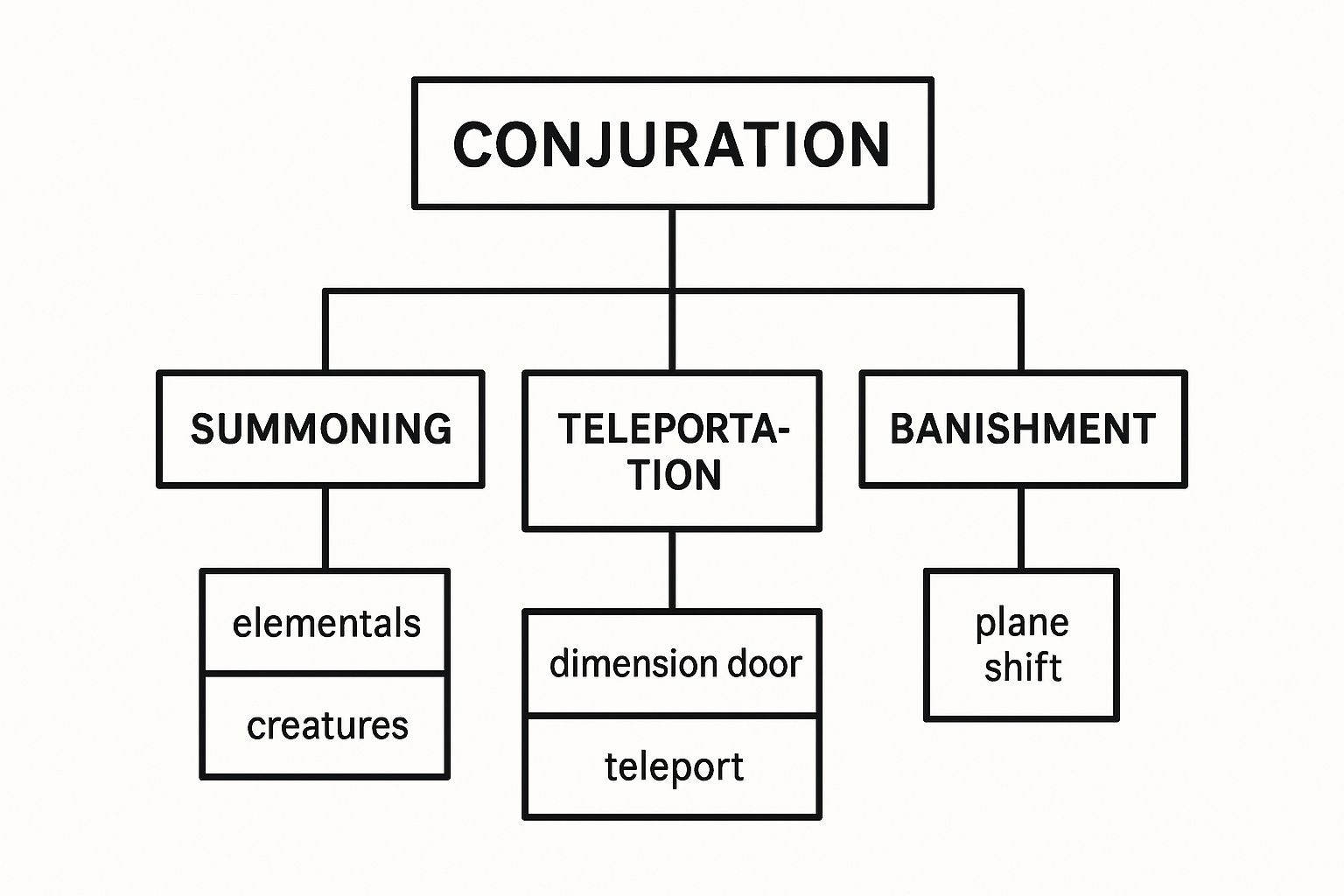
As you see, even one discipline offers multiple paths, from summoning extraplanar allies to bending the very fabric of space.
This idea of strategic depth – choosing a specialization and mastering its intricacies – is a cornerstone of the greatest tabletop games. It matters not if you're summoning a demon in a roleplaying campaign or laying down a powerful creature card in a game like TerraClash; the core principle remains. Understand your power to control the field.
Magic is a language, and the eight schools are its dialects. An Evoker shouts in thunder and flame, while an Illusionist whispers in shadows and lies. To become a master, you must learn to speak them all.
As we prepare to delve into the deeper mysteries of each school, this quick-reference grimoire should serve you well.
Before we unbind the secrets of each school, here is a handy table that summarises their essence. Think of it as a cheat sheet for aspiring wizards.
| School of Magic | Core Function | Typical Practitioner Archetype |
|---|---|---|
| Abjuration | Protection, Warding, Banishment | The Guardian, The Sentinel |
| Conjuration | Summoning, Creation, Teleportation | The Planeswalker, The Creator |
| Divination | Scrying, Prophecy, Revelation | The Seer, The Oracle |
| Enchantment | Influence, Compulsion, Charm | The Diplomat, The Puppeteer |
| Evocation | Elemental Damage, Raw Power | The Artillery Mage, The Destroyer |
| Illusion | Deception, Phantoms, Misdirection | The Trickster, The Shadow Weaver |
| Necromancy | Life, Death, Animation | The Reanimator, The Soul Binder |
| Transmutation | Alteration, Transformation, Shaping | The Alchemist, The Shapeshifter |
This table grants you a glimpse into the immense potential locked within each school. Now, let us pull back the curtain and examine them, one by one.
Power is not always a blinding flash of light or a deafening explosion. Sometimes, the most profound strength comes from quiet certainty and an unbreakable defence. Here we find the subtle but potent might of Abjuration and Divination, two of the most tactical Dungeons and Dragons schools of magic.
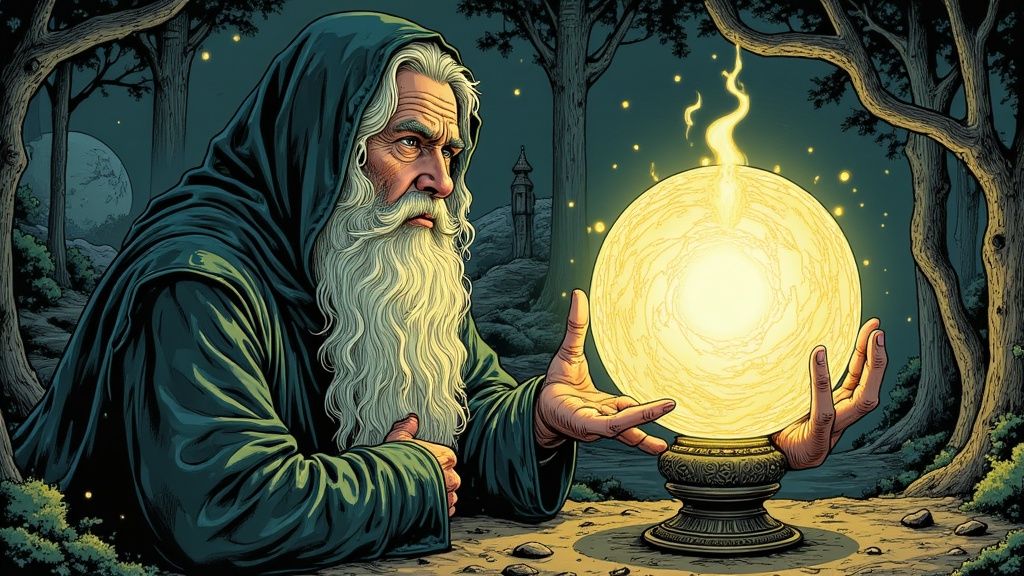
Think of Abjuration as the art of magical protection. It is the shimmering, invisible shield that deflects a killing blow, the ward that seals a demon in its prison, or the perfectly timed countermeasure that snuffs out an enemy spell. An Abjurer is the party's ultimate guardian, a sentinel whose magic declares, "You shall not pass." Spells like Shield and Counterspell form the bedrock of any solid defence, proving that preventing harm is always better than healing it.
Divination, on the other hand, is the art of seeing beyond the veil. It is the school of pure knowledge, offering glimpses into the past, clarity on the present, and warnings of what is to come. A Diviner provides invaluable foresight, whether uncovering hidden enchantments with Detect Magic or steering the party away from disaster with a well-phrased Augury. They do not win battles with brute force, but with information.
While one school guards the body and the other enlightens the mind, both Abjuration and Divination are fundamentally about control. An Abjurer controls the flow of hostile magic on the battlefield, while a Diviner controls the flow of information. This strategic mindset is vital in a game like D&D, where knowing your enemy's intent is as important as stopping them from enacting it.
The supportive and tactical thinking these schools encourage is not just for wizards, of course. You can see similar themes in our guide to powerful D&D Druid spells.
The wise mage knows that a single truth, revealed at the right moment, can be more devastating than any fireball. An unanswered question is a weakness waiting to be exploited.
There's a growing appreciation for these kinds of supportive roles, which reflects a fantastic shift in the tabletop community. The D&D player base is more diverse than ever, with recent data suggesting that around 39% of players identify as female. Here in the UK, one can see this in the explosion of diverse actual-play streams that celebrate clever, non-combat solutions and collaborative storytelling. If you're curious, you can discover more about player diversity on D&D Beyond.
Some spellcasters are not content to simply destroy or defend. They are the true artisans of the arcane, who look upon the world and see a lump of clay awaiting their touch. This is the realm of Conjuration and Transmutation, two of the most inventive and creative Dungeons and Dragons schools of magic. They are a perfect fit for players who love to think on their feet, seeing the world not just as it is, but as it could be.
Conjuration is the spectacular art of summoning, creation, and instantaneous travel. A skilled Conjurer can pluck a celestial ally from another plane to aid them, conjure a solid bridge from thin air, or whisk their friends from a dragon's fiery breath in the blink of an eye. They are the ultimate battlefield controllers, changing the very calculus of a fight by adding new allies or obstacles at will.
Transmutation, by contrast, is about masterfully altering what is already there. This school of magic rewrites the basic rules of matter and life itself. A Transmuter might turn a rampaging ogre into a harmless sheep with a quick Polymorph, grant a friend the power of flight, or even make their own skin as tough as solid stone.
At their heart, these schools are about creating solutions from nothing. A locked door is hardly a problem for a Transmuter who can change the shape of the lock, or for a Conjurer who can bypass it entirely with a well-placed Dimension Door. This kind of creative problem-solving is what makes tabletop gaming so enthralling.
The Conjurer brings new pieces to the board, while the Transmuter changes the very rules of the game. Both understand that victory isn't always about overpowering the enemy, but about reshaping the battle to your own advantage.
This way of thinking—where cleverness and tactical placement win the day—is the same spirit found in the best indie deckbuilding games. A Conjurer's Summon Greater Demon can completely flip the script on a losing battle, much like drawing that one perfect creature card in a game such as TerraClash. Both demand foresight and a knack for controlling the field. The possibilities are practically endless, whether you're calling forth an elemental or reshaping the world itself.
Why batter down a door when a single, well-placed word can convince the guard to open it for you with a smile? Here we enter the truly cunning and mind-bending schools of magic: Enchantment and Illusion. These are not the tools of brute force; they are the instruments of masterful trickery and psychological dominance.
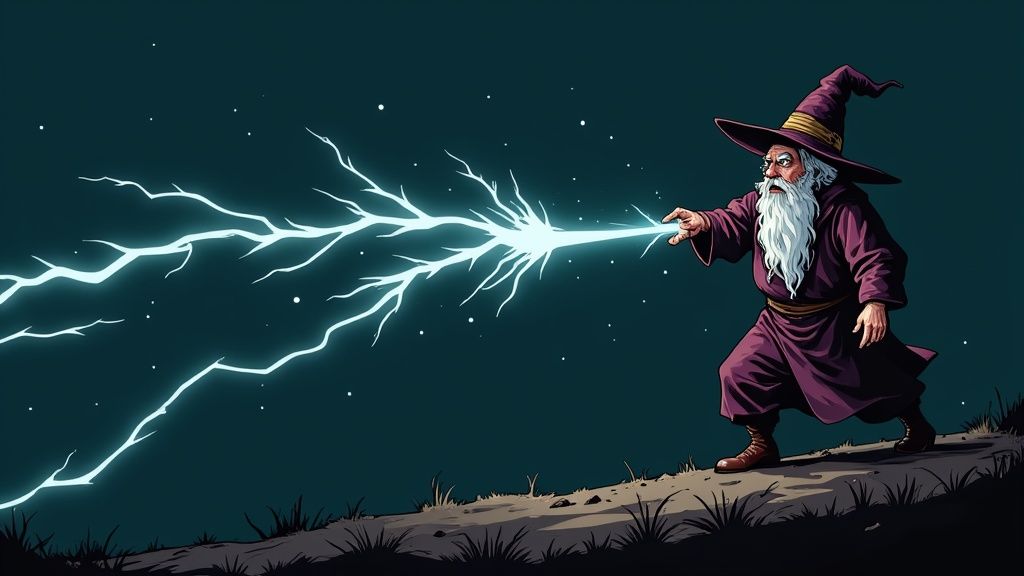
Enchantment is the delicate art of pulling the strings of the mind itself. Think of it as a puppeteer's craft, turning a furious enemy into a helpful, if temporary, friend with a quick Charm Person spell. With a carefully worded Suggestion, you can plant a brilliant idea right into a stubborn noble's head. An Enchanter can fill their allies with unshakeable courage or stop a rampaging ogre dead in its tracks with a wave of magical sleep.
Illusion, on the other hand, is about fooling the senses. The Illusionist is a master of misdirection and psychological warfare. They conjure phantom noises to send guards on a wild goose chase, create the image of a solid stone wall to hide a quick getaway, or simply vanish from sight altogether. Their weapon is perception, twisting what their enemies see, hear, and believe to be real.
While one school meddles with the mind and the other plays tricks on the eyes, both reward the same kind of player: the one who would rather outsmart their foes than simply overpower them. These schools are all about controlling the narrative, whether in a tense diplomatic meeting or a frantic dungeon brawl. After all, stopping a fight before it even starts with a clever charm, or luring a whole patrol into a fake pit trap, is so much more satisfying than just another sword fight.
The most powerful weapon is not a sword, but an idea. Plant the right thought or create the right falsehood, and the world will bend itself to your will without a single drop of blood being spilt.
This strategic mindset—where out-thinking your opponent is the path to victory—is something you see all the time in tabletop card games. In a tactical deckbuilder like TerraClash, you aren't just playing your own hand. You're constantly trying to get inside your opponent's head, anticipating their strategy and using your own abilities to derail it. It is much like an Illusionist making an enemy attack a shadow; a skilled card player can bait their rival into wasting powerful resources on a manufactured threat, letting them seize control and clinch a well-deserved win.
If you are the kind of player who wishes to feel raw, untamed power thrumming at your fingertips, two magical schools stand above the rest. Both Evocation and Necromancy offer a direct path to dominance, one through elemental fury and the other by twisting the very threads of life and death.
Evocation is the art of pure, spectacular destruction. Think of the roaring inferno of a Fireball, the deafening crack of a Lightning Bolt, or the world-ending impact of a Meteor Swarm. An Evoker is a walking, talking piece of magical artillery, channeling the fundamental forces of the cosmos to obliterate their enemies. Their magic is loud, flashy, and gets the job done in the most direct way imaginable.
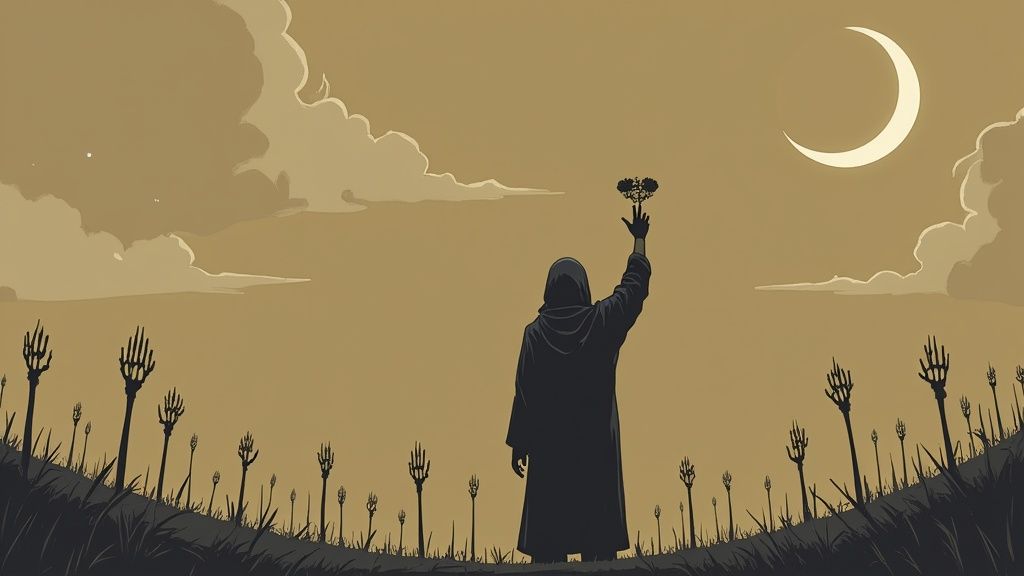
From the heart of the battlefield’s firestorm, we step into the shadows with Necromancy. This is the school that always turns heads, often for the wrong reasons. It is the misunderstood art of manipulating the primal energies of life and death, and it goes so much deeper than just raising a few skeletons. A true necromancer can siphon the very life force from a foe, inflict withering curses, and even snatch an ally back from the brink of the grave.
A savvy Necromancer plays the long game. While the Evoker is busy blowing up the front lines, the Necromancer is controlling the entire flow of the battle. They can raise a tireless legion of undead to swamp their enemies or use their grim powers to keep their friends fighting long after they should have fallen. It’s all about resource management, where the resources just happen to be souls and bodies.
Do not think of the Necromancer as a ghoulish puppet master. They are a student of the soul's delicate balance, understanding that to command death, one must first have an intimate knowledge of life.
This feeling of direct control, whether through overwhelming force or cunning manipulation, is what makes these schools so thrilling to play. Preparing a devastating Chain Lightning has the same satisfying punch as setting up a game-winning combo in a deckbuilder. At the same time, a Necromancer’s tactical use of minions feels a lot like the careful board control needed in card games like TerraClash. Both offer a path to dominion, leaving you with one simple choice: will you command the storm, or the grave?
So, you have a handle on the eight schools of magic. The theory is tucked away, but how do you make it sing at the table? This is where the real fun begins, whether you are the one slinging spells or the one building the world they're slung in.
If you are a player, think of this as more than just picking a spell list. It is about choosing an entire magical philosophy. Do you see yourself as a steadfast guardian, wrapping your allies in the protective energies of Abjuration? Or are you more of a chaotic prankster, someone who delights in bending reality with a clever Illusion? Your chosen school is the heart of your character’s power.
And for you Dungeon Masters? The schools are your toolkit for crafting a world that feels genuinely magical. They are the secret ingredients for designing memorable encounters, challenging puzzles, and entire story arcs that breathe arcane life.
Getting to grips with these dungeons and dragons schools of magic is what transforms a good game into a great one. It moves you beyond a simple series of fights and into a story with real depth. That is the kind of strategic thinking that forges the best tabletop moments, a principle we hold dear in both classic RPGs and our own indie projects like TerraClash.
When you build a world where magic has rules, consequences, and a tangible feel, you are not just giving players problems to solve. You are inviting them to think critically, to see their spells as tools, not just buttons to press. Their choices suddenly have weight, and their victories feel truly earned.
Of course, all the magical theory in the world will not help if your spells do not land. Knowing how to calculate your Spell Save DC in 5e is crucial; it is often the razor's edge between a legendary victory and a disappointing fizzle.
Still have a few lingering questions? Do not worry, every student of the arcane does. The Weave is a complex and beautiful thing. Let's clear up some of the most common queries that cross a spellcaster's mind.
Ah, the classic debate. The truth is, there is no single "best" school. Power in D&D is all about context.
Sure, an Evoker can blast a horde of goblins to smithereens with a single, glorious Fireball. In that moment, Evocation feels like the king of the battlefield. But what if you could have avoided the fight altogether? A subtle Enchantment spell might have convinced the goblin leader to let you pass, or a clever Illusion could have sent the whole warband chasing phantoms. Many would argue that is a far greater display of power.
The most powerful school is always the one that solves the problem right in front of you. It's about having the right tool for the job, whether that tool is a hammer of pure force or a key of subtle influence.
Of course! In fact, you would be a rather limited spellcaster if you did not. Most magic-using classes are designed to dabble across the magical spectrum. Wizards, for example, have the potential to learn spells from every single school, creating a diverse and adaptable arsenal.
Even if you choose to specialise, becoming, say, a Diviner or an Enchanter to gain specific perks, that never locks you out of learning from other traditions. Think of it like a painter.
A wise mage does not limit their palette to a single colour. True mastery comes from knowing when to paint with the gentle hues of Enchantment and when to use the fiery reds of Evocation.
Clerics and Druids also have wonderfully varied spell lists, pulling from different magical philosophies to heal, protect, attack, and control the battlefield. Versatility is a spellcaster's greatest strength.
It certainly has a grim reputation, does it not? But no, Necromancy is not inherently evil. This school is about the fundamental forces of life and death, the positive and negative energies of existence.
While that absolutely includes things like raising skeletons and zombies, it also covers spells that can siphon life from a foe to heal an ally, or even allow you to speak with the dead to uncover a vital clue. The intent behind the magic is what matters. A Necromancer who uses their powers to save lives is no more evil than the Evoker who burns enemies alive. A character’s alignment is defined by their choices, not the label on their spells.
The tactical thinking that goes into mastering the Dungeons and Dragons schools of magic—picking a specialisation, anticipating your enemy's moves, and finding that perfect spell for the moment—is the very same spirit we love in tactical card games. If you enjoy that kind of strategic depth set in a rich fantasy world, you should definitely keep your scrying eye on TerraClash. You can explore our world and prepare for the campaign over at https://terraclash.co.uk. For more tales of tabletop glory, consider exploring the worlds of Gloomhaven or the vibrant Kickstarter scene for indie board games like Frosthaven.

