Gather 'round, adventurers, and lend an ear. If you wish to command the mystical battlefields of the multiverse, you must first learn the very language of power: the magic the gathering types of cards. All arcane might flows from two sources: Lands, which are the wellspring of your energy, and Spells, the incantations that bend reality to your will. This is the fundamental truth of every great duel.
Before you can summon ancient dragons or counter a rival's devastating ritual, you must learn to read the grimoire that is your deck. Do not see it as mere cardboard; it is your spellbook, a tome filled with loyal allies, world-shattering incantations, and the very ground that fuels your magic.
This guide is your map. We shall begin our quest by exploring the seven core card types, the cornerstones upon which every game of Magic is built.
Each type of card has a unique destiny, from the creatures that march to war for you to the sorceries that can reshape reality in a flash. Understanding this elegant system is the first, most vital step on any Planeswalker's journey. It is the kind of foundational knowledge that will serve you well in any test of strategic might, from the storied halls of Magic to the freshest campaigns whispered about on Kickstarter.
This enchanted diagram reveals how the card types are bound together.
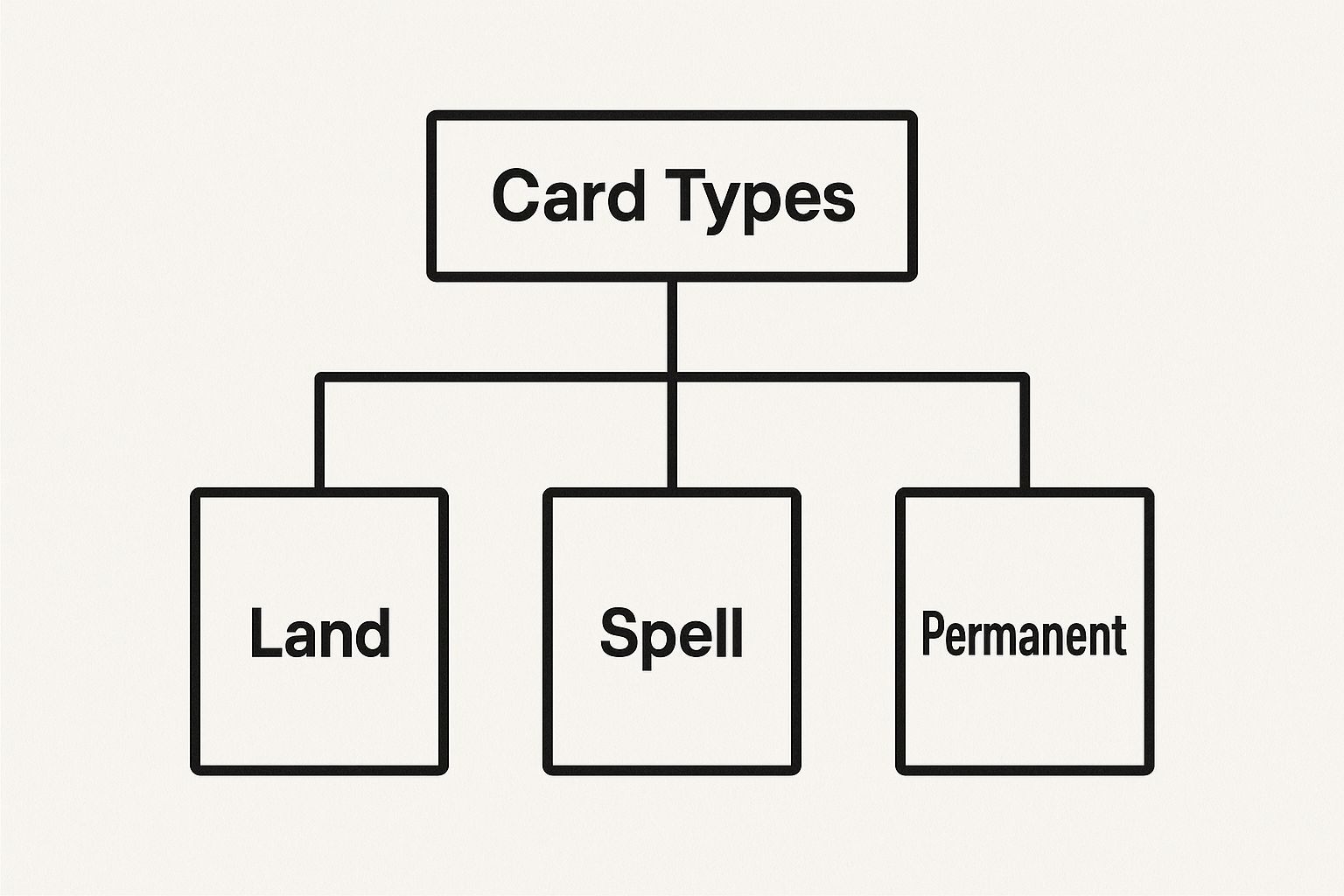
As you can see, the arcane structure neatly divides your resources (Lands) from your actions (Spells), and some of those spells become lasting forces upon the battlefield (Permanents).
To give you a quick cheat sheet before our deeper dive, here is a simple breakdown of what each core card type is summoned to do.
This quick-reference scroll summarises the fundamental roles of the main card types you'll encounter on your quest.
| Card Type | Primary Role on the Battlefield |
|---|---|
| Land | Your mana resource; tapped to generate energy for spells. |
| Creature | The backbone of your army; attacks and blocks. |
| Sorcery | A powerful one-shot spell; cast only on your turn. |
| Instant | A fast, reactive spell; can be cast at almost any time. |
| Enchantment | A persistent magical effect that alters the rules of the game. |
| Artifact | A magical item or construct; provides ongoing abilities or effects. |
| Planeswalker | A powerful ally who fights alongside you with unique abilities. |
Consider this table the first page of your spellbook—the key that unlocks all that is to come.
Mastering these fundamentals is everything. It is like a warrior learning the difference between a sword, a shield, and a bow. Each has its purpose, and knowing the precise moment to wield it is the secret to victory.
The greatest mages are not those with the most powerful spells, but those who understand how every piece of their grimoire works in concert. True power lies in synergy, not singular strength.
Learning these card types is your first true step towards becoming a grand strategist. Once you begin to see the threads that connect them, you’ll be well on your way to building a truly formidable deck. For those ready for that next trial, our guide on how to build an MTG deck offers deeper wisdom for your journey.
Every great general needs an army, and in the grand tapestry of Magic, your creatures are the heart and soul of your forces. They are not just ink and card; they are your soldiers, your beasts, and your mages, summoned forth to wage war in your name. Think of each as a loyal warrior, answering your personal call to arms.
Creatures are arguably the most forthright of all magic the gathering types of cards. Their essence is captured in two crucial numbers in the bottom-right corner: power and toughness. Power is the damage they deal in the clash of combat, while toughness is the measure of the beating they can endure before being sent to the graveyard. A hulking Dragon may possess immense power, whereas a simple Wall could have sky-high toughness, its sole purpose to defend your domain.
A vast portion of Magic's strategy revolves around establishing what seasoned mages call 'board presence'. It's a simple idea: summon enough creatures to the field to pose a true threat to your opponent while also maintaining a solid defence. One powerful champion is a fine thing, but they can be dealt with. An entire legion? That is a riddle your opponent must solve, and quickly.
Your creatures are your primary tools for wearing down your opponent's life total and dealing with their own forces. Knowing the right moment to press the attack versus when to hold back and defend is a skill sharpened with every game you play. It is the core tension of the duel.
But a creature is so much more than its stats. Many arrive with special abilities that can turn the tide of a game. Keywords like Flying let them soar over ground-based defenders, while Trample allows them to smash through lesser blockers and still inflict damage upon your opponent. These tactical layers are a hallmark of great tabletop combat, from sprawling war games to focused deckbuilders, where a single clever unit can outwit an entire army.
The most powerful of these creatures are often one-of-a-kind heroes, which you can explore further in our guide to Magic the Gathering legendary creatures.
A battlefield without creatures is but an empty stage. It is their clash, their abilities, and their ultimate sacrifice that tells the story of victory or defeat.
Mastering your creatures is the first step to mastering the art of combat in Magic. Each one you summon adds a new character to the unfolding saga of your duel, bringing you one step closer to claiming victory.
Mastering Magic isn't just about the armies you summon; it’s about the raw arcane power you command directly from your hand. This is the domain of Instants and Sorceries. They are your one-shot spells, flashes of pure magical energy that create a powerful effect before vanishing into your graveyard.
Think of Sorceries as your grand, deliberate rituals. You can only cast them during your own turn when the battlefield is calm. They are your haymakers: the devastating fireball that clears the board, the incantation that summons a powerful ally, or the scrying spell that lets you peer into your library for the answer you seek.
Instants, on the other hand, are the tools of reflexes and cunning. They are your trump cards, the ace hidden up your wizard's sleeve.
The true power of Instants lies in their timing. Unlike a Sorcery, you can cast an Instant almost whenever you wish – even in the midst of your opponent's turn. This simple rule cracks the game wide open, transforming it from a simple turn-based affair into a dynamic duel of wits and foresight.
Suddenly, you can react. Did your opponent just summon a game-winning beast? You can respond with a spell to banish it before it can act. Are they attacking with their full might? You can spring a trap, boosting your blocker's power at the last possible second. This dance of action and reaction is the heart and soul of what makes the game so thrilling.
This back-and-forth is a hallmark of great fantasy battles, a core element you'll find in many of the exciting new tabletop campaigns materialising from the aether. Mastering this timing is a skill that translates across countless games. If this kind of reactive gameplay excites you, you might want to see how we've explored similar ideas by reading about our approach to spells.
These fleeting but powerful spells are absolutely fundamental to any good strategy. A mage who relies only on creatures is a predictable one, easily outmanoeuvred by a rival with a hand full of tricks.
The most dangerous mage isn't the one with the biggest fireball. It's the one who knows the perfect moment to cast it. Foresight and timing are the sharpest weapons in any spellcaster's arsenal.
Ultimately, Instants and Sorceries grant you the power to shape the narrative of the game. They are your answers, your threats, and your nasty surprises, allowing you to stamp your authority on the duel in a sudden, game-changing flash of power.
Some magic is but a flash in the pan—a quick burst of fire, a momentary shield. It is gone as soon as it appears. But other magic is woven to last, threaded into the very fabric of the battlefield. That is the domain of Artefacts and Enchantments. These are two of the most cunning magic the gathering types of cards you can wield.
Unlike a Sorcery that happens once and is done, these are permanents. Once cast, they remain on the field, quietly (or very loudly) bending the rules of the game in your favour.
An Artefact is best thought of as a magical item. It could be a legendary sword, a strange clockwork device, or a mystical mana-generating rock. Crucially, many are colourless, meaning you need no specific colour of mana to cast them. This makes them incredibly flexible tools for almost any deck.
Enchantments, on the other hand, are persistent spells. Think of them as a magical aura or a lingering curse that settles over the battlefield. You might use an Enchantment to grant your creatures powerful new abilities, or you could afflict your opponent's greatest threat with a debilitating curse, rendering it useless.
The true sorcery begins when you combine these permanents to build a strategic 'engine'. This is the art of getting several Artefacts and Enchantments working in concert, creating powerful synergies that snowball into an overwhelming advantage over time.
Imagine enchanting one of your lands so it produces double the mana. You then use that extra power to fuel an artefact that lets you draw an extra card every turn. Suddenly, you are out-resourcing your opponent at a frightening pace.
This concept of building a lasting advantage is what makes deep strategy games so rewarding. It’s that puzzle-like thrill of assembling the perfect machine, a design philosophy that inspires countless tabletop games today, from epic fantasy board games to inventive new deckbuilders. The real power lies in how these persistent effects warp the very rules of engagement.
A single enchantment can completely change the maths of a duel, altering the value of every other card in play. The most notorious examples, like the game-warping Blood Moon, prove that one well-placed permanent can be more devastating than any creature.
Mastering these cards is about thinking ahead. You are not just trying to win this turn; you are laying the foundations for an inevitable victory. A well-oiled engine can feel completely unstoppable, grinding your opponent down as your own power grows—a true mark of a master spellcaster.
Beyond your armies and your library of spells, a different class of permanent exists: the Planeswalker. These are not mere foot soldiers or fleeting incantations; they are legendary figures, powerful mages whose influence echoes across entire worlds. Think of them less as a card you play and more like a second player joining your side of the fight.
When a Planeswalker enters the battlefield, they arrive with a specific amount of loyalty, tracked with counters. This loyalty is their lifeblood. Each turn, you may activate one of their abilities, which will either add or subtract loyalty, building them toward a devastating final ability—an 'ultimate' so powerful it can often win the game on the spot.
Summoning a Planeswalker completely changes the tempo of the game and forces your opponent into a difficult choice. Do they continue attacking you, seeking to reduce your life to zero? Or do they divert their forces to attack your new, powerful ally before they can unleash that game-ending ultimate? It is a classic dilemma that splits their focus and can buy you the precious time needed to seize control.
A Planeswalker on the field is more than just a source of power; it's a declaration. It tells your opponent the game has just escalated, forcing them to deal with a persistent threat that only gets stronger with each passing turn.
This idea of a central, heroic figure growing in power is something fantasy fans have loved for decades. It is at the heart of countless D&D campaigns and epic board games, where one hero's presence can shift the entire balance of power. We find that feeling so compelling, it's a core tenet we're exploring in new tabletop experiences like TerraClash, designed for brave adventurers aged 12 and up. It's this dynamic that makes Planeswalkers one of the most exciting magic the gathering types of cards to have in your hand.

You cannot cast a single spell or summon the smallest goblin without the raw magical energy to make it happen. That energy is called mana, and it all flows from one place: your Lands. They are, without a doubt, the most fundamental of all magic the gathering types of cards.
Lands are the bedrock of your entire strategy. They possess no power or toughness and will never charge into combat. Instead, they are the engine room of your deck, the silent power source that brings everything else to life.
The rules are simple: you may play one land from your hand each turn. By 'tapping' it (turning it sideways), you draw forth its mana, which you then spend to cast your other cards. Managing this simple resource is one of the most critical skills in the game. Without a steady stream of mana, the most devastating dragon in your hand is just a pretty picture on a piece of cardboard.
The first lands every player learns are the five Basic Lands. Each one taps for a single colour of mana, corresponding to one of Magic's five colours:
Building a solid mana base with these is the first step any new Planeswalker takes. But the Multiverse is a vast place, and there are countless non-basic lands that offer more power and flexibility, often with a catch. Some can produce several different colours of mana, while others have unique abilities, like transforming into a creature to ambush an unsuspecting opponent.
Finding the right balance of lands is a deep and rewarding strategic puzzle that defines how your deck plays.
The flow of mana is the heartbeat of the duel. A mage who stumbles with their lands will find their spells faltering and their creatures arriving too late to the battle. Consistency is the true source of power.
This isn't just a Magic principle, either. The art of building and managing resources is a core skill in almost every great strategy game. Whether you're embarking on a grand board game campaign or exploring an innovative new Kickstarter project like the deckbuilder TerraClash, you'll find that mastering your economy is the key to victory. It’s what separates a fizzling apprentice from a true archmage.
Every journey begins with a first step. The path to becoming a seasoned Planeswalker is paved with questions, and that is a good thing! Let us clear the fog from some of the most common queries that new adventurers have. Consider this your first lesson in the arcane arts.
If you are just starting your quest, become comfortable with two things: Creatures and Lands. Truly, this is the core of the game.
Lands are your engine. They provide the mana you need to do anything. Without them, the mightiest spells in your hand are but useless scrolls. Creatures are your army on the ground. They teach you the fundamental rhythm of combat—when to attack, when to hold back and block, and how to read the state of the battlefield.
Master how these two interact, and you will have a rock-solid foundation upon which to build your legend. Everything else will make far more sense once you do.
The classic rule of thumb, and it is classic for good reason, is to include about 24 lands in a 60-card deck. This puts you at around 40% lands, which is often the sweet spot for consistently drawing enough mana to cast your spells on time.
But this is not an immutable law. It is more of a starting point for your own magical experiments. If your strategy involves a swift, aggressive deck packed with cheap spells, you might get away with a few less. Conversely, if your grand design involves summoning massive, game-ending dragons, you will probably want to add a few more to ensure you can call upon their power.
It all comes down to timing.
Think of a Sorcery as a grand, planned ritual. You can only cast it during the main phase of your own turn when nothing else is happening. It’s a deliberate, powerful move you make on your own terms.
Instants are the opposite. They are a sudden burst of magic you can unleash almost whenever you want, even right in the middle of your opponent's turn. This is what makes them so potent for setting traps, pulling off surprise blocks, or countering a key spell. Mastering instants is how you ascend from simply playing your cards to truly out-thinking your opponent.
Learning the secrets of Magic is an adventure in itself. Every rule you master and every card you understand deepens your connection to one of the richest strategy games ever conceived. If this quest through creatures and spells has you excited to forge your own legendary decks, then keep your scrying glass pointed toward TerraClash. We're building a new world of deckbuilding adventure where strategy is king and every duel tells a story. Find out more about the world we are creating at https://terraclash.co.uk.

