Greetings, adventurer, and welcome. Before you can hope to command the vast forces of the Multiverse, you must first learn the language of magic itself. Every incantation, every summoned beast, hinges on the fundamental nature of the MTG card type – it is the arcane signature of every spell you cast.
Consider your deck a grimoire, filled with varied and potent magics. Some entries summon loyal soldiers to your front line, while others are devastating cannonades of pure energy that can alter the course of destiny in an instant. This is the core schism: magics that endure on the battlefield (Permanents) and those whose power is brilliant but fleeting (Non-Permanents).
To grasp a card's role is the first step on the path to becoming a master tactician. It is akin to learning the difference between a knight's shield and a sorcerer's fireball. Some cards call forth allies to fight at your side, turn after weary turn. Others are sudden, ephemeral bursts of energy – a crackle of lightning or a protective ward that dissipates once its purpose is served.
This concept of lasting resources versus momentary effects is the very essence that gives great strategy games their soul. You see it in the enduring legions of Warhammer, where mighty heroes hold the line, and in modern deckbuilders where a single, cunning play can unravel an opponent's grand design. It is all a matter of what stays, and what fades into the ether.
The battlefield is the crucible where fates are decided, and the greatest distinction between spells is whether they remain.
Permanents: These are your tangible assets in the fray. We speak of Creatures, Enchantments, Artefacts, and the very Lands themselves. Once summoned, they remain, building your presence and furthering your strategy until an adversary finds a way to dispel them. They are your loyal bannermen and lasting magical wards.
Non-Permanents: This is raw, untamed magic. Instants and Sorceries are cast, their world-altering effects unfold, and then they are consigned to the graveyard. They are the comets you call from the heavens, the counter-spells that unravel a foe's machinations—grand, game-swinging moments that are gone in a flash but can change everything.
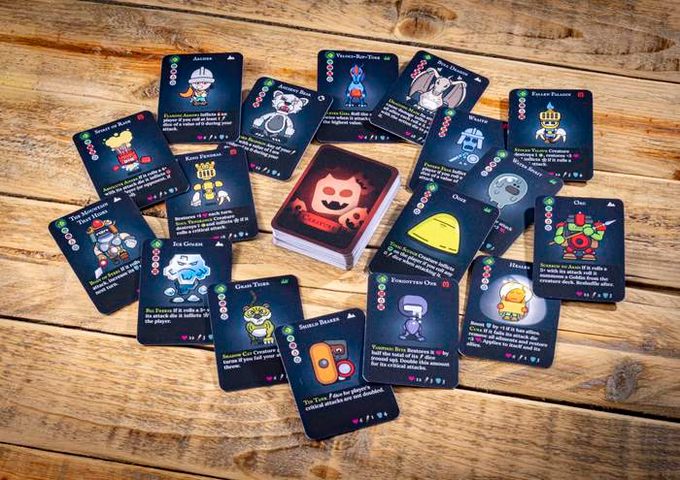
This dynamic is where true tactical mastery is forged. Do you commit your power to raising a formidable army of permanents, or do you hold your mana in reserve for a perfectly timed Instant? This is the kind of weighty decision that breathes life into a fantasy world and is a founding principle that shapes new tabletop realms, like the saga of TerraClash, a game crafted for adventurers aged 12 and up. To delve deeper into how different worlds channel their magic, you can consult our arcane library on potent spells.
This simple chart illuminates the core card types, revealing the most common building blocks you shall find in any spellbook.
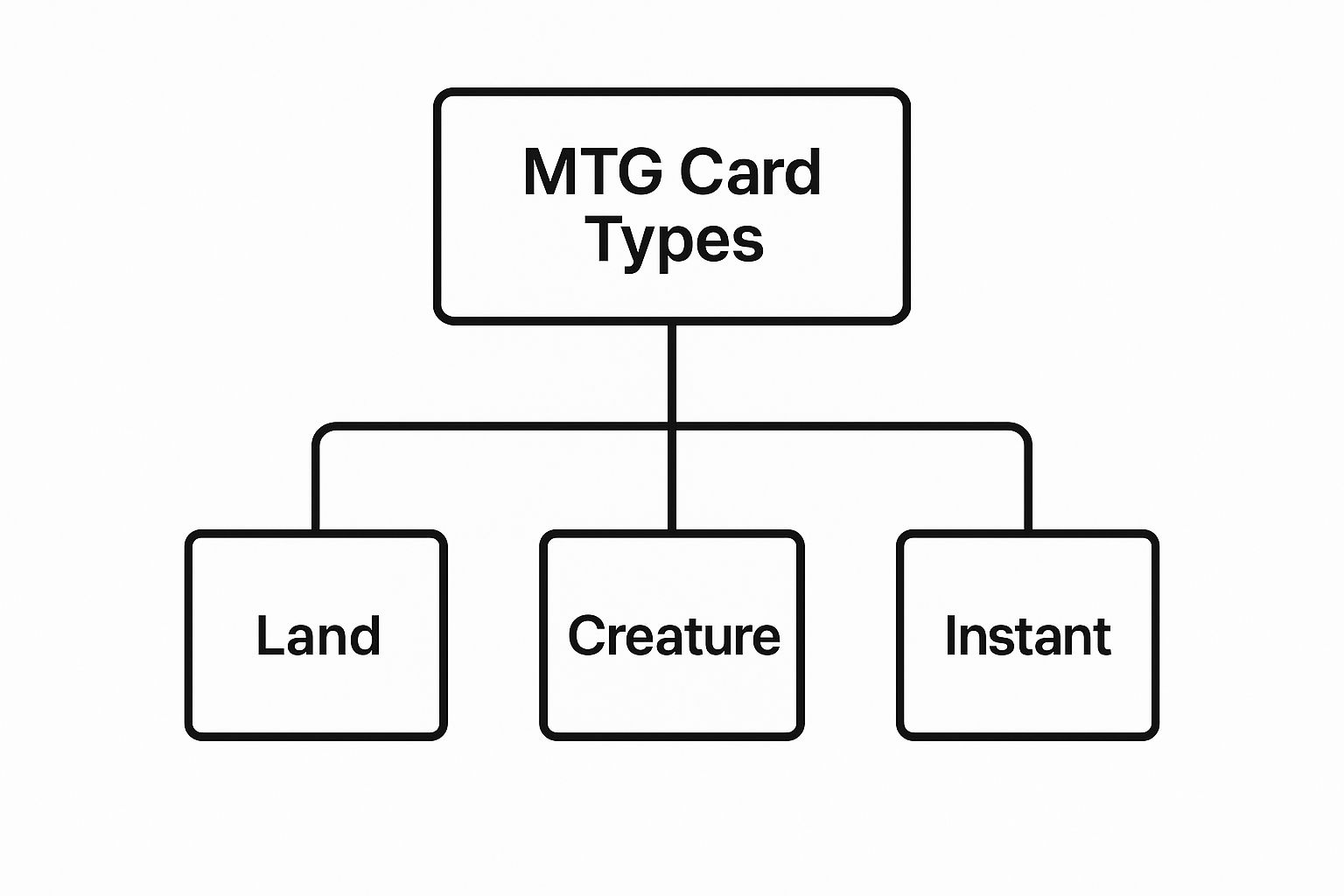
As you perceive, every spell possesses a fundamental identity. From this origin, it branches into the forces you command, the resources you gather, and the fleeting magic you wield.
Heed my words, Planeswalker, for we now speak of the very backbone of any conflict. No general wins a war without soldiers, and in this realm, your soldiers are Creatures. This is the most essential MTG card type, and for good reason. They are the heart and soul of your army—the valiant knights, snarling beasts, and cunning mages who will fight and fall for your cause.
From a single, terrifying Dragon to a chittering horde of Goblins, creatures are your primary means of engaging the foe. They are permanents, meaning they remain upon the battlefield once summoned, ready to obey your commands turn after turn. It is this feeling of marshalling your forces and making those harrowing tactical choices that makes the chronicle of your battles so compelling.
Gaze upon any creature card, and you shall spy two crucial numbers in the bottom-right corner. These are its Power and Toughness, and they tell you all you need to know of how it fares in the crucible of combat.
Think of these two numbers as a creature's martial prowess and its resilience. It is that simple.
When two creatures clash, they strike each other simultaneously, dealing damage equal to their Power. If a creature suffers damage in a single turn equal to or greater than its Toughness, it is slain. This elegant dance of attack and defence is the very soul of Magic's combat.
The true art of battle is knowing when to charge and when to hold the line and defend your own life. It is the core dilemma you shall face each turn—the true test of a commander.
This strategic depth is why creatures are so central to the game. Deciding which creatures to summon is a huge part of your identity as a commander. Some are legendary heroes with unique, game-altering abilities. If you wish to learn of the most iconic figures, our guide to Magic The Gathering legendary creatures is a tome well worth adding to your spellbook.
There is more to a duel than the clash of steel and claw. Beyond the raw power of summoned beasts lies a deeper, more subtle game of magic. Some battles are won not by a single, brutal assault, but by slowly weaving persistent spells that warp the very rules of the fight. This is the domain of Enchantments and Artifacts – two permanent card types that offer lasting, game-changing advantages.
I envision these as the legendary relics and potent curses you might uncover in the depths of a forgotten dungeon. They do not always strike your opponent directly, but once on the battlefield, they fundamentally alter the state of play, creating a puzzle your foe must solve.
An Enchantment is pure magic made manifest upon the battlefield. Once you cast it, it lingers, creating a continuous magical effect. This could be anything from a powerful blessing that bolsters your entire army, to a crippling hex that weakens your opponent’s champion, or even a bizarre new edict that completely upends the game.
They generally come in two forms:
To truly master enchantments, you must think several turns ahead. You are not merely playing for the present; you are laying the magical groundwork for your ultimate victory.
If enchantments are raw magic, Artifacts are the crafted tools, arcane machines, and constructs powered by it. The defining feature for most artifacts is that they are colourless. This means any deck, no matter which colours of mana it channels, can employ them. This versatility makes them some of the most useful tools in a tactician's arsenal.
They can be a simple Manalith that helps you gather more mana, or a terrifying Wurmcoil Engine that stomps across the battlefield. Artifacts can be weapons you equip, arcane trinkets with strange abilities, or even creatures in their own right.
The true power of these permanents lies not in a single, explosive moment, but in their ability to build synergy. A well-placed artifact or a clever enchantment can become the cornerstone of your entire strategy.
This idea of combining different pieces to create an effect greater than the sum of its parts is the very soul of deckbuilding. Learning to perceive those powerful combinations is a skill that translates to almost any tabletop game. It is precisely this kind of strategic depth and synergy that we are exploring with TerraClash, where every item and skill can combine in surprising ways.
Every spell you sling, every creature you summon, and every grand ritual you enact begins in the same place. It all springs from the land beneath your feet. Welcome, Planeswalker, to the absolute foundation of all magic: the Land card. It is the most crucial MTG card type of all. Without lands, your spellbook is but a collection of fanciful words, and your army is naught but a gathering of inert pawns.
Think of lands as your direct conduit to the raw power flowing through the Multiverse. You do not "cast" them like other spells; instead, you are permitted to play one per turn, forging a new connection to the world's energy. Learning to manage this flow of power, which we call mana, is the first great challenge every budding mage must face. It's a skill that feels familiar if you've ever played other grand tabletop games, like carefully hoarding resources in Catan before making your decisive move.
The magical energies of the world are divided into five distinct colours, and each is drawn from a specific type of basic land. Understanding these is the key to comprehending the entire game.
The lands you place in your deck define the very nature of magic you can wield. This direct link between your resources (lands) and your actions (spells) is what makes the strategy so profound. A solid, reliable mana base is the bedrock upon which every victory is built.
A mage without mana is like a dragon without fire—an impressive sight, but ultimately powerless. The art of the duel isn't just in the spells you choose, but in making damn sure you can always pay for them.
Of course, the Multiverse is a strange and wondrous place, and not all lands are so straightforward. Beyond the basics, you shall find nonbasic lands—think ancient temples, shimmering crystal caverns, or unsettling sacrificial altars. These special locations might grant you multiple colours of mana or even possess powerful abilities of their own.
But this power often comes with a price. Some nonbasic lands enter the battlefield tapped, slowing your advance, while others can be incredibly vulnerable to your opponent's schemes. To see just how dire things can become when you rely too heavily on them, you can read our deep dive into the crippling power of the Blood Moon card. Learning to master your lands—both basic and nonbasic—is the first giant leap on your journey to becoming a master Planeswalker.
Not every spell is meant to endure. Some of the most game-altering magic is fleeting – a sudden burst of power that flares into existence, reshapes the battlefield, and then vanishes. This is the realm of Instants and Sorceries.
These are your one-shot spells, your direct interventions in the flow of battle. Think of them as the fireballs you hurl, the sudden surge of healing you bestow, or the cunning tricks that leave your opponent reeling. Unlike a creature or an enchantment, they do not remain on the board. You cast them, their effect transpires, and then they are sent to the graveyard. Knowing the precise moment to unleash these is a true sign of a skilled mage.
Think of a Sorcery as a carefully prepared ritual. It is a powerful piece of magic, but it requires your full attention, which is why you may only cast it during the main phase of your own turn when the din of battle has subsided.
This timing restriction is a trade-off for raw power. Sorceries are often the spells that accomplish grand, sweeping effects: wiping the board clean of creatures, creating a whole army of tokens from thin air, or forcing an opponent to discard their entire hand. Casting a sorcery is a declaration – you are taking your turn to enact a major part of your grand strategy.
Now, if sorceries are the planned rituals, Instants are the lightning-fast reflexes. This is where the true mind games of Magic begin. You can cast an instant almost any time you have priority, and that includes during your opponent's turn.
This flexibility makes them the ultimate tool for surprise and disruption. An instant is the perfectly timed counter-spell that negates your opponent's greatest threat. It’s the sudden surge of power that saves your creature in the midst of combat. It’s that last-second lightning bolt to the face that snatches victory just when they believed they were safe.
The real duels are fought on the stack. An instant is your way of interrupting their grand plan, turning what should have been their moment of triumph into utter despair. It is the art of the unexpected.
This constant back-and-forth, the potential for a sudden reversal, is what creates those truly memorable sagas at the gaming table. It’s a dynamic you see in tense co-op adventures like Gloomhaven, where one clever, perfectly timed action can pull a victory from the jaws of defeat. It’s that thrill of outwitting your opponent that we cherish and aim to capture when designing our own tabletop worlds.
You have almost completed your initiation into the arcane arts. You can command creatures, wield artifacts, and shape the battlefield with powerful spells. But now, it is time to delve into the deeper mysteries – the classifications that truly separate a novice spell-slinger from a master of the multiverse. Let us speak of Planeswalkers.
A Planeswalker is not merely another creature you summon to the field. They are powerful, unique allies who fight alongside you. Think of them as fellow adventurers, heroes with their own agendas and game-changing abilities. They arrive with a set number of loyalty counters, which serves as their life force, and each turn you may activate one of their potent abilities. These are no small feats; they can completely alter the course of a duel.
Of course, such power invites peril. Your opponents can attack your Planeswalkers directly, so keeping them safe is a strategic puzzle in itself. Protecting these powerful friends adds a fascinating layer to any match. They are, in essence, your ultimate champions.
Beyond the main MTG card type, nearly every card has a lineage – its Subtype. You shall find it on the type line right after the main type. Words like ‘Goblin’, ‘Wizard’, or ‘Elf’ are more than just flavour; they are the bedrock of some of the game's most powerful strategies.
This is where tribal synergy comes into play. An ‘Elf’ creature might grant a boon to all your other Elves. A ‘Goblin’ spell might become devastatingly strong if you control enough of its kin. Building a deck around a specific subtype, or tribe, is like assembling a fellowship. Your forces are simply stronger together, and it gives your deck a true sense of identity.
Finally, we have the Supertype, a special designation that comes before the card's main type. The one you shall see most often is Legendary. When you see this word, you know you are dealing with a one-of-a-kind character, item, or place. The game enforces this through the ‘Legend Rule’, which means you can only control one legendary permanent with the same name at any given time.
This rule makes you think strategically about when to play these uniquely powerful cards. You cannot simply flood the board with copies of a legendary dragon; there can be only one. It adds a wonderful narrative weight to the game, making these cards feel every bit as special as they are in the lore.
Understanding these intricate layers—Planeswalkers, Subtypes, and Supertypes—is the final step. It is where deckbuilding ceases to be about simple mechanics and becomes a true art form, a story you craft with every card choice.
It is this kind of deep world-building and mechanical synergy that makes a tabletop universe feel truly alive. This design philosophy, where every detail matters, is a guiding star for any new adventure, including the rich, strategic world of TerraClash that we are excited to soon unveil.
Every Planeswalker, from a fresh-faced neophyte to a grizzled archmage, has questions. Let us address some of the most common quandaries that arise when one begins to walk this path.
If you are just beginning your journey, fix your gaze upon Lands and Creatures. All else may wait.
Think of it thusly: Lands are your engine. They produce the mana you need to do anything. Without a solid mana base, the most powerful scrolls in your hand are but useless parchment.
Then you have Creatures. These are the bread and butter of your campaign. They are how you shall typically assail your opponent and how you shall defend your own life. Understanding how creatures function and how the tide of combat flows is the single greatest step toward claiming your first victory.
An excellent query, for it strikes at the very heart of the game's flow.
A Permanent is anything that remains on the battlefield after you cast it. Think of your Creatures, Artifacts, Enchantments, Lands, and Planeswalkers. They have a lasting impact and stay in play until something specifically removes them. They are your presence on the board.
A Non-Permanent, conversely, is a fleeting affair. This describes your Instants and Sorceries. You cast the spell, its effect occurs, and then the card goes directly to your graveyard. It is a momentary surge of power that can completely swing the game's fortunes, but it does not linger. For a deeper study into balancing these spell types, our guide on how to build an MTG deck holds further wisdom.
The beautiful interplay between all these different card types is what makes this game so endlessly fascinating. If this scroll has stoked your passion for strategic adventure, continue to explore. The world of TerraClash is always waiting with new strategies to discover and new stories to tell. https://terraclash.co.uk