Gather 'round, traveller. You’ve heard the whispers of fire-breathing dragons and forgotten dungeons, haven't you? That echo you hear is the call to adventure, and in the world of Dungeons & Dragons, your imagination is the most powerful weapon you'll ever wield. The roll of the dice can decide the fate of kingdoms, and this guide is your first map.
Welcome to the table.
So, you're ready to become a hero. Fantastic. The world of tabletop gaming is a vast and wondrous place, and Dungeons & Dragons is its cornerstone. At its heart, D&D is a game of shared storytelling. It’s a simple partnership, really, between one storyteller—the Dungeon Master (DM)—and the players, who step into the boots of mighty heroes.
The DM sets the scene, describing the world, the people in it, and the challenges lurking in the shadows. The players then decide how their characters react. This constant back-and-forth, this conversation, is the lifeblood of the game.
Every great fantasy story, whether it’s a dusty old novel or a modern card game, stands on a few core ideas. In D&D, we call these the three pillars of adventure. Get your head around these, and you're well on your way.
These three pillars aren't separate things; they're all woven together. A secret you discover while exploring might give you the leverage you need in a tense negotiation, which in turn might help you avoid a deadly combat encounter. It's all connected.
To help you get started, think of these pillars as the three main ways you'll interact with the world your DM creates. Each one offers a different kind of challenge and a different way to be a hero.
| Core Pillar | What It Means For You | A Simple First Action |
|---|---|---|
| Exploration | You're the one pushing the map's boundaries. It’s about curiosity and discovery. | Ask the DM, "What does my character see in the distance?" or "Is there anything unusual about this room?" |
| Social Interaction | You're a diplomat, a con artist, or an inspiring leader. Your words are your tools. | Approach a character the DM has described and say, "I want to ask the grumpy-looking blacksmith about the local rumours." |
| Combat | You are a warrior, a spellcaster, a defender. When swords are drawn, you act. | When a fight breaks out, declare a simple action like, "I swing my axe at the closest goblin!" |
Getting a feel for these pillars is your first real step into the game. Every decision you make will likely fall into one of these categories, pushing the shared story forward.
"The essence of any great tabletop game is the shared narrative. Whether you are delving into a dungeon in D&D or strategically laying down cards in a game like TerraClash, you and your friends are forging a new legend together, one decision at a time."
This spirit of collaborative storytelling is what makes tabletop gaming so special. It’s a tradition you see everywhere, from epic RPG campaigns to deckbuilding duels where every card tells a story. Now, it's time to begin your own tale.
Before you can stare down a dragon or outwit a cunning king, your hero has to begin somewhere. That "somewhere" is a humble piece of paper: the character sheet. This isn't just about jotting down numbers; it's the very first step of your adventure, the blueprint for the legend you’re about to become.
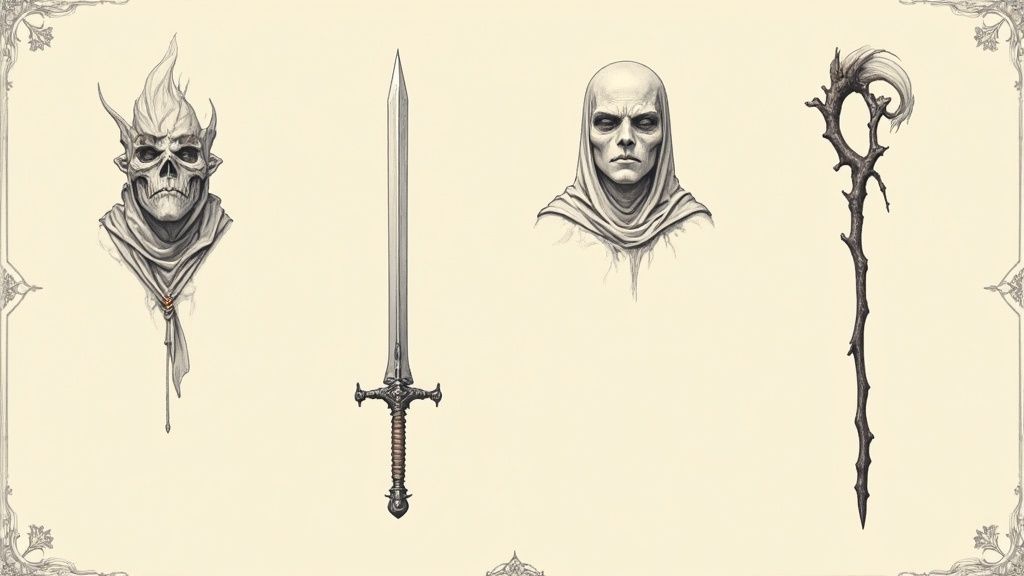
Think of it as your hero’s birth certificate, passport, and CV all rolled into one. Every choice you make here will echo through your entire campaign, defining who you are and what you can do. It's the beating heart of your adventurer.
Right, let's get down to the big decisions. First up is your character’s heritage, or Race. Are you a stout-hearted Dwarf, as resilient as the mountains you call home? Or maybe a graceful Elf, carrying the wisdom of ages in your eyes? Each choice comes with its own unique flavour and abilities that will shape how you see the world—and how it sees you.
Next comes your Class. This is arguably the most important choice you'll make, as it defines what you do. It’s your job, your calling, your unique way of solving problems. Are you a Barbarian who solves problems by hitting them very, very hard? A sneaky Rogue who slips through the shadows? Or a studious Wizard, rewriting reality with ancient words of power?
Your class is your toolkit. It's what you'll pull from when the DM asks, "What do you do?"
Every adventurer, from the mightiest warrior to the cleverest rogue, is built upon a foundation of six core Ability Scores. These numbers are the bedrock of your character, representing their raw talents and natural gifts. They influence just about everything you’ll attempt in the game.
These scores are the nuts and bolts of your hero. They answer the big questions: How strong are you? How quick are your reflexes? How good are you at convincing people? They’re what turn a cool idea into a character you can actually play.
Let's break them down:
A high Strength score means your axe hits harder, while high Charisma might let you talk your way out of a fight altogether. These stats give you a clear idea of what your character is good at and, just as importantly, where they might need a bit of help from their friends. For a full walkthrough, check out our guide on how to make a Dungeons and Dragons character.
Finally, it's time to give your character a soul. A pile of stats is one thing, but what makes them a person? A simple Backstory is what transforms them from a game piece into someone you and your friends will care about.
You don't need to write a ten-page novel. Just a few simple ideas are plenty: a lost sibling you’re searching for, an oath you swore to a forgotten god, a gambling debt that needs paying off. These little hooks are what you’ll use to make decisions in the game, turning your hero into a living, breathing part of the world. This is your story now. Go live it.
Alright, you've brought your hero to life, and now it's time to meet the tools that will shape their destiny: the dice. For anyone just starting out, these strange, many-sided objects are what connect you to the story. They aren't just for random numbers; they're how your character's greatest triumphs and most epic fumbles will play out.
In your arsenal, you'll find a set of polyhedral dice, each with its own job. You've got the pyramid-shaped d4, the classic cube d6, the d8, a pair of d10s, the chunky d12, and the absolute king of them all—the mighty d20. This twenty-sided die is the heart of the game; it’s the final word on almost every action you take.
The fundamental rule of Dungeons & Dragons is actually beautiful in its simplicity. Whenever you want to do something where the outcome is in doubt, the Dungeon Master will ask you to make a roll. In that moment, everything hangs on this one simple act.
Roll a d20, add a bonus from your character sheet, and see if your total beats a target number set by the DM.
That’s really it. That simple formula is the engine behind every heart-pounding chase, every tense negotiation, and every desperate swing of a sword. If your total meets or beats that target number—called the Difficulty Class (DC)—you pull it off. If you fall short, well, that's when things get interesting. It’s an elegant system you might recognise in many modern games, where a single action can turn the tide.
So, where do those bonuses come from? They're pulled directly from your character sheet, tied to the Ability Scores and skills you chose earlier. Trying to heave open a stuck door? You'll add your Strength bonus. Attempting to slip past a sleeping dragon? That’ll be your Dexterity bonus. This ensures that who your character is directly impacts their chances of success.
Almost every single time you pick up that d20, the roll will fall into one of three main categories. Getting a handle on these is key to understanding the flow of the game, as they cover the main ways your character interacts with the world.
This is basically a map of how the game's core mechanics work.
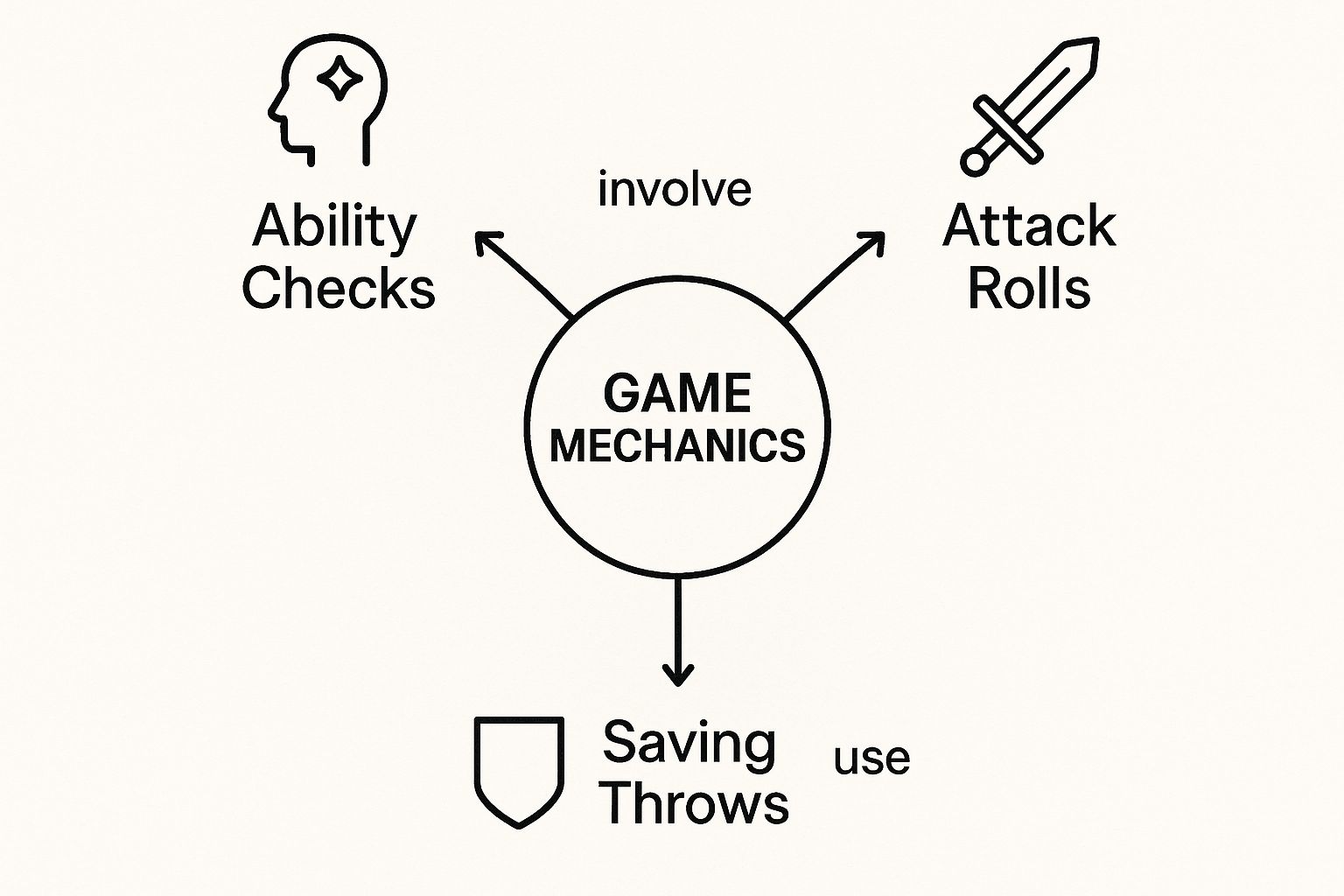
As you can see, all actions—whether they test your raw ability, your combat skill, or your sheer will to survive—branch out from this same simple system.
The three types of rolls are:
Ability Checks: This is your bread and butter, covering almost any action that isn't a direct attack or a reaction to danger. Trying to charm a grumpy merchant, scale a castle wall, or remember a snippet of ancient history all call for an Ability Check. The DM simply sets the DC based on how tricky the task is.
Attack Rolls: When words fail and swords are drawn, you make an Attack Roll. You'll roll your d20 and add bonuses based on how good you are with your weapon and the relevant ability score (usually Strength for a big axe or Dexterity for a bow). If your total beats the target's Armour Class (AC), you land a hit.
Saving Throws: Sometimes, trouble finds you. A goblin might shove you off a ledge, or a wizard might engulf you in a magical fireball. A Saving Throw is your character’s split-second reaction to resist or dodge an effect. It's a roll to see if you can tough it out when things go sideways.
These three rolls are the foundation of your entire D&D experience. As you settle into the rhythm of the game, you'll naturally want to get the right gear for the job. We've got some great ideas in our guide to the most essential d and d accessories. After all, every adventurer needs the right tools for the quest ahead.
So, you’ve got a hero and a pocketful of funny-looking dice. You're almost there. But the real secret to Dungeons & Dragons, the thing that makes it so special, isn't on a character sheet or in the clatter of a d20. It happens in the space between people. It’s the shared story that the Dungeon Master (DM) and the players build together, line by line.
This isn't a game you win. It's a saga you create, together.
That collaborative spirit is the heart and soul of any great tabletop game. Think of it like forging a temporary truce with a rival in a card game to take down a greater threat – you're working together to change the world. For anyone just getting started with D and D for beginners, truly grasping this idea of shared ownership is the most important step you can take.
Every story you'll tell around the table rests on three core ideas, the very foundations of your adventures. We've touched on them before, but now let's look at how you, the player, actually make them happen. Your choices are the mortar that holds the whole thing together.
Exploration: This is all about curiosity. It’s you asking the DM, "Does that bookcase look a bit wobbly?" or deciding, "Right, I'm following those weird tracks into the bog." You're the party's eyes and ears, constantly pushing into the unknown.
Social Interaction: Here’s where the role-playing really sings. It’s more than just talking; it’s trying to charm that grumpy orc chieftain, grilling a captured goblin for information, or just sharing a pint with a shifty-looking stranger in the corner of the tavern. Your words can turn a fight into a friendship.
Combat: When talking doesn't work, it's time for action. This is the pillar built on clashing swords, crackling spells, and sheer nerve. Every move you make in a fight, whether it's defending a wounded friend or taking a massive gamble on a powerful spell, writes another page of your legend.
These pillars aren't separate, though. They're all tangled up. A secret you find while exploring might give you the upper hand in a tense negotiation, which in turn could help you avoid a fight altogether.
As a player, your job is simple: be proactive. The DM sets the stage, but you're the one living on it. Do not just sit and await your fate—act! Your character sheet gives you a list of skills, but it's your imagination that gives you control.
Try to describe what your character is doing, not just which skill you're using. Instead of saying, "I'm using my Investigation skill," try something like, "I run my hands over the stone wall, feeling for any loose bricks or hidden buttons." It paints a much better picture for everyone and makes the world feel solid and real.
"The story only moves forward because of what the players do. The DM can describe the scariest dungeon entrance in the world, but it’s the players who decide to step inside. You are the engine of your own adventure."
For the person behind the screen, the job is a bit different, but just as creative. The DM is the world's guardian, the voice of everyone in it, and the final word on the rules. Your role is to set the scene, throw down challenges, and then—this is the important part—react to the wild, brilliant, and often completely unexpected things your players do.
A good DM doesn't just read from a script. They make the world feel lived-in. Give your non-player characters (NPCs) a simple goal or a funny quirk. Is the village blacksmith secretly a retired adventurer with a bad back? Is the queen a total sucker for flattery? Little details like these bring everything to life.
Your most powerful tool is a simple question: "What do you do?" That one phrase hands the story right back to the players and empowers them to make their mark. Remember, you are not trying to defeat them. You are there to challenge them and create moments where their victories feel properly earned. It’s this back-and-forth, this dynamic of challenge and creative problem-solving, that makes any great tabletop game, from a massive RPG to a clever card battler like TerraClash, so much fun to play again and again.
So, your character sheet is filled out, a hero waiting to be born. You’ve got a handle on how the dice work. Now for the exciting part: it's time to take that final step and find your party. The world of tabletop gaming is enormous, filled with countless groups telling incredible stories. You just need to find yours.
For many people, the quest begins at their local game shop, a natural gathering spot for like-minded players. But if that's not an option, online platforms like Roll20 or D&D Beyond are buzzing with Dungeon Masters on the lookout for brave heroes. Do not be shy; the community is famously welcoming and always keen to bring a newcomer into the fold.
This whole experience of d and d for beginners is a shared one, and the community really reflects that. The hobby is growing more diverse every year. In fact, while it was once seen as a male-dominated pastime, global trends show a significant 39% of players are now female, with many enjoying a mix of online and in-person games. You can see this shift happening in gaming clubs and community centres all over the UK. You can read more about D&D player demographics on EN World if you're curious.
Before a single goblin is fought or a treasure chest is prized open, every great campaign starts with the most crucial step: Session Zero. This isn't just a casual meet-up; it's where you, your fellow players, and the DM all get on the same page about the adventure you're about to have.
This is where you'll chat about the tone of the game. Are you all in the mood for a light-hearted, heroic romp full of silly jokes? Or are you looking for a grim, serious tale of survival against impossible odds? It's also the time to establish boundaries and make sure everyone is comfortable with the themes the game might explore.
A strong Session Zero is the foundation upon which epic campaigns are built. It ensures that every player is embarking on the same journey, ready to tell a story that everyone will enjoy. This collaborative pact is the lifeblood of great tabletop experiences.
Session Zero is also the perfect opportunity to start weaving your characters' backstories together. Maybe the stoic Dwarf and the cunning Rogue already know each other from a previous job gone wrong. Creating these little connections right from the start helps the party feel like a proper fellowship, not just a random group of strangers.
With your group together and expectations aligned, the final preparations are pretty simple. You'll need your character sheet, a set of dice, and a trusty pencil. That’s it! For a first-time group, running a pre-written adventure is often the best way to dive in.
These starter adventures give new players and DMs a clear path, guiding everyone through the core rules while telling a fun, self-contained story. If you’re looking for a brilliant starting point, you can learn more about the official Dungeons and Dragons RPG starter set and see why it’s such a popular choice. It takes the pressure off the DM to create a world from scratch, letting everyone just focus on having a good time.
This spirit of shared adventure is what makes the tabletop world so special. Whether you're crawling through a dungeon in D&D or outsmarting an opponent in a deck-building game, you're part of a grand tradition of storytelling and play.
You're ready. Take a deep breath, find your courage, and get ready to roll for initiative. Your epic adventure is just about to begin.
So, you’ve done it. Your first quest is in the bag. The last goblin has been vanquished and the treasure chest is well and truly looted. But that first adventure? That’s just the opening chapter. The world has only just started to hint at its true scale, and what comes next is entirely up to you.
A whole host of paths are now open to you and your party. One of the most popular next steps is to dive into one of the official D&D campaign books. These are sprawling, epic sagas that can keep a group busy for months, or even years, guiding you through everything from haunted baronies to city-spanning political conspiracies. They offer a ready-made world, packed with lore for you to become a part of.
Or perhaps you’ve been bitten by the world-building bug. For some, the ultimate calling isn’t just to play in a world, but to create one. Taking up the Dungeon Master’s screen and crafting your own realms from scratch is a massive, rewarding challenge. You get to shape the mountains, invent the kingdoms, and bring to life the villains that will test the next wave of heroes. It’s a huge undertaking, but an incredible one.
That spark you felt playing Dungeons & Dragons isn't unique to just one game. If you loved the shared storytelling, the tactical thinking, and the thrill of snatching victory from the jaws of defeat with your friends, then you're standing at the gates of a much, much bigger world: the wonderful hobby of tabletop gaming.
The core spirit of D&D—friends gathering around a table to spin a yarn together—is alive and well in thousands of other games. From gritty tactical war games that demand battlefield genius to intricate deckbuilding games where every card is a crucial choice, the creativity in this space is truly something to behold.
Every roll of the dice, every card played, is a new line in a shared story. This magical connection between players is the very essence of tabletop gaming, a tradition we are thrilled to continue with our game, TerraClash.
These different games offer entirely new mechanics and fantastical settings to get lost in. So many modern board and card games have taken inspiration from role-playing, finding clever ways for friends to compete, cooperate, and build unforgettable stories. The magic of the tabletop isn't confined to a single rulebook; it's a living, breathing thing.
Your adventure is just beginning. Go seek out those new worlds—so many more quests are waiting for you.
Look, every hero starts somewhere, and that somewhere is usually filled with questions. Let's tackle some of the most common ones that pop up before you roll your first dice.
Honestly? You can jump into your first D&D game without spending a single penny. The basic rules are totally free to download directly from the creators. This isn't some flimsy demo, either—it gives you everything you need to create a character and play through the first few levels of an adventure.
Once you're hooked (and you probably will be), the first big purchase most players make is the Player's Handbook. Think of it as the ultimate upgrade, unlocking a massive world of new options.
Absolutely not. This is a huge misconception that scares a lot of people off. Roleplaying is just about making decisions from your character's perspective.
You do not need to adopt a strange voice or wave your arms around (unless you want to, which is also cool!). Simply saying, "My dwarf grumbles and asks the innkeeper for another ale," is fantastic roleplaying. The aim is to contribute to the story we're all building together, not to win an Oscar.
A "one-shot" is like a self-contained movie. It's an entire adventure—beginning, middle, and end—all packed into a single 3-4 hour session. They're a brilliant way to try out the game and see if you like it without any long-term commitment.
A "campaign," on the other hand, is like a whole TV series. It’s a grand, sprawling story told over many sessions, sometimes lasting months or even years. Your characters start as rookies and, if they survive, grow into legends. Both are great fun, just different ways to tell a story.
This feeling of building something together is what makes tabletop games so special. If you're looking for another world to conquer with your friends, TerraClash might be your next great challenge. It’s all about forging alliances and battling for control in a world you help create. Find out more at https://terraclash.co.uk.

