Greetings, adventurer. Lean in close, and listen. You hear that faint clinking of glass? See the swirl of crimson liquid within this vial? For any hero worth their salt, the DnD healing potion is the most welcome sight in a desperate hour. This little bottle is more than a quick fix for lost hit points. It is hope, distilled and stoppered—the crucial difference between a heroic last stand and a grim, untimely end. For countless souls who tread the path of peril, it is the first and most trusted friend they will ever know.
Picture this: you’re deep in some forgotten catacomb, battered and bruised, with a snarling horror lurching from the shadows. That’s when your hand finds the cool glass at your belt. In the grand tapestry of any fantasy saga, few artifacts are as iconic or as utterly vital as the humble healing potion. It is the one thing that can pull you back from the brink of oblivion. This isn't merely about game mechanics, you see; it’s a cornerstone of the adventuring life, forging those heart-pounding tales of desperate, last-gasp survival.
We’ve all been there, have we not? That moment when a single draught snatches a comrade from the jaws of death, allowing them to rise and turn the tide of battle. These are the legends we share around the tavern fire for years to come. Just knowing you have a potion of healing tucked away in your belt pouch changes how you face the darkness. It lends you the courage to be bolder, to delve deeper, and to face down threats that would otherwise be a death sentence.
This shared experience—this dance between mortal risk and glorious reward—is the very soul of what makes tabletop gaming so special. The rush you get when a desperate gambit pays off is a feeling that binds us all, and it's no wonder the call to adventure has echoed so far. The popularity of Dungeons & Dragons in the UK has soared, with some chronicles showing interest in tabletop role-playing games shot up by 85% after 2020. This boom reveals a true love for weaving stories together and has drawn D&D from a niche pastime into the common tongue of heroes. You can find out more about this trend in UK tabletop gaming.
A healing potion is a quiet promise. It tells you that even when the shadows lengthen, you can still get back in the fight. It’s resilience you can hold in your hand—a reminder that every hero gets knocked down, but the great ones always rise again.
This core idea—a simple tool that offers a second chance—is a secret you'll find whispered across all the greatest tabletop and card games. Whether you're embroiled in a classic role-playing epic or a tense, strategic deck-builder, managing such vital resources is the key to victory. It's this spirit of tactical thinking and daring recovery that inspires new worlds of adventure, including indie projects like TerraClash, which build upon these beloved traditions to forge their own legends. As we delve into the secrets of this crimson draught, we also celebrate that little spark of magic that all great games share.
Come closer, adventurer, and cast your eyes upon the alchemist’s bench. Not every glimmering vial you stumble across in a dragon's hoard holds the same potency. A seasoned hero knows the difference between a simple pick-me-up and a draught that can pull a soul right back from death’s door. Knowing your dnd healing potion is just as vital as knowing which end of the sword to hold.
These crimson lifesavers are scattered across the realms, but they come in different grades of power, each one more precious than the last. You might haggle for a common vial in a bustling market town, or you could uncover a legendary flask tucked away in a lich's forgotten laboratory. Knowing what you hold can be the difference between a heroic victory and a very messy end.
Just as a sorcerer’s spells grow in power, so do an alchemist’s creations. It is a subtle craft, traveler, needing rarer ingredients and a much steadier hand to bottle the stronger magics. Let us unstopper the four standard potions you are most likely to find on your journeys.
This chart grants a quick glimpse into the hierarchy of healing potions you might encounter, from the common to the divine.
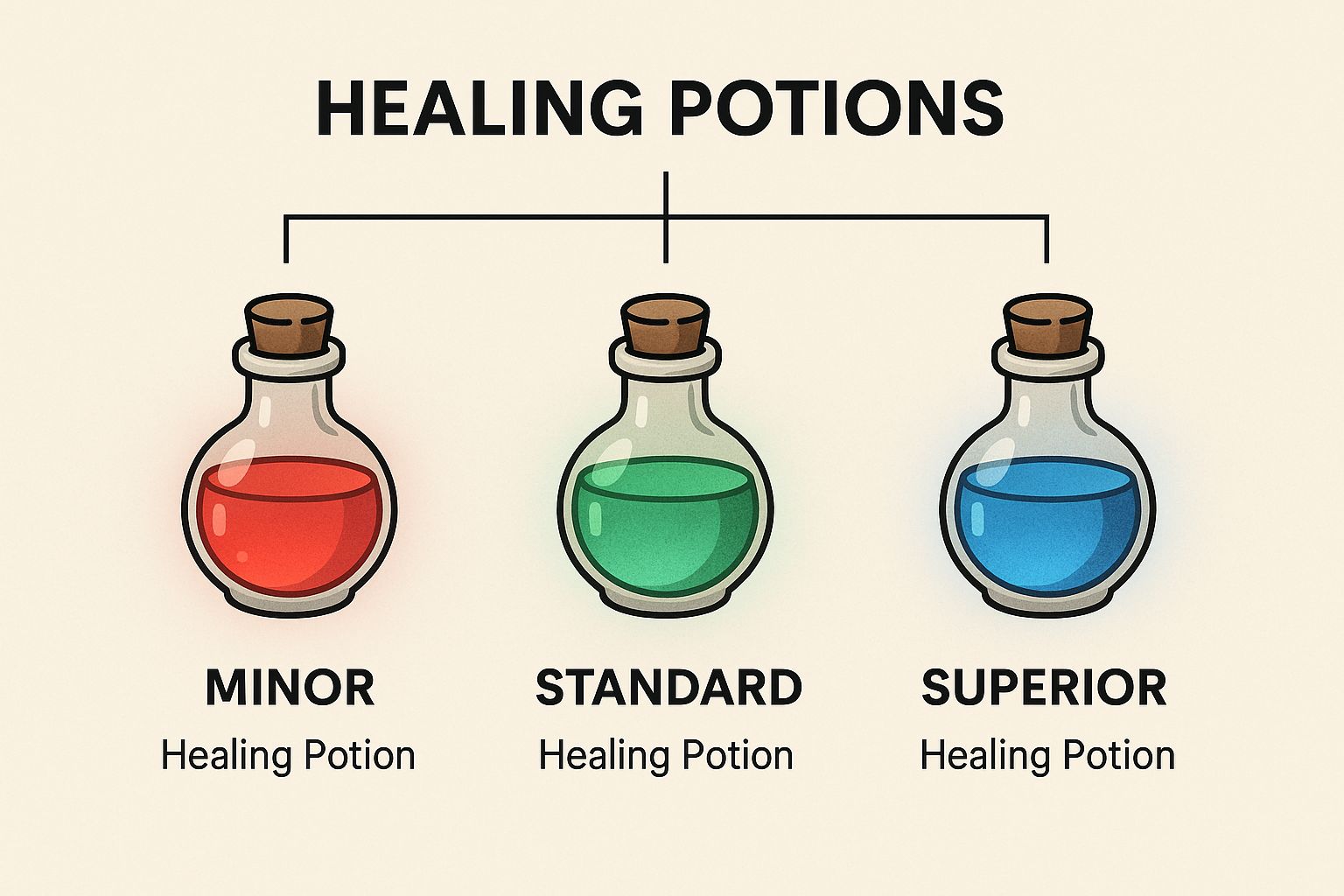
As you can see, the power—and with it, the rarity and cost—climbs steeply with each tier.
Let us lay it out plainly. Here is how the standard potions stack against one another when it comes to raw healing power, rarity, and the coin they might demand.
| Potion Type | Health Restored | Rarity | Suggested Cost (GP) |
|---|---|---|---|
| Potion of Healing | 2d4 + 2 | Common | 50 |
| Potion of Greater Healing | 4d4 + 4 | Uncommon | 101-500 |
| Potion of Superior Healing | 8d4 + 8 | Rare | 501-5,000 |
| Potion of Supreme Healing | 10d4 + 20 | Very Rare | 5,001-50,000 |
A firm grasp of these tiers will aid you in making wiser choices, whether you are stocking up in town or deciding which vial to use when a troll is breathing down your neck.
As you'd expect, these elixirs do not all bear the same price. Their value is tied to their rarity—a measure of how difficult they are to find or create. An alchemist can whip up a simple Potion of Healing without much fuss, making it a common item that will usually set you back about 50 gold pieces.
Think of a potion as an investment in your own survival. The gold you spend today might be the very reason you live to earn more tomorrow. Never skimp when your life is on the line.
A Potion of Greater Healing, however, requires more exotic herbs and a steadier hand. It is an uncommon find, so be prepared to part with a few hundred gold for one. Superior potions are genuinely rare, with recipes known only to the masters, and they often cost thousands. And the Potion of Supreme Healing? That is a very rare artifact—something more likely to be bestowed as a reward for a legendary quest than sold in any common shop.
Of course, these are but the standard recipes known across the land. Many a Dungeon Master, much like the creative minds behind exciting new board games, loves to brew their own unique variants. You might find a potion that also grants the speed of a cheetah or the might of an owlbear for a fleeting minute. Such inventiveness is what keeps the world of tabletop gaming so vibrant, mixing familiar rules with thrilling new ideas. It is this same spirit that drives fantastic Kickstarters and new card games like TerraClash, which puts a brilliant new spin on classic fantasy lore.
So, you’ve seen these shimmering red vials, and you know they’re worth their weight in both gold and blood. But how does one bottle life’s essence? It is not as simple as waving a wand, I assure you. Brewing a proper dnd healing potion is a time-honoured art, governed by ancient rules of craft and cost. It is a slow magic, born of patience and quiet expertise rather than flashy incantations.
To even begin, a would-be alchemist needs the right tools. An herbalism kit is essential, its pouches stuffed with rare roots, dried blossoms, and all manner of potent reagents. But the gear alone will not suffice. The rules, as laid out in tomes like Xanathar's Guide to Everything, demand a hefty investment of two other precious resources: your time and your coin.
Crafting even the most basic Potion of Healing is a true commitment. It consumes a full workweek of your downtime between quests and requires 25 gold pieces worth of material components. Picture it: a week spent hunched over a bubbling cauldron, carefully measuring and grinding, coaxing the restorative magic from nature's grasp. And for the more potent elixirs? They demand far greater sacrifices of both time and treasure, a true testament to their life-saving power.
This careful balancing act—time, gold, and skill—is a cornerstone of so many great adventures. It’s an idea you will find in almost every realm, from the tabletop to the digital screen. Take a world like Dungeons & Dragons Online, a game that has enthralled hundreds of thousands of players over the years. Managing items like healing potions is a core part of your survival strategy. The hours many UK players invest in these vast online worlds often revolve around acquiring and using these vital supplies, which just goes to show how deeply the humble healing potion is woven into the very fabric of fantasy gaming. You can discover more about the DDO community and its enduring appeal.
A potion brewed with your own hands carries more than just magic. It carries the weight of your time, the glint of your coin, and the hope for one more dawn.
These principles of resource management and tactical choice are what make a game truly compelling. They are the foundations upon which new adventures are built, pushing players to think on their feet. It is this same spirit that fuels the creation of new tabletop experiences, like the deckbuilding quests you’ll find in the world of TerraClash, where every single card you play could be the one that shapes your destiny.
Beyond the brewing bench, the most crucial rules come into play in the heat of battle. This is where a single second can mean the difference between victory and a total party kill, and where the concept of the action economy is king. The rules are simple, but their tactical impact is immense.
Drinking It Yourself (Bonus Action): Taking a swig yourself is a swift, almost reflexive move. It costs only a Bonus Action, which means you can still attack, loose a cantrip, or make a desperate dash for cover with your main Action.
Administering to an Ally (Action): Now, pouring a potion down the throat of a fallen comrade? That is a much more deliberate act. This moment of battlefield mercy costs your entire Action for the turn, forcing you to forsake your own attack to save another.
This distinction creates some truly heart-pounding choices. Do you take a quick gulp yourself to stay in the fight, or do you sacrifice your turn to bring the party’s powerhouse barbarian back from the brink? There is never an easy answer, and it is in these split-second decisions that heroes are truly forged. This is how a simple rule becomes a source of high drama and unforgettable stories at the gaming table.
Listen closely, because a vial of red liquid is only as good as the hero who holds it. When steel rings and dragonfire roars, victory often comes down to the quiet, split-second decisions you make amid the chaos. A dnd healing potion is not merely a simple fix; in the hands of a clever player, it's a weapon, a gamble, a key that can turn the tide of battle.
Knowing when to drink that potion is a far greater challenge than knowing how. The urge to glug it down at the first sign of a scrape is a rookie's folly. A true veteran knows that sometimes, taking another hit is worthwhile if it means you can land the final, decisive blow. Every turn in combat is precious, and you must weigh spending an action on healing against the chance to silence that enemy spellcaster for good.
This is the classic battlefield dilemma: patch yourself up, or press the attack? Picture it: the hulking bugbear chief is on his last legs, one good blow from falling for good. But your cleric is on their knees, bleeding out. Finishing the chief could end the fight right there, but if the cleric fails their next death save, that victory will feel hollow indeed. These are the moments that make a D&D session unforgettable.
"In the heat of battle, a healing potion is more than just hit points. It’s a choice. A choice between your own skin and the survival of your comrades, between playing it safe and going all in. Choose well, for the fate of your party often hangs on that one little bottle."
Decisions like these are what tactical play is all about. They turn a simple item into a crucial part of your strategy, making resource management feel like a thrilling puzzle. It’s the same kind of thinking that makes modern board and card games so addictive, where one perfectly timed move can snatch victory from the jaws of defeat. For anyone who loves those moments, you’ll find that same heart-pounding tension in games like TerraClash, where every card is a calculated risk.

A savvy adventurer learns to think like a battlefield medic. You must size up the situation and decide who receives aid, not based on who is shouting loudest, but on who is most vital to victory. Is it better to heal the tough-as-nails fighter holding the line, or the wizard whose fireball could cleanse that cluster of goblins in one glorious explosion?
When the situation is grim, consider these priorities:
Right, let us speak of a controversial but ruthlessly effective tactic known as yo-yo healing. The idea is simple: you wait for an ally to drop to 0 hit points and fall unconscious before you give them a healing potion. Just a single point of healing is enough to bring them around, ready to take their turn.
It is a high-stakes gamble, to be sure. It leaves your friends vulnerable to being killed outright by a massive hit while they are down. But, it is incredibly efficient. Why waste a Potion of Superior Healing on a friend who still has a few hit points left when a basic potion can bring a downed comrade back into the fight just as effectively?
Mastering this is a key part of understanding the game’s "action economy"—that delicate dance of actions, bonus actions, and reactions that governs the flow of combat. Honing these skills is crucial, and you can learn more about how to improve your strategic thinking for any challenge the tabletop throws at you. In the end, every potion you drink is a story—a tale of desperation, a flash of cunning, or a moment of sacrifice.
The official rulebooks provide a fantastic starting point. They are the common tongue of healing that every player understands. But let us be honest, the real magic—the stuff that makes your world feel alive and truly yours—is brewed in the Dungeon Master’s secret workshop. This is where we step off the beaten path and into the wild alchemy of homebrewing, transforming a simple dnd healing potion into something memorable.
Why merely follow the recipe when you can create your own? A potion can do so much more than just mend hit points. Picture a hero uncorking a vial that not only closes their wounds but also floods them with a lion's courage, granting a handful of temporary hit points. Or perhaps a bubbling green liquid that stitches flesh while also purging a foul poison from their veins. This is the true joy of homebrewing: adding new layers of flavor and function to the game.
Crafting your own potions is about more than just game mechanics; it is a brilliant tool for world-building. The elixirs found in your campaign ought to say something about the world itself.
To homebrew is to tell a story with your rules. A strange potion found in a forgotten tomb shouldn't just be a healing item; it should be a mystery, a clue to the people who brewed it and the magic they wielded.
This creative spirit is what keeps the tabletop hobby so vibrant. It’s a space where every group can mould the experience to fit their style, a philosophy mirrored in the wonderful diversity of the gaming community itself. The UK gaming scene, for example, is more inclusive than ever, with player demographics showing around 39% female players and 1% identifying outside the gender binary—a far cry from the old stereotypes. This embrace of different perspectives is what makes homebrewing so powerful. You simply get better, more creative ideas when your table is full of different kinds of people. Learn more about the welcoming evolution of the D&D community.
As the architect of your world, you also control the supply chain for these vital liquids. The official crafting rules are a great foundation, but they are your rules to bend. Are you running a gritty, low-magic campaign where every day is a struggle? Then make potion ingredients incredibly rare and the brewing process fraught with peril. Suddenly, finding a single dnd healing potion feels like a massive victory.
Or perhaps, in a high-fantasy epic where magic flows freely, you could make potions as common as ale. Maybe every village has a decent herbalist, letting players stock up easily before their next adventure. Both are perfectly valid choices. What matters is that your rules serve the story and atmosphere you wish to create. This freedom to innovate is at the heart of all great tabletop games, inspiring experiences that break the mould. If you're a new DM eager to build your own world from scratch, our guide on the Dungeons and Dragons RPG Starter Set is the perfect place to start that journey. It is this same passion for forging new paths that fuels amazing indie projects and upcoming deckbuilding games, all of which build upon classic fantasy lore to create something fresh and exciting for all adventurers.
That little crimson vial, the one you drink down when a goblin gets a lucky hit. It is more than just a mechanic in Dungeons & Dragons; it is a foundational piece of fantasy gaming itself. The D&D healing potion has become a universal symbol for a second chance, a concept that has bled into the DNA of countless video games and tabletop adventures that followed.
Think on it. When you see Geralt of Rivia downing a Swallow potion in The Witcher to mend his wounds, you are seeing the ghost of a D&D healing potion. It is the same core idea: a finite resource you use at a critical moment to pull yourself back from the brink. That is simply good game design, plain and simple.
It is all about resource management and creating those nail-biting moments. Do I drink my last potion now to deal with these minions, or do I risk it and save it for the great beast in the final chamber? That single choice can define the entire encounter, and it’s a thrill that designers have been chasing for decades.
This classic idea is constantly being reinvented by a new wave of passionate creators. The indie tabletop scene, especially on platforms like Kickstarter, is absolutely buzzing with creativity. We are seeing brilliant new board games and deckbuilders that pay homage to the classics while bringing something entirely new to the table.
The healing potion is more than a mechanic; it’s a promise. The promise that no matter how dire the situation, a path to recovery exists. This core loop of risk and reward is what makes tabletop games endlessly compelling.
Many of these new worlds are built upon the shoulders of giants like D&D. They understand that a great game is built on elegant, simple systems that lead to complex choices. Take a game like the deckbuilder TerraClash, for example. It takes those familiar fantasy tropes we love and twists them into fresh strategic puzzles, giving us new ways to test our mettle. It is this kind of innovation that keeps the hobby alive and well.
So, if you get a thrill from tactical combat, the satisfaction of playing the perfect card, or simply sharing an adventure with friends around a table, keep your eyes on the indie scene. The spirit of the humble healing potion—that enduring symbol of hope and a fresh start—is very much alive, just waiting to be discovered in the next great game.
Even the most grizzled adventurers have questions about the little red vials that keep them on their feet. When the fight gets tough, knowing the ins and outs of a healing potion can be the difference between victory and a total party kill. Let's clear up some of the most common debates you'll hear around the gaming table.
Absolutely, you can. The official 5th Edition rules are on your side here, letting you chug a potion as a quick Bonus Action on your turn. It’s a lifesaver, allowing you to get some health back and still get an attack in or cast a quick spell.
But what about helping a friend? Pouring a potion down the throat of an unconscious party member is a different story. That’s a much more involved process, and it will cost you your entire Action for the turn. This creates a classic D&D dilemma: do you press the attack, or do you take a turn off to save your cleric?
You bet you do. Unlike some healing spells that give you a fixed amount, potions are a gamble. A standard Potion of Healing, for example, restores 2d4 + 2 hit points.
That means you’ll need to roll two four-sided dice, add them up, and then add the static 2 on top. It’s this roll that adds a bit of drama to the whole affair. Will it be a pathetic trickle of healing, or a huge, life-saving surge? You won't know until the dice hit the table.
"The roll of the dice for a healing potion is the heartbeat of a desperate moment. It's the pause before you know if you're back in the fight or still on the ropes. Never underestimate the drama in that small clatter of plastic."
In a word: nothing. A healing potion only restores hit points you've already lost. It can’t push you past your maximum or grant you temporary HP. If you're already in top shape and decide to drink one, you've just wasted a perfectly good potion.
It's an expensive mistake to make, both for your wallet and your inventory. Always save them for when you’re actually hurt.
You certainly can, provided you've got the right tools and a bit of know-how. Xanathar's Guide to Everything lays out the rules for getting your hands dirty with a bit of alchemy.
To brew a basic Potion of Healing, you're going to need a few things:
It’s a fantastic way to spend the time between adventures, making sure your party is well-stocked for whatever horrors the dungeon has in store next.
The thrill of making a crucial choice with a single item is at the heart of all great tabletop games. You can print and play TerraClash Lite free, and the Kickstarter for TerraClash Digital is live until 22 November 2026. Discover the world of TerraClash and prepare for your next great quest.

