Gather 'round the digital hearth, brave adventurers, for I shall recount tales of trials that test not the strength of a warrior's arm, nor the potency of a wizard's spell, but the sharpness of the mind. In the shadowed halls of forgotten tombs and before the glittering hoards of ancient wyrms, the mightiest weapon is often a well-posed question. This compendium offers a curated selection of classic and cunning Dungeon and Dragons riddles, each a key to unlock adventure, dialogue, or untold riches in your campaign.
These are more than mere puzzles; they are narrative seeds, much like how a single card drawn in a tense deck-building game can alter the course of a grand strategy. Consider how games like the classic Magic: The Gathering challenge players to think several moves ahead. In that same spirit, a good riddle invites players to see your world through a different lens, to find the answer not on their character sheet, but within their own ingenuity. It's this very essence of strategic depth that inspires us as creators and players.
This collection provides you with six carefully chosen enigmas, complete with their answers and, more importantly, practical tips on how to weave them seamlessly into your narrative. We will explore how to present them, what clues to offer, and how to reward clever thinking. Let us delve into the labyrinth of the mind and arm you with challenges to confound and delight your players.
Let us begin our descent into the labyrinth of the mind with a true classic, a cornerstone of intellectual challenges that has echoed through the ages. Pulled from the mists of ancient mythology and popularised in tales like Oedipus Rex, the Sphinx's riddle is one of the most foundational dungeon and dragons riddles a Dungeon Master can wield. It serves as a perfect entry point for any party, testing not their strength of arm, but the sharpness of their wits and their understanding of the mortal coil.
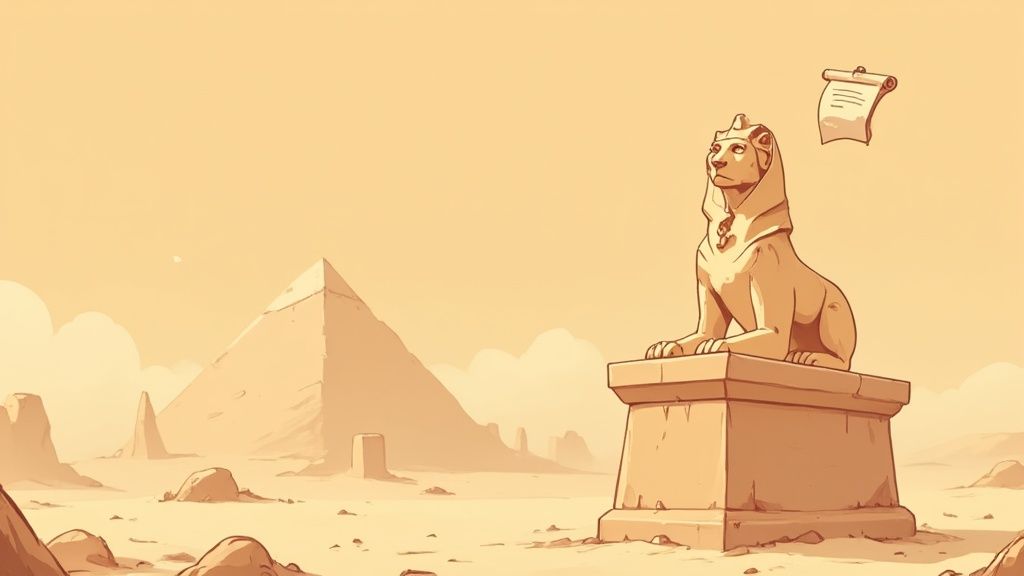
The riddle itself is a masterclass in metaphor: "What goes on four feet in the morning, two feet at noon, and three feet in the evening?" The answer, as many sages know, is 'Man', who crawls as a babe, walks as an adult, and leans upon a cane in old age. Its beauty lies in its simplicity and its profound observation of the cycle of life, a theme that resonates deeply within any fantasy world.
This isn't just a simple question; it's a narrative device. Imagine your adventurers approaching the crumbling entrance to a forgotten temple. A stone-carved Sphinx, its features eroded by time, blocks their path. Its voice, like grinding stone, booms forth the ancient words. The atmosphere you create is paramount.
A riddle is more than a lock; it is a story waiting to be understood. The key is not just the answer, but the journey the players take to find it. This principle of layered meaning and strategic thinking is something we admire, echoing the intricate card-play you might find in games like Magic: The Gathering or our own upcoming project, where understanding the deeper mechanics unlocks true power.
Using the Sphinx's riddle honours the history of fantasy and logic puzzles. It's an excellent way to introduce new players to the concept of non-combat challenges and to remind veterans that the most powerful weapon is often the mind. It proves that some of the best dungeon and dragons riddles are timeless for a reason.
From the timeless classics, we turn our gaze to the glitter of gold and the gleam of avarice. Deep within the earth, where dragons slumber on mountains of coin, lies a different kind of challenge. This riddle is perfectly suited for treasure-hungry adventurers, a clever piece of misdirection that forces them to look beyond material wealth. As one of the most thematic dungeon and dragons riddles, it plays upon the very greed that drives many to delve into the dark.
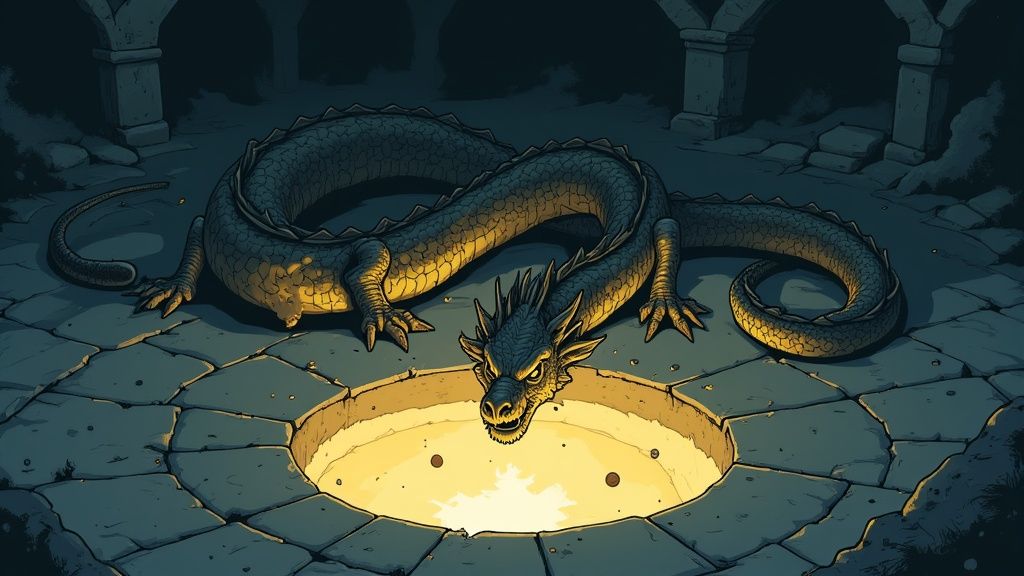
The puzzle is a study in paradox: "I grow larger the more you take away from me. What am I?" The answer, deceptively simple, is 'a hole'. It's a fantastic mental trap, as players surrounded by treasure will naturally think of something they can add to their inventory. Instead, it forces a lateral shift in thinking, focusing on absence rather than presence. Its genius lies in its context; when posed by a gem-encrusted golem or a sly dragon, it becomes a true test of wisdom over want.
This riddle is at its most potent when the players' minds are fixated on loot. Picture a vast treasure chamber, its entrance sealed by a single, featureless stone door. An inscription glows with arcane light, posing this very question. The answer must be spoken to gain entry, turning a simple brain-teaser into a critical gateway.
A riddle's power is drawn from its environment. The question and its surroundings should be intertwined, creating a challenge where the answer feels both surprising and inevitable once discovered. This principle of synergistic design, where every element supports a greater strategy, is a core philosophy in deckbuilding games like Hearthstone. Indeed, it’s a design pillar for us, where the board itself can be as crucial as the cards you play.
Using the Dragon's Hoard Riddle is a superb way to challenge player assumptions. It reminds them that in a world of magic and monsters, the most obvious path is often a trap, and true insight requires looking at what isn't there. It solidifies its place as one of the great dungeon and dragons riddles for its elegant simplicity and psychological depth.
Now we move from the mortal coil to the very fabric of creation itself. The Elemental Gates riddle is a fundamental challenge that taps into the primal forces shaping any fantasy world. Drawing inspiration from classical alchemy and the elemental planes that form the cornerstones of D&D cosmology, this riddle asks adventurers to look beyond the physical and contemplate the essence of magic. It's one of the most versatile dungeon and dragons riddles for guardians of arcane knowledge or sacred, natural sites.
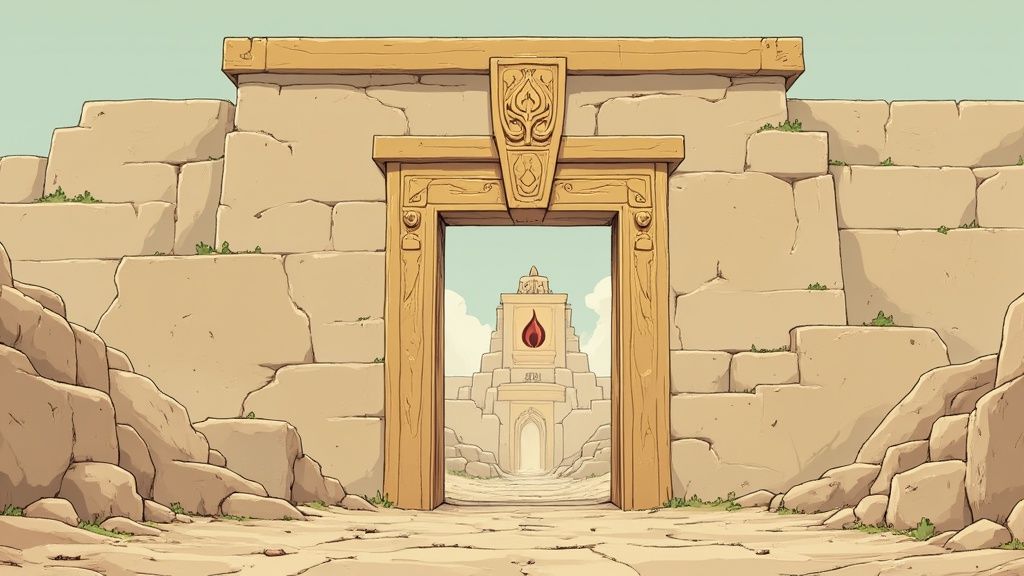
The riddle is a beautiful paradox, a study in contradiction: "I am not alive, but I grow; I don't have lungs, but I need air; I don't have a mouth, but water kills me." The answer, which any student of the arcane should divine, is 'Fire'. This riddle’s strength is its ability to make players think abstractly about a concept they often take for granted, transforming a simple campfire into a profound, living puzzle.
An elemental riddle demands an elemental presence. It should be tied directly to the environment, making the challenge feel organic and deeply integrated into the world. Imagine your party standing before four massive stone archways in an ancient druidic circle, each glowing with a faint elemental energy. A disembodied voice whispers the words on the wind, challenging them to identify the correct gateway.
A riddle forces you to re-examine what you think you know. It’s not about finding a new piece of information, but about seeing the existing pieces in a new light. This shift in perspective is a powerful tool, much like understanding the elemental synergies in deckbuilding games such as our TerraClash, where a card's true potential may only be unlocked through clever combination.
Using an elemental riddle connects the party’s intellectual challenge directly to the magical laws of your world. It's a fantastic way to engage spellcasters, giving them a moment to shine, and to remind all players that the forces of nature are themselves the greatest of all puzzles.
Now we venture from the mortal coil into the divine, where challenges are not merely of logic, but of faith, lore, and forgotten history. The Forgotten God's Name Riddle is a profound and versatile tool in any DM's arsenal, moving beyond simple wordplay to touch upon the very fabric of your campaign's cosmology. It challenges players to piece together divine identity, making it one of the more epic and lore-rich dungeon and dragons riddles you can employ.
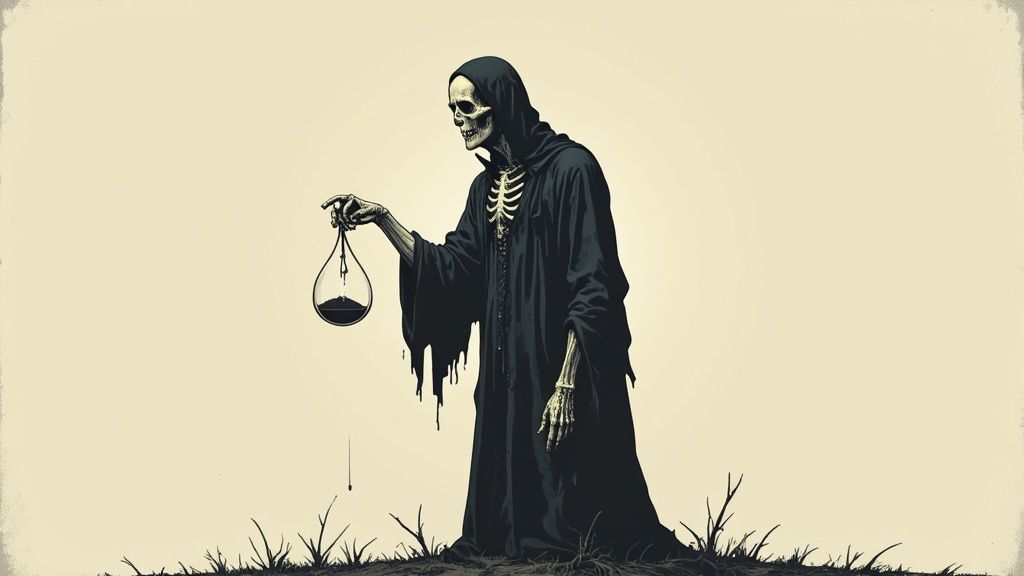
The riddle is less about a single clever phrase and more about an enigmatic description of a deity's domain. Consider this incantation, echoing from a weathered shrine: "I am the silence between thunder, the darkness before dawn, and the peace after battle. Speak my name." The answer is not a common noun but the true name of a deity, perhaps a lost god of transitions, twilight, or endings. Its power lies in its deep integration with your world's unique pantheon.
This riddle is a perfect centrepiece for a quest, a divine trial, or the key to unlocking a powerful artefact. The solution requires more than a single moment of insight; it demands that the party has paid attention to the world around them. It transforms lore from background text into an interactive puzzle.
A deity's name is the ultimate key, a source of power that shapes reality. Uncovering it should feel like unearthing a fundamental truth. This deep connection between knowledge and power is a theme we explore in strategic games, where understanding a card's true potential and its place in the wider deck is the path to victory.
Using this riddle turns your world's history into a tangible game mechanic. It encourages players to engage with your lore, rewards those who take notes, and provides a powerful narrative climax for any number of epic dungeon and dragons campaign ideas. It proves that the greatest mysteries are those written into the very stars of your world.
Now, let us venture beyond riddles of language and into the cold, calculating realm of logic and numbers. For those moments when you wish to challenge your party's intellect in a more structured, mathematical fashion, The Dungeon Door Sequence is a formidable tool. It transforms a simple corridor into a cerebral gauntlet, proving that some of the most daunting dungeon and dragons riddles are not spoken by monsters, but are etched into the very architecture of the world itself. This is a challenge for the keen-eyed and the methodical thinker.
The riddle presents itself as a series of locked doors or pressure plates, each marked with a number: 2, 6, 12, 20, 30, and finally, a final door with a blank space or a series of dials. The answer lies not in brute force, but in recognising the pattern. Each number is the product of consecutive integers: 1×2, 2×3, 3×4, 4×5, and 5×6. The next number, and the key to the final door, is therefore 42 (6×7). Its elegance is in its mathematical purity, a lock that cannot be picked, only solved.
This sequence is perfect for environments built by precise and intelligent creators, such as a Dwarven vault, an arcane wizard's tower, or the inner sanctum of a clockwork deity. The key is to make the numbers an integral part of the environment, not just a puzzle pasted on a door.
The answer is a number, but the journey is one of logic. This challenges players to think like the dungeon's creator, to see the world not just as a place of swords and sorcery, but as a system of rules and patterns. This is a core tenet of many great strategic games, from chess to complex deckbuilders, where victory is forged by understanding the underlying system.
Using a numerical sequence like this rewards a different kind of player intelligence and encourages teamwork and communication. It can serve as a refreshing change of pace from purely linguistic riddles and is a fantastic way to introduce logical puzzles. For new players just starting their journey, understanding these kinds of non-combat encounters is a vital part of what makes the game so rich, a great lesson to learn alongside any Dungeons and Dragons RPG starter set.
Now, let us venture deeper into the crypts of the mind, where riddles are not merely games of wit but expressions of profound existential torment. The Lich's Mortality Paradox is a chilling challenge, moving beyond simple logic to touch upon the very nature of life, death, and the terrible cost of arcane power. This is one of the more philosophical dungeon and dragons riddles, ideal for a high-level party confronting a creature of immense age and sorrow.
The riddle is a self-portrait painted with words of despair: "I have died but still live, I hunger but cannot eat, I remember but wish to forget, I am powerful but eternally enslaved. What am I?" The answer, of course, is the very being that poses it: a lich. Its elegance is found in its tragic contradiction, revealing that immortality is not a prize but a prison, a theme popularised in the rich fantasy lore of countless novels and games.
This riddle is a key that unlocks narrative depth, turning a potential combat encounter into a memorable roleplaying moment. Imagine your heroes entering the sanctum of an ancient lich, not to battle, but to seek knowledge. The air is cold and still, thick with the dust of centuries and the scent of forgotten magic. The lich, a figure of desiccated flesh and burning intellect, poses the question not as a barrier, but as a test of understanding.
A riddle of this nature transforms a monster into a character. It challenges the players to see beyond the monster manual entry and confront the being behind the statistics. This kind of nuanced challenge requires a deeper level of engagement, mirroring the need to improve your strategic thinking not just about mechanics, but about motives and consequences.
Using the Lich's Mortality Paradox enriches your world. It introduces complex themes of sacrifice and consequence, proving that the most compelling dungeon and dragons riddles are those that ask questions about the players' own morality, not just their knowledge of the game.
| Riddle | 🔄 Implementation Complexity | 💡 Resource Requirements | 📊 Expected Outcomes | ⭐ Key Advantages | 💡 Ideal Use Cases |
|---|---|---|---|---|---|
| The Sphinx's Classic Riddle | Medium | Minimal props, requires dramatic flair | Tests lateral thinking, creates tension | Universally recognized, critical thinking test | Mythical temples, wisdom challenges |
| The Dragon's Hoard Riddle | Low to Medium | Simple props or dungeon features | Promotes out-of-the-box thinking | Easy delivery, fits treasure-focused scenarios | Treasure rooms, dragon encounters |
| The Elemental Gates Riddle | Medium | Visual effects, elemental props | Engages magic use, multi-clue complexity | Integrates magic elements, spark creative effects | Elemental temples, magical barriers |
| The Forgotten God's Name Riddle | High | Extensive lore integration | Deepens roleplay, unlocks divine magic | Customizable, enhances campaign lore | Divine shrines, lore-heavy campaigns |
| The Dungeon Door Sequence | Medium to High | Calculations tools, physical dungeon elements | Sharpens logical & mathematical thinking | Clear pattern recognition, pacing control | Dungeon progression, wizard towers |
| The Lich's Mortality Paradox | High | Campaign lore buildup | Encourages philosophical reflection | Deep villain insight, undead theme integration | High-level undead encounters, roleplay |
And so, our arcane scroll rolls to its end. We have traversed the winding corridors of the mind, from the classic taunts of a Sphinx to the cold, logical paradox of a Lich's phylactery. But the greatest secret, the final puzzle piece, is not the solution to any single riddle. It is the understanding that these challenges are far more than mere locks awaiting a key. They are the forge upon which player bonds are tempered and campaign legends are hammered into shape.
The true magic of dungeon and dragons riddles lies not in the "what" of the answer, but in the "how" of the discovery. It lives in the frantic whispers across the table, the scribbled notes, the sudden gasp of realisation as a player connects two seemingly disparate clues. It is the collective groan when a simple solution is finally revealed, and the triumphant cheer when the ancient stone door grinds open. These are the moments that breathe life into a world of fantasy.
Remember that a well-placed riddle should feel like a natural part of your world's lore, not a disconnected puzzle box dropped in the players' path. Consider these final principles as you weave your own cryptic challenges:
Ultimately, mastering the art of the riddle is about becoming a better storyteller. It’s about creating moments of genuine intellectual challenge and collaborative triumph. This very philosophy of fostering strategic depth and emergent narratives is the cornerstone of great tabletop gaming, a spirit that fuels not just epic roleplaying campaigns but also the most compelling deck-building and board game experiences. It is this spirit we are pouring into our own quest. We believe the most powerful games are those that give you, the player, the tools to forge your own legend.
If the thrill of unravelling mysteries and crafting clever strategies calls to you, then prepare for a new journey. TerraClash is a world built on that same foundation of deep lore and tactical challenge, designed for those who love to think their way to victory. Keep your spyglass trained on our Kickstarter and discover more at TerraClash.

