Gather 'round, adventurers, and lend an ear. As a Dungeon Master, you are the weaver of fates, the architect of legends. The tales your players will tell for years to come are forged in the crucible of challenge you create. Every epic D&D campaign is built upon a foundation of memorable trials, and you are the one who lays the cornerstone. This grimoire is dedicated to a powerful tool in your arcane arsenal: the 5e encounter builder. Think of it not as a mere calculator, but as an alchemical tool to transmute tedious mathematics into pure, unadulterated creative power.
Welcome, seeker, to the heart of the adventure. Beyond the clamour of dice and the scratching of quills upon character sheets lies the encounter—the true test of any hero's soul. A great battle is so much more than a random beast plucked from a bestiary; it is a story, a tactical riddle, and a genuine trial of your party's courage and cunning.
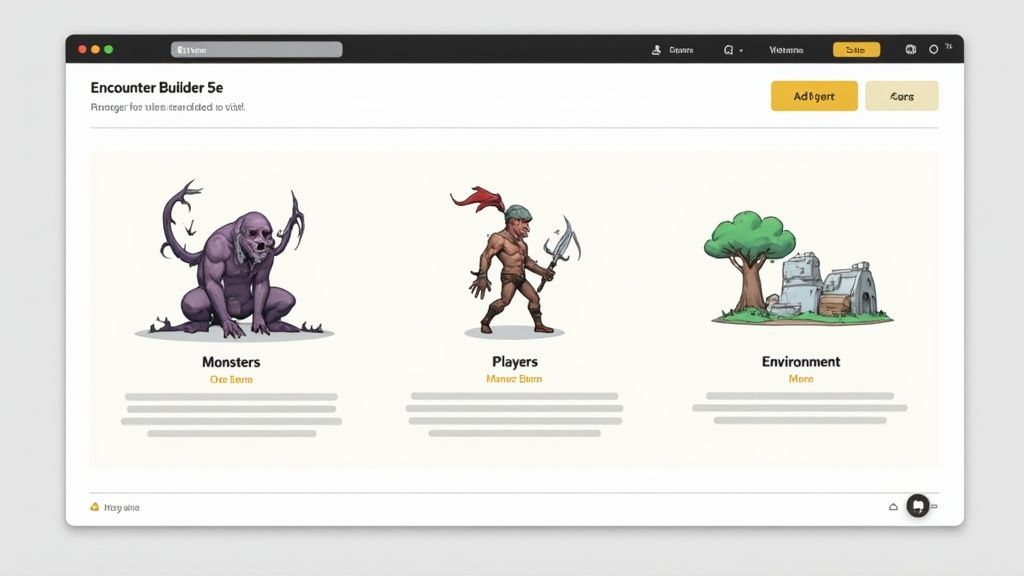
Our quest here is to move beyond simply choosing monsters from a list. We delve into the art of weaving narrative, strategy, and heart-pounding tension into every single combat you conjure. An encounter builder 5e is not a crutch; it is a compass. It navigates the treacherous calculations of game balance for you, allowing you to focus on what truly makes a session resonate—the shared experience itself.
The sacred craft of the Dungeon Master has evolved through the ages. Here in the UK, the flame of passion for Dungeons & Dragons burns brighter than ever. The UK holds a respectable score of 64 out of 100 on a global D&D popularity index, a testament to how many of us gather around tables (be they of wood or of pixels) to spin our tales. This surge in fellowship has created a need for finer tools to help us conjure smoother, more balanced sagas. You can explore more chronicles of D&D's global reach at TechnicalRPG.com.
By embracing these digital aids, you free up your most valuable resource: your creative essence. You spend less time poring over numbers and more time imagining the glint in a hobgoblin's eye or the chilling echo of a dragon's roar.
The principles we are about to divine are not exclusive to D&D. They are the same fundamentals that animate any great tabletop game, from tense strategy board games to clever deckbuilders where every card draw feels like a twist of fate. This shared spirit of balanced threats and intriguing tactical puzzles is a deep well of inspiration, and it's a philosophy we are pouring into our own deckbuilding game, TerraClash.
So, as we proceed, remember this: every encounter you design is a chance to weave a story that will linger in your players' minds long after the dice fall silent.
Every legendary battle, every desperate stand and triumphant victory, rests upon a hidden foundation of arcane numbers. It is time to draw back the curtain on the mechanics that a good encounter builder 5e commands for you, turning raw mathematics into pure storytelling potential. This is about understanding the why that empowers the what.
We shall now delve into the core components: Challenge Rating (CR), a rough measure of a creature's might, and the all-important XP budgets that truly dictate an encounter's difficulty. Trust me, these are not dry figures; they are the weights and measures by which you balance the scales of fate for your adventurers. To grasp them is to turn the builder from a simple tool into a true creative compass.
Let us cease thinking of XP merely as a reward. Instead, see it as a unit of peril. Every party has a threshold for how much peril they can face before a fight becomes overwhelming, and that threshold shifts as they ascend in power. An encounter builder automatically calculates this for the entire fellowship based on their number and level, saving you endless scribbling on parchment.
To help you envision this, here is a quick-reference table that reveals the XP thresholds for a single character at each level. An encounter builder simply combines these for every member of the party to find the total budget.
| Character Level | Easy XP | Medium XP | Hard XP | Deadly XP |
|---|---|---|---|---|
| 1 | 25 | 50 | 75 | 100 |
| 2 | 50 | 100 | 150 | 200 |
| 3 | 75 | 150 | 225 | 400 |
| 4 | 125 | 250 | 375 | 500 |
| 5 | 250 | 500 | 750 | 1,100 |
| 6 | 300 | 600 | 900 | 1,400 |
| 7 | 350 | 750 | 1,100 | 1,700 |
| 8 | 450 | 900 | 1,400 | 2,100 |
| 9 | 550 | 1,100 | 1,600 | 2,400 |
| 10 | 600 | 1,200 | 1,900 | 2,800 |
| 11 | 800 | 1,600 | 2,400 | 3,600 |
| 12 | 1,000 | 2,000 | 3,000 | 4,500 |
| 13 | 1,100 | 2,200 | 3,400 | 5,100 |
| 14 | 1,250 | 2,500 | 3,800 | 5,700 |
| 15 | 1,400 | 2,800 | 4,300 | 6,400 |
| 16 | 1,600 | 3,200 | 4,800 | 7,200 |
| 17 | 2,000 | 3,900 | 5,900 | 8,800 |
| 18 | 2,100 | 4,200 | 6,300 | 9,500 |
| 19 | 2,400 | 4,900 | 7,300 | 10,900 |
| 20 | 2,800 | 5,700 | 8,500 | 12,700 |
Knowing these numbers helps you see precisely what the encounter builder is divining behind the scenes. It is the framework for every calculation that follows.
For instance, this chart scries the total XP thresholds for a party of four 4th-level adventurers. As you can see, the builder neatly categorises a fight's difficulty based on where the monsters' total XP value falls.
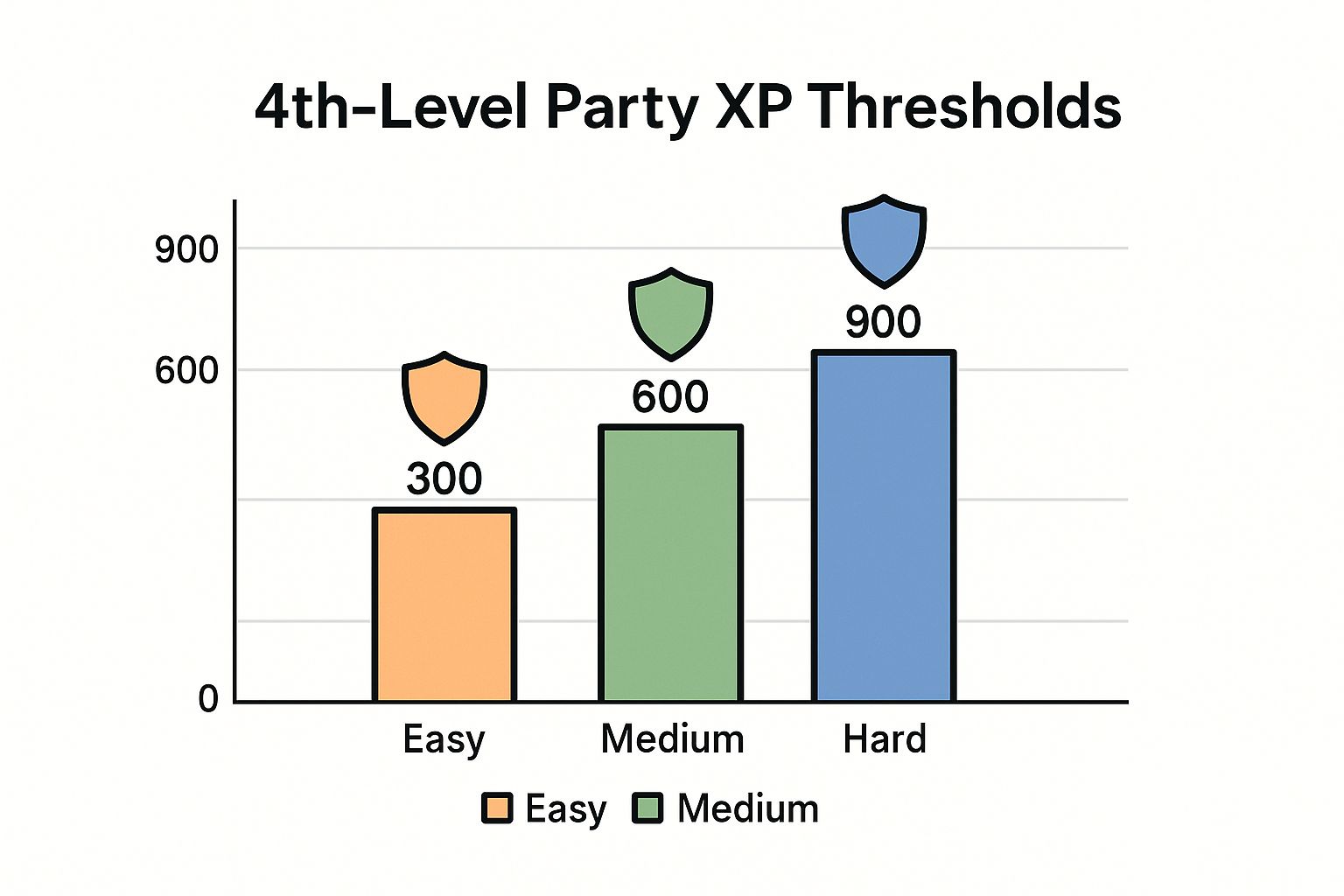
This simple visual guide is your truest ally for fine-tuning the challenge you wish to present to your players, whether it be a walk in a sun-dappled glade or a desperate fight for survival.
Now, let us turn to practice. Imagine you are planning an ambush in a tangled wood for your four third-level heroes. You summon forth an owlbear (CR 3, 700 XP) and see it aligns perfectly with the 'Hard' encounter budget. A simple matter, yes? Well, this is where raw numbers can lay a trap for an unwary DM.
The secret language of encounter design is not merely about total XP; it is about the Action Economy. Four heroes receive four turns. One owlbear receives one. The beast may be a powerhouse, but it can be overwhelmed by sheer weight of numbers before its fury can be truly unleashed.
Now, let us exchange that owlbear for another foe. Consider a war band of eight goblins (CR 1/4, 50 XP each) led by their two goblin bosses (CR 1, 200 XP each). The total XP comes to 800, nearly the same as the owlbear. But the danger is of a completely different nature.
This is where the encounter builder truly proves its worth. It knows that multiple foes are far more dangerous, so it applies a multiplier, correctly flagging this fight as ‘Deadly’. Why? Because ten enemies mean ten attacks may rain down on the party each round. Suddenly, your heroes are fending off a hail of arrows and scimitars from all sides—a far more dynamic and genuinely threatening scenario.
It is this kind of subtle but absolutely critical calculation that a good builder manages for you. Understanding that a coordinated host of smaller threats can be more potent than a single lumbering giant is the key. For those seeking to weave such challenges into a grander tapestry, you may find a wealth of inspiration in these D&D Campaign Ideas to set your creative fires roaring.
A pack of goblins in an empty chamber is but a nuisance. But that same pack, hidden amidst crumbling, moss-covered ruins with a rickety bridge separating them from the heroes? Now that is an encounter. I have found that the most potent tool you wield when building a 5e encounter isn't a monster's stat block—it's the very ground upon which the battle is fought.
It is time to move beyond the flat, featureless battle map. A truly great encounter transforms the environment into a third combatant, a dynamic puzzle that forces players to think beyond their attack bonuses. A monster, after all, is only as dangerous as its lair allows it to be.
Think of your battle map as a character in its own right. What history does it hold? What dangers lie hidden just beneath the surface? Answering these questions is what elevates a simple skirmish into a cinematic showdown.
Try introducing a few of these environmental elements to add true tactical flavour:
Suddenly, players must make meaningful choices. Do they risk a dash across open ground or take the slower, safer path through cover? Does the wizard burn a spell slot to create a bridge of ice, or does the rogue attempt a daring leap across the chasm?
An encounter becomes truly memorable when the environment is not just an obstacle but an active participant. Your encounter builder 5e helps you balance the creatures, but it's your imagination that breathes life into the world. This is where you can add layers that reward cleverness.
For example, imagine a fight in a grand, decaying ballroom. A massive, precariously balanced chandelier hangs overhead. A single well-placed arrow could send it crashing down, changing the entire shape of the fight in an instant. Or perhaps the hobgoblins have set up arcane traps that the party must disable while fending off attacks.
The objective does not always have to be 'defeat all enemies'. What if the true goal is to prevent cultists from completing a ritual, or to rescue a prisoner before a rising tide floods the chamber? This shifts the focus from a simple war of attrition to a desperate, time-sensitive puzzle.
This layered approach to encounter design echoes the strategic heart of great board games and deckbuilders, where positioning and environmental control are paramount. This very philosophy is being woven into the fabric of TerraClash, where controlling the field is as vital as the cards in your hand.
Recent chronicles show that players here in the UK have a strong preference for dynamic, personalised adventures. The clever use of an encounter builder for D&D 5e is a direct response to this, allowing DMs to rapidly craft these bespoke challenges, complete with unique monsters, traps, and narrative elements that make each session feel special. If you’re curious about what makes the UK player base tick, you can find a fascinating look at player preferences in this insightful breakdown of player statistics.
The battles your players will recount for years to come are not those against a single, lumbering beast. They are the ones where the monsters fought with a terrifying, unified purpose. This is where you graduate from simply choosing monsters to becoming a true battlefield general. Let us move past throwing a random collection of creatures at the party and begin to think with tactical cunning.
An encounter builder 5e is your war tent. It's where you marshal your forces not just for brute strength, but for strategic guile. The true magic happens when you create synergy, making the whole encounter far deadlier and more interesting than the sum of its parts. This is the secret ingredient that makes for truly unforgettable D&D moments.
Consider the classic pairing of might and mischief. An Ogre is a straightforward problem; it is a large sack of hit points that the party's fighter will gladly charge. But what happens when you pair that Ogre with a few Kobold slingers, peppering the heroes with stones from rocky ledges above?
Suddenly, the fight's entire dynamic shifts. The players are forced into making hard choices. Do they focus on the immediate, hulking threat, or do they try to deal with the annoying, hard-to-reach slingers first?
This is the core of creating genuine tactical puzzles that force your players to think on their feet. Here are a few combinations I've found work wonders for creating memorable problems:
When you combine creatures with abilities that complement each other, you are not just creating a fight; you are creating a puzzle. The solution is not always "hit the biggest thing." It is about divining the enemy's strategy and dismantling it piece by piece.
This concept of synergy is not unique to D&D, of course. It is the lifeblood of countless great fantasy games. You see it in cooperative dungeon crawlers, where heroes must combine their unique abilities to survive. It is also absolutely crucial in deckbuilding card games, where discovering powerful card combinations is the very path to victory.
It’s a design philosophy we’re weaving into our own deckbuilder, TerraClash, because we know the true thrill comes from discovering those game-winning combinations that turn the tide.
The need for tools like an encounter builder to manage these complex scenarios has never been greater, especially given how our gaming habits have evolved. Recent analyses of D&D players in the UK revealed that a massive 58% play weekly, and 60% have a hybrid playstyle, mixing online and in-person games.
This demand for frequent, flexible sessions means DMs need digital tools that help them quickly create these balanced, synergistic encounters. If you're curious, you can read more about these player demographic trends and what they mean for the game.
You have journeyed far, Dungeon Master. You have waded through the arcane mathematics, wrestled with monster statistics, and learned to conjure something more than just a random fight. Take a moment to reflect. What you have truly been learning is the art of crafting a worthy challenge.
It is about more than just unleashing goblins upon the party. It is about balancing the scales, pushing your players to think tactically, and telling a story through the clash of steel and sorcery. It is a genuine skill, and one you should be proud to wield.

You will find that this craft appears in every corner of the tabletop realm. Have you ever felt the pressure in a Gloomhaven scenario, where every card played feels like a life-or-death decision? Or what of the mental chess of a tense Magic: The Gathering match, where knowing your deck's deepest secrets is the only path to victory?
These games, at their core, are all about creating those incredible moments of tension, triumph, and, yes, sometimes even spectacular failure. Those are the stories we all tell for years after the dice have been put away.
The true magic of a great game is not in the rulebook; it is in the epic stories we create together. All those lessons about monster synergy, using terrain, and controlling the pace of a fight? Those are your tools for building those legends.
You are the one setting the stage. Every single encounter you design is an invitation for your players to step up, be clever, and become the heroes they are meant to be.
This deeper understanding of what makes a game resonate is priceless. It will make your D&D games richer, and you will begin to see the clever design in other games you play. If you are keen to sharpen that tactical edge even further, we have a guide on how to improve strategic thinking that delves into these very ideas.
Take these skills with you on your next adventure. The fundamentals of creating compelling, strategic combat are the bedrock of any great tabletop experience. In fact, it is this same passion for strategic depth that we are channelling into our own deckbuilding game, TerraClash, which will soon be seeking brave champions on Kickstarter.
So, whether you're planning your next D&D session or exploring a new game, remember you are not just a Game Master anymore. You are a legend-maker.
Even with decades of experience behind the screen, with miniatures at the ready and dice worn smooth by time, I still pause and ponder. As you grow accustomed to your new encounter builder 5e, you are bound to face a few riddles. Let us tackle some of the most common ones.
Ah, the classic DM's quandary: the party that is armed like a small army. Most builders base their calculations on character level, completely ignoring that gleaming +2 flaming longsword or the staff of power the wizard brandishes.
A quick and effective trick I often employ is to simply treat the party as one level higher than they truly are when I consult the builder. It is a surprisingly effective way to account for their enhanced might.
Another favourite tactic of mine is to add a few extra low-CR "minions." These lesser foes won't make the fight significantly deadlier, but they will absorb some of those powerful attacks and extra actions. This prevents the party from overwhelming the main villain and ending the fight in a single round. If your group is consistently triumphing over 'Deadly' encounters, that is your sign to raise the stakes.
The greatest mistake one can make is to blindly trust the builder's difficulty rating without considering the action economy. On paper, a single CR 10 monster might seem 'Deadly' for a level 5 party. But remember, it still only gets one turn for every four or five the players take. It is easily disabled and overwhelmed before it can ever feel like a true threat.
Indeed, with but a little creative thinking. While these tools are forged for combat, their core logic revolves around risk and resource management – a principle that applies to all challenges.
Instead of thinking about an XP budget as a measure of violence, think of it as a measure of the stakes.
For example, a 'Hard' social encounter might risk the party's reputation with a local lord if they fail their checks. A 'Deadly' magical puzzle could trigger a catastrophic trap or alert the entire dungeon to their presence.
The builder gives you a solid framework for balancing risk against reward, even when swords remain sheathed. It's not so different from the strategic thinking found in the best deck-building games, where victory is about much more than just raw power.
At the end of the day, these tools are but a starting point. They are there to give you the skeleton of an idea. It is up to you to add the narrative muscle and tactical flesh. That is how you go from simply running a game to truly crafting a world, creating moments your players will be talking about for years to come.
Crafting memorable challenges lies at the heart of any great tabletop game. It’s a philosophy we have poured into our own deck-building adventure, TerraClash. If you seek a new world of strategic combat and rich storytelling, keep a watchful eye for our Kickstarter campaign – it will be launching very soon. You can follow our quest over at https://terraclash.co.uk.

