Gather 'round, adventurer, for the secrets I shall impart are not for the faint of heart. If you've ever navigated the shadowed crypts of Gloomhaven or built a stellar empire in Ascension, you already grasp a fundamental truth whispered in ancient halls: victory is not a matter of luck, but of cunning. True power flows from a mind as sharp as a sorcerer's blade.
Beyond the mere roll of enchanted dice lies a realm of pure intellect, where every choice is a test of foresight and resourcefulness. We are here to explore how you can sharpen your mind for the battles ahead, drawing lessons from the war table itself. This is not about simple plays; it is about the masterful orchestration of fate.
The trick, you see, is to shift your focus from reacting to the immediate threat to proactively weaving a grand design. You must learn to see the board not merely as it is, but for what it could become several turns hence, when your grand tapestry of victory is revealed.
This journey is about mastering foresight, managing your resources like a dwarven king guards his gold, and anticipating your rival’s every scheme. We'll translate the skills you perfect in your epic campaigns into practical wisdom, preparing you not only to conquer your next game night but also to spot and champion the next legendary indie game saga on Kickstarter.
It all begins with a simple shift in your perception: view every game as a crucible for your mind.
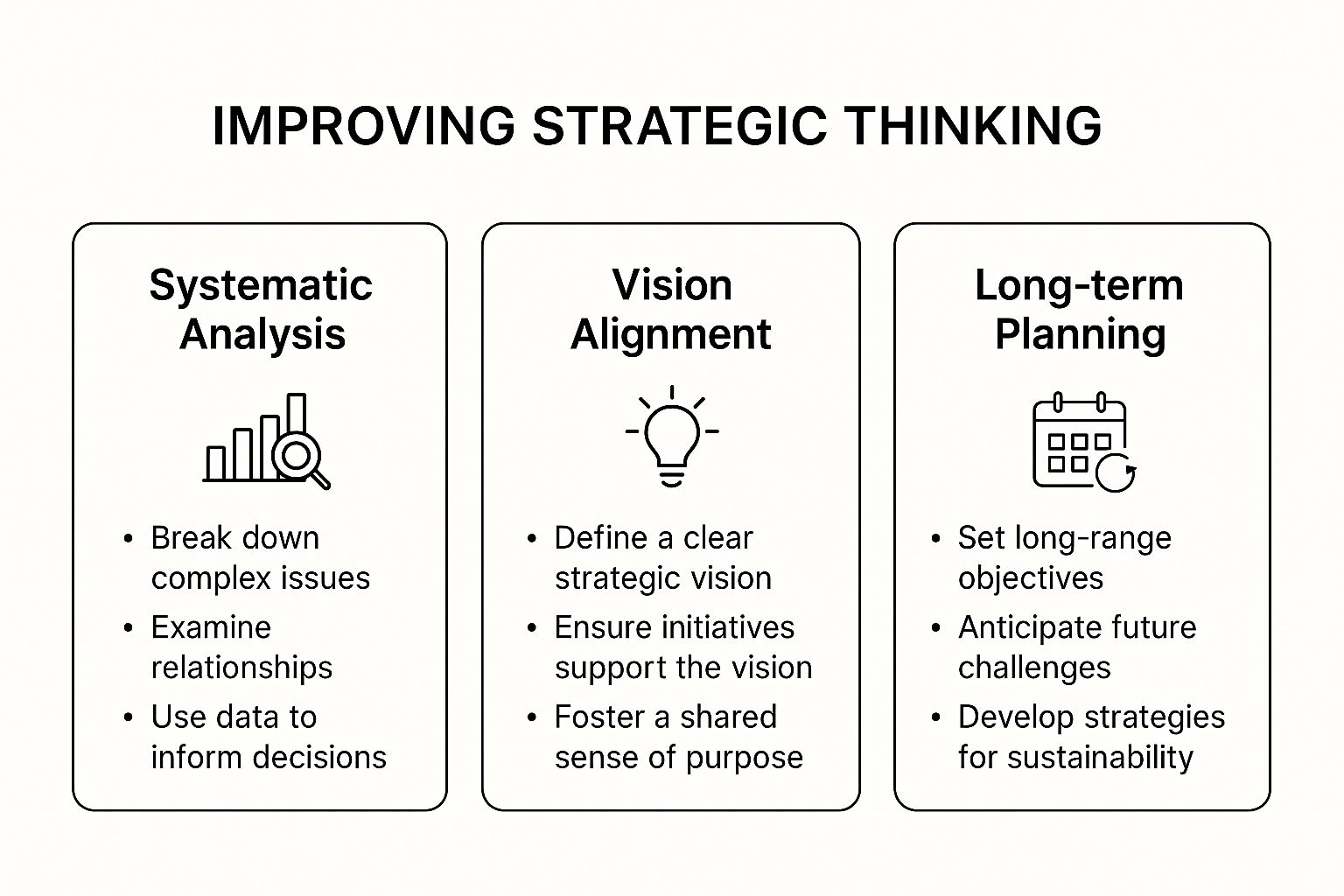
This ancient scroll illuminates the core of a strategic mind. It reveals how systematic analysis, unwavering vision, and a gaze fixed upon the long game are the very bedrock of tactical supremacy.
Whether you command legions of undead or carefully construct a deck of arcane spells, the core tenets of strategy are eternal. These are the arts that separate a fumbling squire from a true grandmaster of the realm.
If you are but a novice on this path, our tome on easy-to-learn card games is a fine place to practice these fundamentals in a more forgiving arena.
Heed this overview of the core tenets every tabletop general must master to claim victory.
| Pillar of Strategy | What It Means at the Table |
|---|---|
| Foresight | The scryer's art of seeing the ripples of your actions several turns into the future. It is anticipating your foe’s response to your move. |
| Resource Management | The wisdom that every card, coin, and action is a finite resource. You must spend each with deliberate and potent purpose. |
| Adaptability | The cunning to pivot when the tides of battle turn against your grand design. A plan that cannot bend will surely break. |
| Pattern Recognition | The keen eye of an elven scout, needed to spot an opponent's brewing strategy before it fully manifests, giving you the chance to counter it. |
Mastering these four pillars will elevate your game from a tavern brawl to a royal gambit. They are interconnected skills that build upon one another, forging a mind of steel.
To think strategically is to play the long game. It’s about planting a seed in the first turn that only blossoms into a game-winning move on the tenth.
By delving into these arcane arts, you shall reshape how you approach not just the game before you, but any challenge that dares cross your path. So, let our quest begin.

Any seasoned war-mage will tell you that the true game is not just played upon the board you see. It is waged in the realm of possibilities—what the board could look like three turns from now. Herein lies the heart of strategy: in the art of foresight, in reading the subtle currents of the match and predicting where they shall lead.
A novice sees the pieces. A master sees the patterns they are about to form.
To truly elevate your game, you must learn to analyse the board state far beyond your immediate turn. This skill is what separates players who merely react to threats from those who prevent them from ever materialising. It is about seeing the future in the present arrangement of cards and resources.
Take a classic deckbuilder like Dominion. Foresight is not just grabbing the shiniest treasure. It is glancing at your rivals’ discard piles to divine the nature of their decks. It is knowing the precise moment to cull your starting cards, making your powerful combos more likely to appear. Every choice becomes a subtle calculation, a gentle nudge of probability in your favour.
In games of direct conflict, like the iconic Magic: The Gathering, this becomes even more vital. You must anticipate your opponent's mana curve. If you see they are building towards a devastating seven-mana dragon, you know to hold back a counter-spell or summon a creature that can deal with it before it ever takes flight.
This is not some dark magic; it is calculated prediction. You are reading the tale your opponent is trying to tell with their plays and writing a better ending for yourself.
A powerful, and genuinely practical, way to train this mental muscle is to simply pause before each turn. Take a moment. Mentally play out the next two or three moves—not just your own, but your opponent’s as well.
What is their most likely play? If they do that, what is your best response? And what will their counter to that response be? This chain of questioning is the very heart of foresight.
This simple ritual forces your brain to stretch beyond the immediate. It is how you transform reactive, gut-instinct plays into proactive, deliberate strategies that win wars.
Think of it thusly: a reactive player is a foot soldier, seeing only the enemy directly before them. A proactive strategist is the general upon the hill, seeing the entire battlefield and directing their forces to where the enemy will be.
To begin honing this skill, try these mental drills during your next game night:
Practicing this art of prediction is how you learn to control the tempo of a match. You stop being a victim of ill fortune and start becoming the architect of your own victory. It is a massive step on the quest to sharpening your strategic mind.
Listen closely, adventurer. Every card in your hand, every token you hoard, and every action point you can spend are the precious ingredients in the grand alchemy of victory. Resource management is a subtle art, one that goes far beyond just splashing gold on a shiny new sword. It is the very rhythm of the game, the beat that decides whether you rise to glory or fall to ruin.
The true craft is seeing the hidden value in all you control. Your life points are not just a countdown to defeat; they are a resource you can spend to soak up a blow, keeping a vital creature on the board for that game-winning counter-attack. A single action is not just a move—it is a moment in time you can never reclaim.
If you’ve ever stared at your hand in a game like Mage Knight, you know the brutal lessons it teaches. The action economy is so punishingly tight that one wasted move can be the beginning of your doom. A true master of strategy understands this. They have learned the Principle of a Patient Hand.
Sometimes, the most powerful play is to do nothing at all.
By holding your resources—keeping that killer spell instead of zapping a minor threat—you await the perfect moment. You force your opponent to show their hand first, revealing their grand plan while yours remains shrouded in mystery. This patience is a weapon.
Your resources are your power, but true power lies in knowing when not to use them. Every choice to conserve is a bet on a more impactful future.
This is often the most difficult lesson in leveling up your strategic thinking. The temptation to simply do something is ever-present. But trust this old Dungeon Master, the rewards for restraint can be immense, letting you unleash an overwhelming force when the time is finally right.
This same discipline extends beyond the game board. Think of backing a new project on Kickstarter. Your gold is a resource, and your attention a currency all its own. Knowing when to commit them is a strategic skill that can bring legendary games to life.
It is much like managing your energy in the upcoming Slay the Spire: The Board Game. If you squander energy on weak plays early, you’ll be left wide open when the true behemoths appear. Pledging to the right project at the right time doesn't just help create a new world; it makes you a part of its very foundation. If you wish to delve deeper into the arcane arts of card combos, our guide to the best collectible card games offers many potent insights.
Whether in-game or out in the world, effective resource management boils down to a simple, powerful framework:
Mastering this delicate balance of spending, saving, and sacrificing is what turns a common player into a true alchemist—one who can spin humble resources into pure, unassailable victory.
Think of your deck as more than just a pile of cards, traveller. It is an engine. A wondrous machine you have painstakingly designed for one single, glorious purpose: to win. If you truly wish to know how to improve strategic thinking, you must cease picking cards that look powerful on their own. The true magic happens when you weave them into a web of unstoppable synergies.
Building a solid deck engine is about creating combinations where the whole becomes far greater than the sum of its parts. Each card should not stand alone; it must amplify the power of everything else you play.
We see this principle beautifully in games like Wingspan. Every bird you add to your habitat contributes to a bigger, point-scoring machine that gains incredible momentum as the game progresses. A well-oiled engine, much like a successful Kickstarter campaign such as that for Frosthaven, begins with small, deliberate choices that snowball into a spectacular finish.
In the vast history of card games, a few tried-and-true deck archetypes have proven their worth time and again. Grasping these patterns is the first true step towards mastering the art of the build.
The Aggressive "Rush" Deck: This engine is forged in pure, unadulterated speed. The goal is to flood the board and overwhelm your opponent with a constant barrage of low-cost, high-impact plays, aiming to seal their fate before they can mount a defense.
The Methodical "Control" Deck: This is the choice for the patient strategist. A control engine is designed to shut down threats, meddle with your opponent's plans, and slowly grind out a victory through superior resources and sheer inevitability.
The Elaborate "Combo" Deck: A combo deck is like a magical incantation waiting to be completed. You patiently gather specific key cards, often appearing passive, right before unleashing one explosive, game-ending turn that leaves your opponent utterly speechless.
The question you must ask of every card is not simply, 'Is this card good?' but rather, 'How does this card make my other cards better?' This shift in perspective is the secret to building a truly formidable deck.
To put this into practice, start viewing every potential card through the lens of synergy. Does a card let you draw more cards? Excellent, that helps you dig for your combo pieces faster. Does a creature buff all others of its kind? Fantastic, that rewards you for committing to a specific tribal strategy.
For a deeper dive into this concept with some brilliant examples, our guide on the best deck-building games is packed with forbidden knowledge.
Every card must be a gear that slots perfectly into place, turning in unison with the others to drive your engine forward. This deliberate construction—this focus on how everything connects—is what transforms a random collection of cards into a game-winning force. It is a core discipline of advanced strategic thought, turning chaos into order and raw potential into undeniable power.
Let us speak plainly. Even the most perfect strategy, the one you have theory-crafted for hours, can completely fall apart with a single ill-fated draw. It happens. A true master of the game is not defined by their flawless plans, but by how gracefully they react when chaos inevitably erupts at the table.
This is where the real test of your mettle begins. What do you do when the cards you are counting on refuse to appear? Or when your rival unleashes a cataclysm upon the board you never saw coming? You must learn to pivot. A rigid oak tree snaps in a storm, but a supple willow bends and survives. You must be the willow.
We see this all the time in a game like Terraforming Mars. You could have a brilliant long-term plan for building cities, but a sudden global event can throw a wrench in the works. Suddenly, you’re forced to shift gears and focus on oceans or greenery instead. The players who stubbornly cling to their original plan are the ones who are left in the dust.
The same fate befalls players at the card table. You might have been carefully setting up a game-winning combo for five turns, but if your opponent is about to win on their next turn, that beautiful plan of yours is suddenly worthless. Knowing when to abandon a failing strategy is every bit as important as knowing how to build a good one in the first place.
This is not just a gaming skill, I assure you. A 2023 survey of 300 UK IT managers found that a whopping 73% ranked strategic thinking as their most sought-after skill. The world beyond the tavern craves people who can navigate unexpected challenges, which is precisely what you're practising every time the board state turns against you. You can see the full breakdown of these valuable skills over on techrepublic.com.
So, how do you learn this art? It begins with constantly re-evaluating the state of the game. Every single turn, you should ask yourself a few crucial questions.
True mastery is not about preventing failure; it is about recovering from it faster than your opponent. Every setback is an opportunity to surprise them with a new line of attack they have not prepared for.
Knowing when to let go of a plan is an advanced skill. It is about seeing a dead end before you waste three more turns walking down it. It takes humility and a sharp eye, but it is how you turn a moment of near-defeat into a display of tactical brilliance. This adaptive mindset is absolutely central to how you can improve strategic thinking in a way that truly matters.
You've journeyed through the shadowy realms of strategy, traveller, and sharpened your mind into a formidable weapon. With that keen intellect, you have earned a rare gift: the sight to spot true potential, to see the spark of genius in a new quest long before the crowds gather.
The world of tabletop gaming is built upon the raw passion of indie creators and their wondrous tales, from the sprawling world of The Witcher: Old World to the intricate dungeon crawls of Gloomhaven. When you back a project, you are not just a customer; you become a patron, a vital part of breathing life into a new world. It is a responsibility, and an honour, that your new strategic senses are perfectly tuned for.
Your wits now allow you to break down a Kickstarter campaign with a tactician's precision. You can see the cleverness in a new mechanic, the depth in a well-realised fantasy world, and the foresight in a properly planned campaign. You have gone from being just a player to a connoisseur of game design.
Finding the next legend means looking past flashy art and grand promises. It demands the same pattern recognition and resource analysis you use at the game table. A truly great project almost always shows a few tell-tale signs.
To back a project is to make a strategic investment of faith. You are betting that a creator’s vision, combined with your support, will forge something legendary. This is the ultimate long-term play.
Keep your eyes peeled. New quests are always appearing on the horizon. A campaign forged in the fires of passion and designed with a strategic heart is calling for aid. Be ready to answer that call, to lend your strength and your insight, and to etch your name into the annals of a new gaming saga.
The adventure is just beginning. Your sharpened mind is your greatest asset in spotting the next great tale waiting to be told on the tabletop.
Your own quest for a legendary experience is about to begin. TerraClash is a new fantasy deck-building adventure where every campaign is a unique world shaped by your decisions. If you crave deep strategy, meaningful choices, and a world brimming with classic fantasy reimagined, then prepare to answer our call. Our Kickstarter launches soon.
Join the adventure and follow our progress at https://terraclash.co.uk.

